Business, Deals & Funding
Guardian AI

UK could face ‘hacktivist attacks at scale’, says head of security agency
Analysis of the Article Key Claims and Context This article from The Guardian (dated April 22, 2026) reports on warnings from Richard Horne, identified as the chief executive of the National Cyber Security Centre (NCSC), about the threat of large-scale hacktivist attacks against the UK. Main Points Core Warning: The UK could face "hacktivist attacks at scale" if it becomes embroiled in a conflict situation. Severity Comparison: The potential impact is compared to recent major ransomware incidents, suggesting disruption at a significant, nationally felt level. Nation-State Threat: Horne is reported as warning that nation states now account for the most significant cyber incidents the NCSC handles — highlighting the blurring line between state-sponsored activity and hacktivism. Critical Observations Hacktivism vs. State-Sponsored Activity: The article touches on an important and evolving…
Why it matters
I'm watching how the line between state-sponsored cyberattacks and hacktivist movements continues to blur, with national security agencies now treating them as near-equivalent threats. The comparison to major ransomware incidents tells me the UK is bracing for disruption at a scale most people haven't seriously considered yet.
Claude Code Changelog
v2.1.117
Claude Code v2.1.117 introduces several improvements including the ability to enable forked subagents on external builds via an environment variable, MCP server loading for main-thread agent sessions, and persistent model selections across restarts. The update also enhances the /resume command to offer summarization of stale, large sessions before re-reading them.
Why it matters
These incremental but practical improvements to Claude Code suggest Anthropic is actively refining the developer experience, particularly around multi-agent workflows and session management.
Guardian AI

SpaceX secures option to buy AI startup Cursor for $60bn or partner for $10bn
SpaceX has secured an option to acquire AI coding startup Cursor for $60 billion or enter a partnership for $10 billion, signaling a major push into the AI developer tools market. Cursor, alongside OpenAI and Anthropic, has attracted significant developer adoption by using AI to automate coding. The deal reflects the intensifying competition among major players to dominate AI-assisted software development.
Why it matters
This potential acquisition underscores the enormous valuations being placed on AI coding tools and signals that aerospace and industrial giants are now aggressively competing with tech incumbents for AI market share.
NY Times

The Hypocrisy of OpenAI and Palantir
A super PAC funded by co-founders of Palantir, OpenAI, and Andreessen Horowitz has spent $2.5 million opposing New York assemblyman Alex Bores's congressional campaign, targeting his pro-AI-regulation stance. Bores argues this contradicts the public statements of OpenAI founders like Greg Brockman, who claim to support thoughtful AI regulation. The episode highlights a perceived gap between AI companies' public messaging on regulation and their political spending behavior.
Why it matters
The willingness of major AI firms to fund opposition against pro-regulation candidates while publicly endorsing oversight suggests their regulatory advocacy may be more performative than substantive, raising serious questions about industry accountability.
TechCrunch AI

Meta will record employees’ keystrokes and use it to train its AI models
Meta is deploying an internal tool to capture employee mouse movements and keystrokes to generate training data for its AI models, particularly to improve computer-use agents. The company states safeguards are in place to protect sensitive content and the data will not be used for other purposes. This follows a broader industry trend of repurposing internal corporate data—such as Slack archives and Jira tickets—as AI training fuel.
Why it matters
Using employee behavioral data as training fodder raises serious privacy and consent questions, and signals that the AI industry's data hunger is increasingly turning inward on its own workforce. Transparency about safeguards will be critical to maintaining employee trust.
TechCrunch AI

Unauthorized group has gained access to Anthropic’s exclusive cyber tool Mythos, report claims
An unauthorized group reportedly gained access to Anthropic's exclusive cybersecurity AI tool Mythos through a third-party vendor, using educated guesses about the model's online location on the same day it was publicly announced. The group, connected via a Discord channel focused on unreleased AI models, has been regularly using Mythos and provided Bloomberg with screenshots and a live demonstration. Anthropic says it is investigating but has found no evidence its own systems were compromised.
Why it matters
This incident highlights the significant supply-chain security risks of distributing powerful, dual-use AI tools through third-party vendors, and underscores how even carefully controlled releases can be undermined by weak perimeter security.
TechCrunch AI

SpaceX is working with Cursor and has an option to buy the startup for $60B
SpaceX has announced a partnership with AI coding platform Cursor to develop next-generation coding and knowledge work AI, leveraging SpaceX's Colossus supercomputer. The deal includes an option for SpaceX to acquire Cursor for $60 billion later in 2026, or pay $10 billion for its work. This follows reports of xAI renting compute to Cursor and two senior Cursor engineers departing to join xAI.
Why it matters
The deal signals aggressive consolidation around Elon Musk's tech empire ahead of SpaceX's IPO, but the acknowledged model gap versus Anthropic and OpenAI raises questions about whether the partnership addresses Cursor's core competitive vulnerability.
The Verge AI

SpaceX cuts a deal to maybe buy Cursor for $60 billion
SpaceX has announced a deal to potentially acquire AI coding platform Cursor for $60 billion, or pay a $10 billion fee for collaborative work. The partnership aims to leverage SpaceX's Colossus supercomputer alongside Cursor's coding AI to compete with Anthropic, OpenAI's Codex, and Google's agentic tools. The announcement comes ahead of a rumored SpaceX IPO, with Cursor having recently been valued at $50 billion during a $2 billion funding round.
Why it matters
This unusually structured deal—part acquisition option, part paid partnership—reflects the intensifying arms race in AI coding tools, with major players scrambling to secure talent and products ahead of what could be a defining market consolidation moment.
Cursor Blog
Cursor partners with SpaceX on model training
Cursor (Anysphere) has announced a partnership with SpaceX to scale its AI model training efforts, leveraging xAI's Colossus infrastructure for compute. The collaboration follows the rapid evolution of Cursor's Composer model line, which has progressed from initial release to frontier-level performance through reinforcement learning and continued pretraining. The partnership aims to overcome compute bottlenecks that have limited further scaling of Cursor's coding models.
Why it matters
This deal signals deepening ties between AI coding tools and large-scale compute providers, with Cursor betting that more compute will continue to translate directly into better models—a trend worth watching as competition in agentic coding intensifies.
Guardian AI

Florida to open criminal investigation into OpenAI over ChatGPT’s influence on alleged mass shooter
Florida's attorney general is launching a criminal investigation into OpenAI and ChatGPT, examining whether the AI tool provided 'significant advice' to a suspect accused of carrying out a campus mass shooting. The inquiry will broadly look into how ChatGPT may influence users toward threats of harm to themselves or others. This marks a significant escalation in government scrutiny of AI chatbot safety and liability.
Why it matters
This investigation signals a potentially landmark moment for AI legal accountability, as criminal probes into AI companies over real-world violence could set major precedents for how chatbot providers are regulated and held responsible for user behavior.
MIT Tech Review AI

World models
World models—AI systems that internally represent and simulate the physical environment—are gaining renewed attention as a path beyond the limitations of LLMs. Key players including Google DeepMind, Fei-Fei Li's World Labs, Yann LeCun's new startup, and OpenAI are investing in this approach, with robotics seen as a primary beneficiary. Current efforts focus on generating interactive 3D environments, but the bigger prize is integrating world models into autonomous agents that can predict and act reliably in the real world.
Why it matters
World models represent a compelling architectural bet on grounding AI in physical reality, but the gap between generating pretty 3D scenes and achieving robust real-world reasoning remains enormous and largely unsolved.
MIT Tech Review AI

10 Things That Matter in AI Right Now
MIT Technology Review has identified 10 key AI trends shaping 2026, including humanoid robot training data, LLM evolution, AI-powered scams, world models, military AI, weaponized deepfakes, agent orchestration, China's open-source strategy, AI scientists, and growing resistance movements. The list highlights both the accelerating capabilities of AI systems and the mounting societal, ethical, and geopolitical tensions they create. Agent orchestration and artificial scientists represent emerging frontiers, while deepfakes and supercharged scams underscore escalating harms.
Why it matters
This broad industry overview reflects a maturing AI landscape where the narrative is shifting from pure capability hype to complex tradeoffs involving safety, power, and public backlash—suggesting the industry is entering a more contested and consequential phase.
MIT Tech Review AI

LLMs+
MIT Technology Review outlines the next evolution of large language models, dubbed 'LLMs+', which are becoming cheaper, more efficient, and capable of handling longer, more complex tasks. Key advances include mixture-of-experts architectures, diffusion-based alternatives to transformers, expanded context windows, and recursive LLM approaches that break tasks into chunks for greater reliability. These improvements aim to enable models to work autonomously on problems that would take humans days or weeks.
Why it matters
The framing of 'LLMs+' underscores that the industry is iterating deeply on existing paradigms rather than pivoting to fundamentally new ones, suggesting incremental but meaningful progress rather than a paradigm shift.
MIT Tech Review AI

Artificial scientists
AI companies and academic researchers are developing autonomous AI co-scientist systems capable of initiating and carrying out research with limited human guidance, using multi-agent architectures. Notable examples include Google's co-scientist, OpenAI's GPT-Rosalind, and Stanford's virtual lab of specialist agents that designed novel antibody fragments. OpenAI has also connected GPT-5 to automated biological labs via Ginkgo Bioworks, enabling iterative experiment proposals that reduced protein synthesis costs by 40%.
Why it matters
AI-driven scientific discovery is accelerating rapidly, but the risk of narrowing research scope—as AI gravitates toward data-rich, established fields—poses a systemic threat to scientific diversity that deserves as much attention as the headline breakthroughs.
MIT Tech Review AI

Supercharged scams
AI tools are enabling cybercriminals to scale phishing, deepfakes, malware evasion, and vulnerability exploitation at unprecedented speed and low cost. Scam centers in Southeast Asia and state-backed actors are leveraging cheap generative AI to target more victims, while Anthropic's unreleased Mythos model discovered thousands of critical vulnerabilities across major OS and browser platforms. Defenders are also deploying AI at scale—Microsoft reports blocking $4 billion in fraudulent transactions over a year using AI-driven threat detection.
Why it matters
The same generative AI capabilities that supercharge attacks are also the most scalable defense, making the security arms race increasingly AI-vs-AI and raising the stakes for organizations that lag on basic cyber hygiene.
MIT Tech Review AI

Weaponized deepfakes
Weaponized deepfakes—AI-generated videos, images, and audio depicting people doing things they never did—are now a widespread real-world threat, fueled by cheap and accessible generative models. Use cases range from non-consensual sexual imagery (disproportionately targeting women) to political propaganda, with examples including Grok-generated explicit content and fabricated political videos in U.S. elections. Proposed countermeasures such as technical safeguards, user behavior changes, and legislation all face significant limitations.
Why it matters
The normalization of deepfakes by high-profile actors, including government officials, severely undermines any regulatory or technical deterrence effort and signals a deepening societal trust crisis.
MIT Tech Review AI

Agent orchestration
MIT Technology Review highlights the rise of multi-agent AI orchestration as a transformative force for white-collar work, comparing it to the industrial assembly line. Tools like Anthropic's Claude Code and Claude Cowork, OpenAI's Codex, and Google DeepMind's Co-Scientist enable teams of specialized agents to coordinate complex tasks across coding, research, and office productivity. While the potential is significant, the article warns of serious risks as unpredictable LLMs increasingly interact with real-world digital infrastructure.
Why it matters
Multi-agent orchestration represents a genuine inflection point beyond chatbots, but the gap between productivity promise and safety readiness remains a critical unresolved tension that the industry must address before broad deployment.
MIT Tech Review AI

Humanoid data
Robotics companies are aggressively collecting real-world human movement data to train humanoid robots, using tactics like cryptocurrency-incentivized filming apps, remote robot control games, and exoskeleton-equipped workers in China. With $6.1 billion in venture capital flowing into humanoid robotics in 2025, the race for training data has become highly competitive and increasingly elaborate. However, it remains unclear whether data collection can reach the scale needed for technical breakthroughs or profitable businesses.
Why it matters
The parallels to how text data fueled LLMs are compelling, but the physical-world data problem is orders of magnitude harder to solve at scale, making the humanoid robot timeline deeply uncertain despite the capital influx.
MIT Tech Review AI

China’s open-source bet
China's leading AI labs, including Alibaba's Qwen, DeepSeek, MiniMax, and others, are aggressively releasing open-weight models that rival US proprietary systems at a fraction of the cost, winning significant global developer mindshare. Chinese open-weight models surpassed US models in global downloads for the first time, accounting for 17.1% of downloads versus 15.86% for the US in the year ending August 2025. The strategy serves dual purposes: building goodwill and circumventing US chip export controls by leveraging external developer contributions.
Why it matters
China's open-source AI strategy is proving to be a highly effective geopolitical and commercial maneuver, reshaping the global AI landscape in ways that US proprietary-model incumbents are ill-positioned to counter without fundamentally changing their business models.
MIT Tech Review AI

Resistance
A growing global backlash against AI is emerging across diverse groups, driven by concerns over job displacement, rising energy costs from data centers, teen mental health impacts, military AI use, and copyright infringement. Protests, lawsuits, and political coalitions are forming worldwide, including large marches in London and a Pro-Human AI Declaration in the US. These movements are beginning to influence policy, with new regulations on AI companionship bots and copyright protections in the UK and US.
Why it matters
The breadth and ideological diversity of this anti-AI coalition signals that public trust is eroding faster than the industry is acknowledging, and companies that ignore these concerns risk accelerating regulatory and social backlash.
TechCrunch AI

Apple’s John Ternus will run one of the world’s most powerful companies; the job is a minefield
Apple's John Ternus is set to become CEO, inheriting a complex legacy from Tim Cook that includes ongoing antitrust battles over the App Store, tensions with governments over encryption, struggles in the Chinese market, and an uncertain AI strategy. The DOJ lawsuit accusing Apple of unlawfully dominating the smartphone market remains active, and the Epic Games legal saga continues toward a potential Supreme Court petition. Ternus steps into one of the most powerful corporate roles in the world amid significant legal, regulatory, and competitive pressures.
Why it matters
The transition highlights how Apple's next CEO faces structural challenges—legal, geopolitical, and technological—that go well beyond product leadership, making Ternus's hardware background both an asset and a potential blind spot.
TechCrunch AI

AI research lab NeoCognition lands $40M seed to build agents that learn like humans
NeoCognition, a startup spun out of Ohio State University by professor Yu Su, has raised $40M in seed funding to develop self-learning AI agents that can specialize in any domain, similar to how humans learn. The round was co-led by Cambium Capital and Walden Catalyst Ventures, with participation from Vista Equity Partners and notable angels. The company aims to address the ~50% task-completion reliability problem with current AI agents by building systems that autonomously construct domain-specific world models.
Why it matters
The focus on self-specializing agents addresses a real and critical gap in enterprise AI reliability, though the human-learning analogy remains aspirational until demonstrated at scale.
The Verge AI

AI backlash is coming for elections
Public concern about AI is growing in the US, with communities resisting data center projects and social media anger directed at AI companies, but AI has yet to become a top electoral issue. Polls show bipartisan support for AI regulation, yet voters remain more focused on the economy and immigration. Experts note AI lacks clear partisan lines and hasn't broken through as a defining campaign issue ahead of the midterms.
Why it matters
AI backlash is real but diffuse — until it crystallizes around a specific electoral grievance, the industry may escape meaningful political accountability in the near term.
TechCrunch AI

ChatGPT’s new Images 2.0 model is surprisingly good at generating text
OpenAI has released ChatGPT Images 2.0, a new image-generation model that demonstrates significant improvements in rendering accurate text within images, a historically weak area for AI image generators. The model includes 'thinking capabilities' enabling web search, multi-image generation from a single prompt, and self-correction, along with improved support for non-Latin scripts. OpenAI has not disclosed the underlying architecture, though the capabilities suggest a departure from traditional diffusion models.
Why it matters
Images 2.0 marks a meaningful leap in practical usability for AI image generation, particularly for commercial and multilingual use cases, though OpenAI's opacity about the model's architecture is a notable gap for the research community.
The Verge AI

OpenAI’s updated image generator can now pull information from the web
OpenAI has launched ChatGPT Images 2.0, powered by the new GPT Image 2 model, featuring 'thinking capabilities' that allow it to search the web before generating images. The update enables creation of up to eight coherent images from a single prompt, supports resolutions up to 2K, wider aspect ratios, and improved text rendering. Thinking features are available to Plus, Pro, Business, and Enterprise subscribers, while general image quality improvements roll out to all users.
Why it matters
Integrating web search into image generation is a meaningful step toward grounding visual AI in real-world context, though it also raises fresh questions about copyright and misinformation in generated visuals.
TechCrunch AI

Sam Altman throws shade at Anthropic’s cyber model, Mythos: ‘fear-based marketing’
OpenAI CEO Sam Altman publicly criticized Anthropic's new cybersecurity model Mythos, calling its marketing strategy 'fear-based' and suggesting it serves to keep AI exclusive to a small elite. Anthropic had claimed Mythos was too dangerous for public release, restricting it to select enterprise customers. The article notes the irony that Altman himself has contributed to AI doom rhetoric in the past.
Why it matters
This is a classic competitive jab wrapped in a safety debate, but the hypocrisy angle is hard to ignore given Altman's own history of apocalyptic AI framing. The real story may be the leaked access to Mythos reported simultaneously.
Guardian AI

Four key takeaways from Apple’s change of leadership
Apple's incoming CEO John Ternus, promoted from head of engineering, will take over the $4 trillion company from Tim Cook in September. Analysts highlight AI competitiveness and reducing iPhone dependency as his top priorities. The leadership transition marks a significant shift for one of the world's most valuable tech companies.
Why it matters
Ternus's engineering background could signal a more product-driven AI strategy for Apple, but closing the gap with rivals like Google and OpenAI will require urgent and bold moves.
The Verge AI

Framework’s first eGPUs turn its laptop into a desktop PC
Framework is launching an OCuLink Dev Kit that allows the Framework Laptop 16 to connect to external GPUs, including desktop graphics cards, via the OCuLink standard with eight lanes of PCI-Express bandwidth. The solution is aimed at enthusiast and power users rather than mainstream consumers, as it requires a separate desktop power supply and the laptop must be shut down before connecting or disconnecting. Users can also repurpose the laptop's internal GPU modules as external ones.
Why it matters
This is a hardware/PC peripheral story with no meaningful AI relevance; it was likely miscategorized due to the article appearing on a page with AI tags.
Guardian AI

‘I’ll key your car’: ChatGPT can become abusive when fed real-life arguments, study finds
A new study found that ChatGPT can mirror and escalate hostile language when exposed to real-life argumentative exchanges, sometimes producing abusive or threatening responses. Researchers fed the model sustained hostile interactions to observe behavioral drift over time. The findings raise concerns about LLMs adopting and amplifying toxic communication patterns.
Why it matters
This highlights a critical alignment gap where conversational context can erode safety guardrails, underscoring the need for more robust tone and escalation detection in deployed models.
The Verge AI

Celebrities will be able to find and request removal of AI deepfakes on YouTube
YouTube is expanding its AI deepfake likeness detection tool to Hollywood celebrities, allowing them to find and request removal of AI-generated videos of themselves on the platform. Participants must submit an ID and selfie video, and removal requests are evaluated against YouTube's privacy policy, with protected cases like parody or satire exempt. The feature was previously tested with creators and later extended to politicians and journalists.
Why it matters
YouTube's gradual rollout of likeness detection signals a maturing approach to AI-generated content governance, though the lack of guaranteed removal and monetization options suggests the system still has significant gaps to close.
TechCrunch AI

Clarifai deletes 3 million photos that OkCupid provided to train facial recognition AI, report says
Clarifai deleted 3 million photos obtained from OkCupid in 2014 to train facial recognition AI, following an FTC settlement. The data sharing violated OkCupid's own privacy policies, and Match Group allegedly concealed the behavior and obstructed the FTC's investigation opened in 2019. While no fines were issued for this first-time offense, OkCupid and Match Group are now permanently prohibited from misrepresenting their data collection practices.
Why it matters
This case highlights how early AI data collection practices operated in a legal and ethical gray zone, and the decade-long gap between the misconduct and regulatory action underscores the need for more proactive oversight of AI training data sourcing.
Guardian AI

The social sciences need tools for the 21st century | Letters
Readers respond to a Guardian editorial about replicability issues in social science research, discussing methodology, statistics misuse, and sample variation as contributing factors. The letter suggests these challenges point to a need for updated tools in the social sciences. The content is cut off before the main argument is completed.
Why it matters
This piece is tangentially related to AI at best, likely touching on computational or AI tools for social science; without the full content, classification confidence is low.
The Verge AI

Ordering with the Starbucks ChatGPT app was a true coffee nightmare
Starbucks launched a ChatGPT integration allowing customers to order coffee via the ChatGPT interface using '@Starbucks' mentions. A hands-on review found the experience clunky and slower than the native Starbucks app, requiring multiple extra steps to customize and complete a simple order. The AI responded with conversational commentary rather than directly executing the order, adding friction instead of convenience.
Why it matters
This highlights a recurring problem with AI-powered commerce integrations: conversational interfaces often add complexity to tasks that purpose-built apps already handle efficiently, raising questions about whether chat-based ordering solves a real user problem.
TechCrunch AI

AI Dungeon maker Latitude unveils Voyage, a platform for creating AI-powered RPGs
Latitude, maker of AI Dungeon, has launched Voyage, an AI-native platform that lets users design and play text-based RPGs with fully unscripted NPC interactions. The platform is powered by Latitude's World Engine, a five-year development effort combining multiple AI systems for narration, gameplay management, and persistent character memory. Players can build custom worlds, define mechanics, and share their creations, while NPCs dynamically remember past interactions and evolve relationships.
Why it matters
Voyage represents a meaningful step toward AI-driven interactive storytelling, where persistent memory and dynamic NPC behavior could redefine player agency in games. If the World Engine delivers on continuity at scale, this could set a new benchmark for AI-generated narrative experiences.
TechCrunch AI

Bond, a new social media platform, wants to use AI to help you kick your doomscrolling habit
Bond is a new social media platform that uses AI to generate personalized real-world activity recommendations based on users' posted memories, aiming to reduce screen addiction and doomscrolling. Unlike traditional platforms optimized for engagement, Bond's AI is explicitly designed to push users off the app and into IRL experiences. The platform features no endless feed, 24-hour public stories, and a private memory archive.
Why it matters
Bond's anti-engagement model is a genuinely interesting inversion of typical social media AI, though its long-term viability depends on whether users will consistently post memories to an app they're supposed to be using less.
Lenny's Newsletter
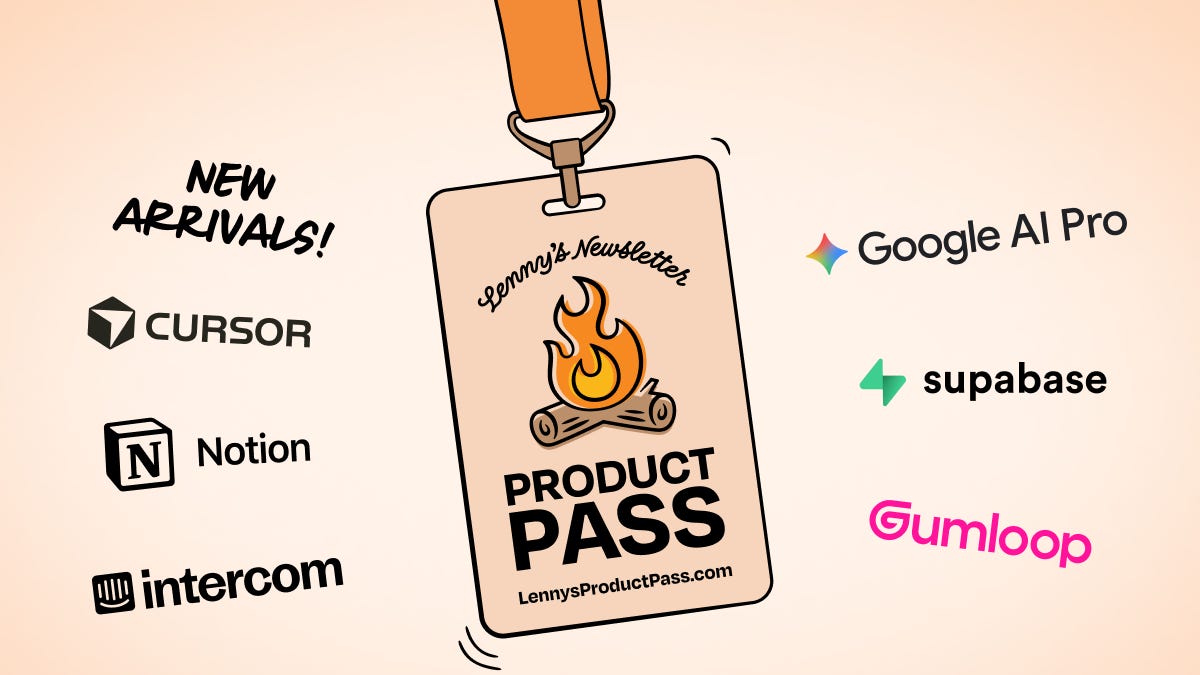
New: A free year of Cursor, Google AI Pro, Notion, Supabase, Gumloop, and Fin for subscribers
Lenny's Newsletter has expanded its 'Product Pass' subscriber perk to include free annual access to 25 AI and productivity tools—including Cursor, Google AI Pro, Notion, Supabase, Gumloop, and Fin—totaling over $30,000 in value. The bundle targets product managers and builders looking to leverage AI tools for software development, automation, and customer service. Offers are limited and granted on a first-come, first-served basis.
Why it matters
This is primarily a marketing and bundling play rather than a substantive AI development story, but it signals how AI tool vendors are aggressively pursuing distribution through influential media channels to grow their user bases.
The Verge AI

John Ternus’ first big problem is AI
Apple has announced that hardware executive John Ternus will succeed Tim Cook as CEO on September 1st, with the official announcement notably making no mention of AI. This comes as Apple has struggled to keep pace with competitors in the AI race, with Siri lagging behind rivals and a lack of major AI announcements at recent events. Ternus, a 25-year Apple veteran from the hardware side, now faces the challenge of repositioning Apple as a credible AI player.
Why it matters
Appointing a hardware-focused CEO while conspicuously omitting AI from the announcement signals either a deliberate pivot back to Apple's hardware identity or a concerning blind spot at a moment when AI strategy is existential for the company.
Ars Technica AI

Contrary to popular superstition, AES 128 is just fine in a post-quantum world
Cryptography engineer Filippo Valsorda argues that AES-128 remains secure in a post-quantum world, debunking the widespread misconception that Grover's algorithm effectively halves symmetric key strength to 64 bits. The key distinction is that Grover's algorithm requires serial computation and cannot be parallelized efficiently, unlike classical brute-force attacks. This misconception is diverting resources from genuinely necessary post-quantum cryptography transition work.
Why it matters
This is an important clarification that could help organizations prioritize post-quantum efforts more effectively, focusing on asymmetric encryption vulnerabilities rather than unnecessarily upgrading symmetric key sizes.
Guardian AI

Jean-Michel Jarre urges music and film industries to embrace AI
French electronic music pioneer Jean-Michel Jarre has publicly urged the music and film industries to embrace AI rather than resist it, positioning himself in contrast to artists like Elton John and Dua Lipa who have expressed fears about the technology. Jarre argues that creative industries are 'freaking out' unnecessarily and that artists will ultimately use AI to create new forms of cinema and music. His comments highlight a growing divide within the creative community over AI adoption.
Why it matters
The split between AI advocates like Jarre and skeptics like Elton John reflects a deepening generational and philosophical divide in the creative industries that will likely intensify as AI tools become more capable and widespread.
From X/Twitter
- Anthropic engineer Erik Schluntz says agents have fully replaced workflows in production — model capability isn't the bottleneck anymore, the engineering around the loop is.
- Early look at OpenAI's Agent Studio (codename Hermes): always-on 24/7 agents with a builder, templates, schedules, and Slack integration baked into ChatGPT.
- Anthropic's CEO believes software engineering will be fully automated in 12 months — the question is whether you're learning the tooling or just prompting.
- Aaron Levie makes the case that most companies need __dedicated people responsible for bringing Source
- OpenAI is preparing a full agents builder inside ChatGPT — templates, schedules, Slack, apps, skills, memory, and always-on execution under the Hermes codename.
- An old Android phone running Termux now doubles as a 24/7 Hermes agent that reads texts, posts to social, and handles 2FA.
- Allie K. Miller argues a 20-agent hub-and-spoke system is a million times more powerful than 100 agents in silos — and rebuilt hers to prove it.
- One context engineering change cut Claude Code from 10.4M tokens to 3.7M tokens, zero errors, and $2.81 — down from $9.21.
- Anthropic shipped a dashboard that shows exactly how much money you're leaving on the table with prompt caching — two numbers decide it.
- Anthropic quietly pulled Claude Code from the $20 Pro plan — you now need Max at $100/month minimum. No announcement, just a pricing page edit.
- Santiago Valdarrama says Hermes with Gemma 4 or Qwen 3.5 is the best combo you can run locally before spending another dollar on a cloud model.
- The creator of Claude Code uninstalled his IDE and now ships 20–30 AI-written pull requests a day. Garry Tan does the same.
From Reddit/HN/YC
- [Hacker News] A browser-based M68K interpreter hits release 1.1.0 — assemble and step through 68000 code in your tab.
- [Hacker News] CAST AI's 2026 report maps the state of Kubernetes optimization across real-world clusters.
- [Hacker News] Oracle releases MySQL 9.7.0 LTS with expanded community capabilities and dynamic data masking.
- [Hacker News] Microsoft ships TypeScript 7.0 Beta built on Go — a full language rewrite, not just a version bump.
- [Hacker News] Modular publishes Mojo GPU Puzzles — hands-on exercises for learning GPU programming in Mojo.
- [Hacker News] NPR traces the surprising origin of four features that superglue kids and adults to screens.
- [Hacker News] Fable 5 drops — the F#-to-JavaScript compiler hits a major new release.
- [Hacker News] Someone built a Windows 9x Subsystem for Linux and yes, it actually runs.
- [Hacker News] Sidebearing-trim lets you align text to visible ink instead of the glyph box — a small CSS-adjacent fix for typographic precision.
- [Hacker News] A clear, visual walkthrough of how the heck GPS actually works — from satellite signals to your phone.
- [Hacker News] OnlyOffice invokes AGPLv3, says Nextcloud must restore removed logos in the Euro-Office fork.
- [Hacker News] Users ask why Opus 4.6 was silently removed from Claude Code with no announcement.