Business, Deals & Funding
The Verge AI

Microsoft wants lawyers to trust its new AI agent in Word documents
Summary Microsoft is launching a Legal Agent, a new AI agent embedded in Microsoft Word, specifically designed for legal teams. The agent handles document edits, negotiation history, and complex legal documents, assisting with tasks like clause-by-clause contract review against a playbook. Key Details How it works: Rather than relying on general AI models, the Legal Agent follows structured workflows modeled on real legal practice, managing clearly defined, repeatable tasks such as reviewing contracts and spotting risks and obligations. Document capabilities: It can work with existing documents that have tracked changes and analyze agreements and contracts. Availability: Initially being released to members of Microsoft's Frontier program in the US. Broader strategy: Part of Microsoft's wider effort to bring agentic AI features to Word. Origin: The agent draws on talent and expertise fro…
Why it matters
I'm watching how Microsoft is moving beyond general-purpose AI to build domain-specific agents that mirror actual professional workflows, starting with legal. The bet here is that lawyers will trust AI more when it follows structured, familiar processes rather than acting like a freeform chatbot.
NY Times
OpenAI’s Big Reset + A.I. in the Doctor’s Office + Talkie, a pre-1930s LLM
OpenAI's Big Reset + A.I. in the Doctor's Office + Talkie, a pre-1930s LLM This appears to be a reference to an episode of the Hard Fork podcast from the New York Times, dated May 1, 2026 — which is a future date as of my knowledge cutoff. I don't have information about this specific episode, as it falls beyond what I can verify. However, based on the title and teaser, the episode seems to cover: OpenAI's "Big Reset" — possibly a major restructuring, leadership change, or strategic pivot at OpenAI. A.I. in the Doctor's Office — the growing adoption of AI tools in healthcare/clinical settings. Talkie, a pre-1930s LLM — what sounds like a novel or niche language model trained specifically on text from before the 1930s, which could be an interesting experiment in cultural and linguistic time-capsule AI. The teaser line — "Will the rising tide of A.I. adoption lift all boats?" — suggests th…
Why it matters
I'm watching how OpenAI's latest structural shake-up fits into the broader pattern of the company constantly reinventing itself under pressure. The "pre-1930s LLM" angle also has my attention — training models on historically bounded text raises fascinating questions about what we lose and gain when we constrain an AI's linguistic world.
The Rundown AI

The White House rethinks its Anthropic fight
The White House Rethinks Its Anthropic Fight Summary This article from The Rundown AI (dated May 1, 2026) describes an evolving and complicated relationship between the White House and Anthropic, centered around Anthropic's advanced AI model called Mythos. Key Points The Core Conflict The White House is pushing back on Anthropic's plan to more than double private-sector access to Mythos (from ~50 firms to ~120), citing concerns that expanded access could strain compute resources needed for government use. This comes amid an ongoing Pentagon feud with Anthropic, including a "supply chain risk designation" and legal battle. The Complicated Pivot A White House AI memo is reportedly being prepared that would: Push multi-vendor AI adoption for government agencies Address some of Anthropic's concerns that sparked the original feud Potentially allow agencies to circumvent the supply chain risk…
Why it matters
I'm watching how the government's relationship with its preferred AI vendors is becoming increasingly transactional and fraught, with compute scarcity now driving policy as much as security concerns. The tension between Anthropic's commercial ambitions and Washington's desire to lock down frontier model access tells me we're entering a new phase where AI resource allocation becomes a genuine geopolitical lever.
MIT Tech Review AI

A new US phone network for Christians aims to block porn and gender-related content
Analysis of Radiant Mobile: A Christian-Focused MVNO with Network-Level Content Blocking Summary This MIT Technology Review article from May 2026 reports on Radiant Mobile, a new mobile virtual network operator (MVNO) launching on May 5, 2026, that operates on T-Mobile's network and markets itself to Christian consumers. The network implements network-level content blocking that cannot be overridden by adult users—a first for a US cell plan, according to network security experts. Key Details The Company Founder: Paul Fisher COO: Chris Klimis, a minister in Orlando Network partner: T-Mobile (through MVNO manager CompaxDigital) Cybersecurity partner: Allot, an Israeli company that categorizes website domains into 100+ categories Price: $30/month subscription Launch date: May 5, 2026 What It Blocks The network uses Allot's domain categorization system to block content at the network level:…
Why it matters
I'm watching how values-based consumer products are moving into telecom infrastructure, with network-level filtering that even paying adult customers can't override. The line between parental controls and ideological gatekeeping is getting harder to draw when it's baked into the carrier itself.
Guardian AI

UN warns women in public life face increasingly sophisticated online violence
UN Warns Women in Public Life Face Increasingly Sophisticated Online Violence Summary On May 1, 2026, The Guardian reported on a new UN Women report highlighting the escalating and increasingly technologically sophisticated forms of online violence targeting women in public life — including rights campaigners, journalists, and other public communicators. Key Points The Growing Threat Women in public-facing roles are experiencing deepening threats in digital spaces. The report warns that online violence against these women is not only increasing in volume but also in sophistication, driven by emerging technologies. Three Key Drivers Identified The UN Women report identifies a dangerous convergence of factors: Artificial Intelligence: AI tools are being weaponized against women, with the report specifically warning that "AI-assisted 'virtual rape' is now at the fingertips of perpetrators.…
Why it matters
I'm watching how AI tools are being weaponized as instruments of gendered harassment, moving abuse from crude trolling to scalable, hyper-realistic attacks that are increasingly difficult to detect or counter. This story is a sobering reminder that the same generative capabilities driving productivity gains are simultaneously lowering the barrier for some of the most violating forms of online harm.
Guardian AI
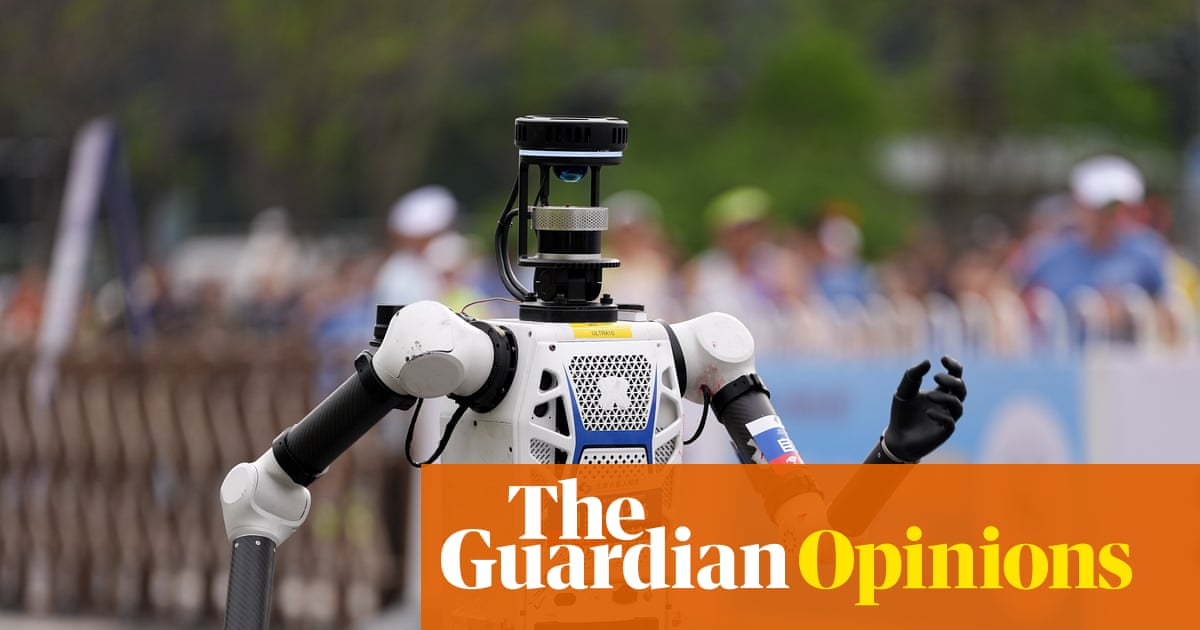
Robo athletes miss the point of sport – there is no drama without emotion | Emma John
Robo Athletes Miss the Point of Sport – There Is No Drama Without Emotion Summary This article by Emma John, published in The Guardian on May 1, 2026, explores the growing presence of robots in competitive sports and argues that while their technical perfection may be impressive, it fundamentally undermines what makes sport compelling: human emotion, drama, and vulnerability. Key Points The Incident The article opens with a scene from a Japanese basketball league game (Alvark Tokyo vs. Shimane Susanoo Magic) in April 2026, where a robotic player appeared to show disappointment after missing a shot. The emotional display looked convincingly real — but was, of course, programmed rather than genuinely felt. The Core Argument Emma John contends that: Perfect scores are dull: While robots can achieve technical perfection, flawless performance removes the tension, uncertainty, and narrative a…
Why it matters
I'm watching how the line between authentic human drama and simulated emotion in sport is becoming genuinely blurry — a programmed robot "showing disappointment" is a striking signal of how far this has come. What strikes me most is the deeper philosophical question it raises: if we can't tell the difference, does the difference still matter to the audience?
Guardian AI

‘Completely horrible’: UK job hunters share frustration with AI interviews
Analysis of "UK Job Hunters Share Frustration with AI Interviews" Summary This Guardian article from May 1, 2026, reports on growing frustration among UK job seekers with AI-conducted interviews. According to research by the hiring platform Greenhouse, based on a survey of 2,950 active job seekers (including 1,132 UK-based workers), nearly half (47%) of UK job seekers have experienced an AI interview, and 30% of UK candidates have walked away from a hiring process specifically because it included an AI interview. Key Findings 47% of UK job seekers surveyed had been interviewed by AI 30% abandoned a hiring process due to the inclusion of AI interviews Job hunters describe the experience as "awkward," "unnatural," and "completely horrible" The survey also included respondents from the US, Germany, Australia, and Ireland Key Issues Raised Candidate Experience The descriptions — "completely…
Why it matters
I'm watching how the backlash against AI-driven hiring tools is intensifying, with nearly a third of candidates actively opting out of processes that use them. This tells me that companies racing to automate recruitment may be quietly shrinking their own talent pools in ways they haven't fully measured yet.
TechCrunch AI

ChatGPT Images 2.0 is a hit in India, but not a big winner elsewhere, yet
Summary of the Article ChatGPT Images 2.0: Strong in India, Modest Globally This TechCrunch article from April 30, 2026, reports on the reception of ChatGPT Images 2.0, OpenAI's latest image-generation upgrade launched the previous week. Key Findings India as the dominant market: India emerged as the largest user base for the new feature Approximately 5 million downloads in India during launch week vs. ~2 million in the U.S. Indian users are primarily using it for self-expression — studio-style portraits, social media-ready images, avatars, and fantasy-themed visuals Daily active users in India rose about 3.4% week-over-week Modest global response: App downloads rose 11% week-over-week globally (per Sensor Tower) Overall engagement gains were limited: daily active users and sessions up only ~1% Global web traffic increased just ~1.6% week-over-week (per Similarweb) Emerging market spike…
Why it matters
I'm watching how India is becoming a breakout market for AI image tools, with 5 million downloads dwarfing the U.S. figure in just one week. It's a signal worth tracking — emerging markets may drive the next wave of generative AI adoption in ways Western-centric metrics tend to underestimate.
From X/Twitter
- Aakash Gupta warns that two of Claude Design's refinement tools are free but the third costs tokens every click — get the order wrong and you'll burn your plan in a week.
- Brad Smith introduces a Legal Agent in Microsoft Word built to follow the structured redlining workflows lawyers actually use.
- Anthropic shipped a security product that claims to solve what engineers have wanted for 20 years: stop sending 864,603 false alarms a year.
- Anthropic's own team says 90% of their code is written by Claude agents — one agent delegates, multiple execute in parallel.
- The pitch for Hermes on a MacBook: pair it with a $100/mo Codex subscription running GPT-5.5 and skip everything else.
- Stripe just announced a way for any agent to purchase from your site without a human ever scrolling the page.
From Reddit/HN/YC
- [Hacker News] AI commerce still lacks a proper benchmark — this early attempt at an MLPerf for shopping agents is a start.
- [Hacker News] Herb Sutter breaks down what C++26 means for production systems in a new talk.
- [Hacker News] California's billionaire tax proposal has already attracted 1.5 million signatures.
- [Hacker News] Someone got Adobe's 1991 PostScript interpreter running in the browser and it's delightfully cursed.
- [Hacker News] Git-issues is a lightweight issue tracker that lives in your repo as Markdown files — no external service needed.
- [Hacker News] OpenAI adds WebSocket support to the Responses API, speeding up agentic workflows with persistent connections.