Business, Deals & Funding
Guardian AI
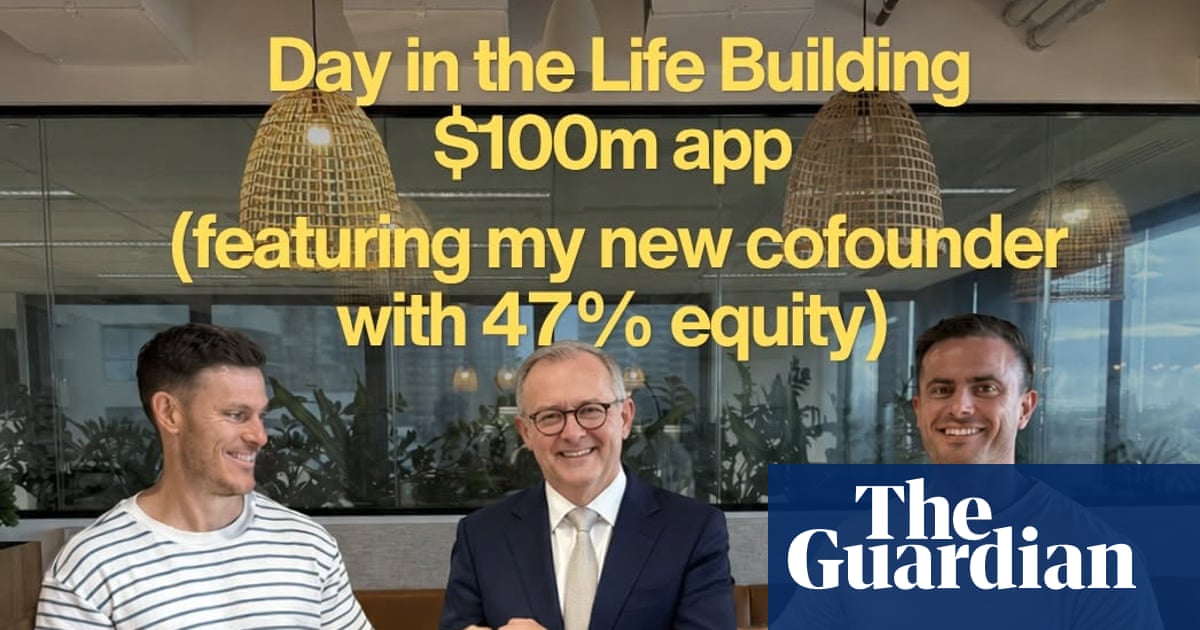
Tech founders use AI-generated images to poke fun at Anthony Albanese in protest against tax changes
Australian tech founders are protesting the government's capital gains tax changes by creating and sharing AI-generated images depicting Prime Minister Anthony Albanese as their 'new founder,' joking about his '47% equity' stake. The entrepreneurs warn that the increased tax burden could discourage people from joining startups and potentially drive new businesses overseas.
Why it matters
This is a creative form of political protest that highlights legitimate concerns about how tax policy affects startup ecosystems. The use of AI-generated satirical images is an effective attention-grabbing tactic. However, the substantive policy debate deserves serious analysis beyond memes — whether a 47% capital gains rate genuinely threatens Australia's startup competitiveness compared to other factors like talent, market access, and infrastructure. The founders raise valid points about ince…
NY Times
My Classmate, ChatGPT
The article reflects on the experiences and lessons learned from the first college graduating class that had access to ChatGPT and similar AI tools throughout their entire academic career, examining how AI shaped their education.
Why it matters
The author likely explores both the benefits and drawbacks of AI integration in education, offering a nuanced perspective on how students who grew up alongside generative AI tools navigated learning, critical thinking, and academic integrity, while raising questions about what education means in an AI-augmented world.
Lenny's Newsletter

🧠 Community Wisdom: Screening AI slop in hiring, Wispr Flow alternatives for voice transcription, multi-agent pipeline vs. MCP, and more
This is a paid subscriber-only edition of Lenny's Newsletter's 'Community Wisdom' series (issue 185), published May 16, 2026. The article promises to cover topics including screening AI-generated content ('AI slop') in hiring processes, alternatives to Wispr Flow for voice transcription, the comparison between multi-agent pipelines and MCP (Model Context Protocol), and other highlights from the newsletter's members-only Slack community. However, the full content is behind a paywall and not accessible without a paid subscription.
Why it matters
The topics teased are genuinely relevant and timely for product managers and tech professionals in 2026. The 'AI slop in hiring' question is particularly pressing as AI-generated cover letters and interview responses become ubiquitous, and the multi-agent pipeline vs. MCP discussion reflects real architectural decisions teams are grappling with. Unfortunately, since the actual content is paywalled, there's nothing substantive to evaluate here. Lenny's Newsletter generally delivers high-quality,…
TechCrunch AI

The haves and have nots of the AI gold rush
A Menlo Ventures partner, Deedy Das, posted on social media about the growing divide in the AI boom, estimating that roughly 10,000 people at companies like OpenAI, Anthropic, and Nvidia have accumulated retirement-level wealth above $20 million, while most tech workers feel left behind with stagnant pay, layoffs, and anxiety about their skills becoming obsolete. The post sparked debate, with some dismissing the concerns as privileged complaints and others noting the unique nature of this cycle where the same technology serves as both a wealth-generating opportunity and a threat to existing careers.
Why it matters
This article captures a real and important tension in the AI industry: the extreme concentration of wealth among a small group while the broader tech workforce faces genuine uncertainty. The observation that AI is simultaneously the lottery ticket and the threat to one's fallback career is particularly sharp and worth reflecting on. However, the article is quite brief and relies heavily on a single social media post, offering little deeper analysis of the structural dynamics at play. The eye-ro…
TechCrunch AI

Research repository ArXiv will ban authors for a year if they let AI do all the work
ArXiv, the widely used open preprint research repository, announced it will impose a one-year ban on authors who submit papers containing clear evidence that AI-generated content was not reviewed or checked by the authors. Signs of unchecked AI use include hallucinated references and LLM conversation artifacts. After the ban, authors must have subsequent submissions accepted by a peer-reviewed venue first. The policy, announced by computer science section chair Thomas Dietterich, doesn't prohibit LLM use outright but requires authors to take full responsibility for all content regardless of how it was generated. Moderators must flag issues and section chairs must confirm evidence before penalties are imposed, and authors can appeal.
Why it matters
This is a sensible and proportionate policy response to a real problem. ArXiv occupies a critical role in scientific communication, and the flood of AI-generated slop threatens to undermine its value and credibility. The policy wisely targets negligence rather than AI use itself — researchers who can't even be bothered to remove ChatGPT artifacts or verify citations clearly aren't doing science. The one-year ban with subsequent peer-review requirements is a meaningful deterrent without being dr…
Guardian AI

John Lennon: The Last Interview review – Soderbergh imagines there’s no people with bland AI clipshow
The Guardian reviews Steven Soderbergh's documentary 'John Lennon: The Last Interview,' which premiered at Cannes. The film covers the final interview given by John Lennon and Yoko Ono on December 8, 1980, the day of Lennon's murder. The reviewer finds the documentary surprisingly mediocre compared to Soderbergh's previous film 'The Christophers,' criticizing it for being dominated by bland, pointless AI-generated visual snippets that detract from the subject matter rather than enhancing it.
Why it matters
The reviewer is clearly negative about the film, describing it as 'surprisingly moderate' (used pejoratively) and 'marred by uninteresting and pointless AI.' The headline's wordplay on 'Imagine' underscores the dismissive tone, calling it a 'bland AI clipshow.' While the reviewer acknowledges the inherent poignancy of the subject matter and praises Soderbergh's previous work, they view this documentary as a significant disappointment where the AI-generated content adds nothing of value to the f…
The Verge AI

Sony tries to explain that its AI Camera Assistant doesn’t suck
Sony is attempting to clarify how its AI Camera Assistant feature works on the Xperia 1 XIII after receiving backlash over poorly received demonstration photos. The company explains the feature doesn't edit photos but suggests adjustments to exposure, color, and background blur based on lighting, depth, and subject analysis, offering four options per shot. However, Sony's follow-up examples posted on X still drew criticism for being overly saturated, flat, over-processed, or having excessive contrast, with each AI suggestion looking worse than the original photo.
Why it matters
This is an embarrassing situation for Sony. When a company has to publicly explain that its feature doesn't suck, and the evidence it provides to support that claim still looks bad, it suggests the feature was rushed to market. The AI Camera Assistant appears to be a solution in search of a problem, producing results that are consistently worse than the unmodified photos. Sony's strength has traditionally been in imaging hardware and professional-grade camera technology, so releasing a half-bak…
TechCrunch AI

OpenAI co-founder Greg Brockman takes charge of product strategy
OpenAI co-founder and president Greg Brockman is officially taking charge of the company's product strategy, solidifying a role he assumed on an interim basis while CEO of AGI deployment Fidji Simo is on medical leave. In a staff memo, Brockman outlined plans to merge ChatGPT and the programming product Codex into a single unified experience, consolidating product efforts toward an 'agentic future' across consumer and enterprise. OpenAI confirmed that Simo collaborated with Brockman on these changes and that the company has already been discussing plans to combine ChatGPT, Codex, and its API into one platform with a single core product team. This move follows CEO Sam Altman's 'code red' declaration at the end of last year, which called for refocusing on the core ChatGPT experience and halting side projects like Sora and OpenAI for Science.
Why it matters
This consolidation move signals a significant strategic pivot for OpenAI, one that makes considerable sense given the increasingly competitive AI landscape. Merging ChatGPT and Codex into a unified platform reflects the broader industry trend toward all-in-one AI assistants rather than fragmented specialized tools. The framing around an 'agentic future' suggests OpenAI is betting heavily on AI agents that can seamlessly handle both conversational and coding tasks — a smart bet given how competi…
From X/Twitter
- Anthropic is building managed agents that learn from experience through memory and dreaming — storing long-term knowledge and sharing learnings across sessions.
- Dario Amodei says it's "absolutely wild" that people focus on tired political issues when we're near the end of the AI exponential — then spends ten minutes explaining why almost nobody sees it.
- After 1,000+ hours building AI products and deploying agentic systems at scale, JustAnotherPM shares the hard-won lessons from hundreds of bad decisions.
- Alex Lieberman built a Claude artifact that calculates the live ROI of his AI-assisted work based on hourly rate and session history.
- Pawel Huryn walks through setting up Claude Code as a PM in five steps, no coding required.
- Shreyas Doshi argues the most underrated use of AI is giving it deep ongoing context on your product and letting it call out your BS during product discussions.
From Reddit/HN/YC
- [Hacker News] Neptune brings Direct3D virtualization to QEMU, letting virtual machines tap real GPU acceleration without passthrough.
- [Hacker News] The 2ality JavaScript blog goes temporarily offline because AI scrapers kept stealing the work wholesale.
- [Hacker News] Beshr Kayali makes the case that domain knowledge is the real leverage — not the tooling, not the framework.
- [Hacker News] Musk vs. Altman week 3: the two traded blows over each other's motives and OpenAI's future in court.
- [Hacker News] The PyCon US 2026 Packaging Summit recap is out, covering the state of Python packaging and what's next.
- [Hacker News] A paper on Base64 encoding and decoding at nearly the speed of a memory copy — the kind of micro-optimization that compounds.