Business, Deals & Funding
Guardian AI
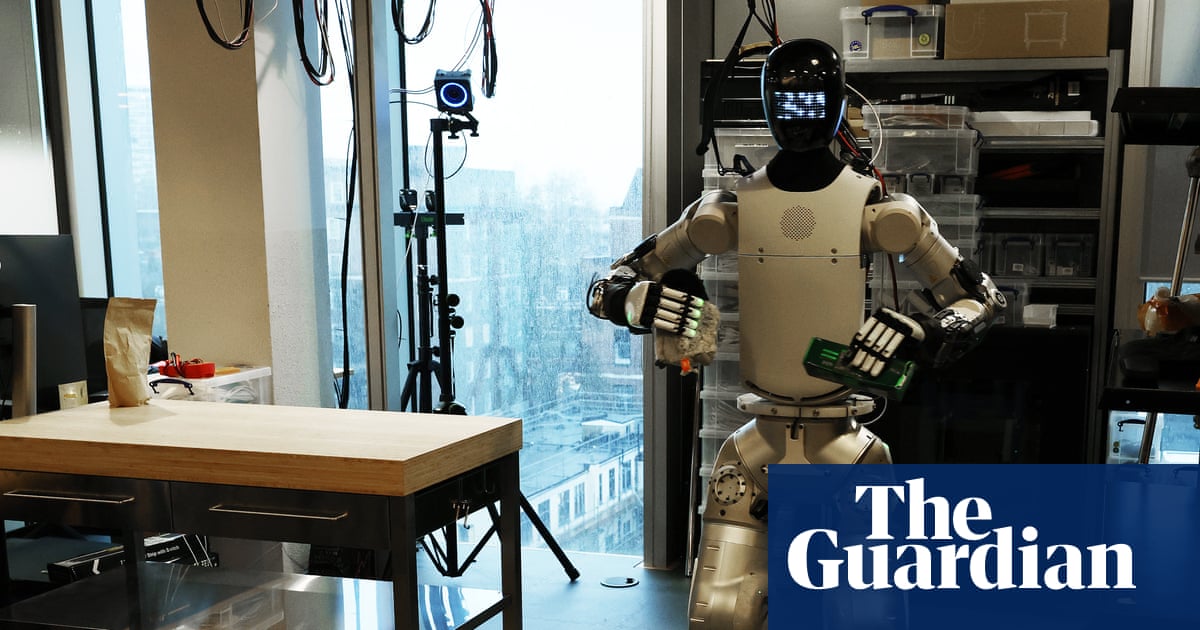
AI will help make a Nobel prize-winning discovery within a year, says Anthropic co-founder
Jack Clark, co-founder of Anthropic, predicts that an AI system working with humans will make a Nobel prize-winning discovery within 12 months. He also forecasts that bipedal robots will assist tradespeople within two years and that AI-only companies will generate millions of dollars. Clark describes a 'vertiginous sense of progress' in AI technology while acknowledging the profound societal changes and risks it brings.
Why it matters
This prediction reflects the growing confidence—and perhaps hype—within the AI industry about the transformative potential of these systems. While AI has already shown remarkable capability in scientific domains like protein folding (AlphaFold) and materials science, claiming a Nobel-worthy discovery within a year is a bold and self-serving statement from someone whose company stands to benefit from such optimism. Nobel prizes typically reward decades of foundational work, so even if AI acceler…
The Verge AI

In SpaceX’s IPO, Elon Musk is a risk factor
SpaceX's IPO filing reveals extensive interconnections between Elon Musk's various companies, including Tesla, xAI, X, Boring Company, and Neuralink. The 330-page filing mentions these companies frequently, showing how they interact, overlap, and shuffle money between each other. SpaceX acknowledges it is 'highly dependent' on Musk's leadership and lists his other companies as possible competitors. The IPO could potentially make Musk the world's first trillionaire, but the filing highlights the complex web of cross-ownership and dealings among his enterprises as a significant risk factor for investors.
Why it matters
This is a significant and well-framed piece of business journalism that highlights a genuinely important concern for potential SpaceX investors. The entanglement of Musk's corporate empire — where companies are shareholders in each other and resources flow between them in opaque ways — represents a real governance risk that deserves scrutiny. The article's approach of quantifying mentions of other Musk companies in the filing is a clever way to illustrate the depth of these interconnections. As…
NY Times

The A.I. threat to audiobooks
The New York Times video report by Alexandra Alter examines how artificial intelligence is being used to create pirated audiobooks more quickly and with higher quality, making them harder to detect. The piece highlights this as a growing threat to the publishing industry, as AI-generated voice technology enables unauthorized reproduction of copyrighted books in audio format at scale.
Why it matters
This is an important topic that sits at the intersection of AI advancement, intellectual property rights, and the creative economy. The threat of AI-powered audiobook piracy is real and significant — it undermines authors' and publishers' revenue streams and devalues the craft of professional narration. However, the article appears to be primarily a video segment with minimal accompanying text, making it difficult to assess the depth of reporting. The issue deserves serious attention: as AI voi…
TechCrunch AI

Jensen Huang says he’s found a ‘brand new’ $200B market for Nvidia
Nvidia CEO Jensen Huang announced on the company's earnings call that the company's new Vera CPU, purpose-built for agentic AI, opens a 'brand new' $200 billion total addressable market for Nvidia. The announcement came alongside another record-breaking quarter with $81.6 billion in revenue and a $91 billion forecast for next quarter. Huang explained that while AI model 'thinking' uses GPUs, AI agents primarily run on CPUs, and Vera is specifically designed to process tokens as fast as possible rather than running multiple app instances like traditional cloud CPUs. He reported that Nvidia has already sold $20 billion worth of standalone Vera CPUs this year. Huang predicts the world will eventually have billions of AI agents, each needing CPU-powered tools analogous to PCs for human users. The move comes as competitors like AWS develop their own AI chips, with Amazon recently signing a m…
Why it matters
This is a strategically significant move by Nvidia that demonstrates the company's ability to identify and capitalize on emerging computing paradigms before competitors can fully establish themselves. Huang's track record of delivering on ambitious claims lends credibility to the $200 billion TAM projection, and the $20 billion in Vera sales already this year suggests real market traction rather than mere hype. The logic is sound: if agentic AI becomes as pervasive as predicted, the CPU workloa…
TechCrunch AI

Anthropic says it’s about to have its first profitable quarter
Anthropic has informed its investors that it expects to more than double its revenue to approximately $10.9 billion in its second quarter of 2026, which would mark its first-ever profitable quarter with an operating profit. This represents significant quarter-over-quarter growth that positions the company favorably against competitor OpenAI. However, the Wall Street Journal reports that Anthropic may not sustain profitability throughout the year due to large upcoming compute costs. The company's growth has been driven by increasing professional preference for its Claude chatbot and efforts to diversify its customer base, including new services for small businesses and law firms. The profitability news coincided with reports of OpenAI potentially filing for an IPO soon.
Why it matters
This is a remarkable milestone for Anthropic and a strong signal of the AI industry's maturation from cash-burning startups to viable businesses. Doubling revenue to $10.9 billion in a single quarter is extraordinary growth, and achieving profitability — even if temporary — gives Anthropic significant credibility with investors and the broader market. The timing alongside OpenAI's IPO news feels strategic, as it positions Anthropic as a financially disciplined competitor. However, the caveat th…
TechCrunch AI

Clouted wants to take the guesswork out of making short videos go viral
Clouted, a startup that went through a16z's Speedrun accelerator in 2024, has raised a $7 million seed round led by Slow Ventures with participation from Gold House Ventures, Weekend Fund, Peak XV's Surge, and others. The company builds infrastructure to automate the creation and distribution of short video clips for marketing purposes. It leverages a network of over 100,000 gig creators to edit clips from podcasts, songs, and movies, then uses AI to determine optimal social media platforms and target audiences for distribution. Co-founder and CEO Justin Banusing originally applied the technology to promote his Manila-based electronic dance music festival &Friends. Clouted's AI runs a continuous testing loop, experimenting with different formats and channel strategies to learn what triggers virality — a process the company likens to penetration testing for social media algorithms. The s…
Why it matters
Clouted is tackling a real and growing market need — the explosion of short-form video content has created enormous demand for efficient clipping and distribution at scale. The combination of a large gig creator network with AI-driven distribution optimization is a compelling approach that creates a data flywheel: more campaigns yield better targeting intelligence. However, the moat here is questionable. The gig creator network could be replicated, and AI-based clipping tools are becoming commo…
TechCrunch AI

xAI burned $6.4B last year — SpaceX’s IPO filing shows why the spending is far from over
SpaceX's IPO filing reveals that Elon Musk's xAI lost $6.4 billion on $3.2 billion in revenue in 2025, with losses widening from $1.56 billion in 2024. AI capital expenditures reached $12.7 billion in 2025 and are on pace to exceed $30 billion annualized in 2026. The filing shows Grok has 117 million monthly active users out of 550 million total across Grok and X. SpaceX plans to scale Grok to 'multiple trillions of parameters' and expand AI compute infrastructure, including potential orbital data center satellites by 2028. xAI's revenue includes $365 million from subscriptions, $88 million from data licensing, and $116 million from advertising. Meanwhile, competitor Anthropic is reportedly nearing its first operating profit.
Why it matters
The financials paint a stark picture: xAI is burning cash at an accelerating rate while generating relatively modest revenue, and the gap is widening rather than narrowing. The $30.8 billion annualized capex run rate is staggering for a division generating $3.2 billion in revenue. The comparison with Anthropic approaching profitability on $10.9 billion in revenue is particularly unflattering. The 'multiple trillions of parameters' ambition and orbital data center plans read more like aspiration…
TechCrunch AI

Nvidia posts another record quarter, reveals $43B of holdings in startups
Nvidia reported record Q1 FY2027 revenue of $81.6 billion (up 20% QoQ), with $75.2 billion from data centers, while forecasting a slowdown to $91 billion next quarter (12% growth). The company authorized $80 billion in share repurchases. A major revelation was Nvidia's $43 billion in privately held startup stakes, nearly doubling from $22 billion at the start of the quarter, driven by $18.5 billion in new purchases. This excludes public company investments and uncommitted deals like a $30 billion OpenAI investment. CEO Jensen Huang highlighted expanding partnerships, including a significant new buildout with Anthropic. Chinese export revenue remained negligible despite H200 approval.
Why it matters
This is a remarkable earnings report that underscores Nvidia's dominance in AI infrastructure, but the most striking revelation is the massive $43 billion in private startup holdings. Nvidia is essentially becoming a venture capital powerhouse alongside its chip business, creating a deeply intertwined ecosystem where it both supplies and invests in AI companies. This raises questions about conflicts of interest and market concentration. The projected revenue growth slowdown from 20% to 12% QoQ,…
From X/Twitter
- Adam Grant cites five studies showing managers pile extra work on intrinsically motivated employees — argues it's time to end the passion tax.
- Andrej Karpathy spent two hours on what happens to humans when AI takes over knowledge work — the talk most AI educators won't give.
- Hermes Agent shipped native skill bundles — but be careful, triggering one loads every skill's context into the agent at once.
- Most people aren't vibe coding — they're panic prompting. Anthropic just showed the better version: AI as the system, not the engineer.
- Lenny Rachitsky calls this piece from Maja Media a killer guide on finding a job right now.
- Claire Vo opened Cohort 2 of her AI playbook for execs course on June 27–28, aimed at CTOs, CPOs, VPEs, and Staff+ ICs.
From Reddit/HN/YC
- [Hacker News] An indie hacker grew an AI orchestration platform to $3k MRR in four weeks — breakdown on Indie Hackers.
- [Hacker News] A visual guide to the 15 patterns behind most LeetCode problems — interactive and actually useful.
- [Hacker News] Max Chernyak revisits his server-informed UI thesis — four years later, he still argues don't build a general purpose API.
- [Hacker News] The Economist pulls economics lessons from Home Depot — supply chains, labor markets, and the housing cycle in one retailer.
- [Hacker News] Encore benchmarked TypeScript backend frameworks to see if they're ready for AI agent workloads — the gaps are real.
- [Hacker News] Claude Mythos audited the Symfony framework and found 19 vulnerabilities — a real-world stress test for AI code review.