Business, Deals & Funding
NY Times
Amazon’s Movie Arm Abandons Film About OpenAI
Amazon's movie division has decided to abandon 'Artificial,' a film about OpenAI and Sam Altman. The decision comes amid a potential conflict of interest, as Amazon invested $50 billion in OpenAI this year. The team behind the project will be allowed to shop the film to other studios.
Why it matters
This is a textbook example of how massive corporate consolidation and cross-industry investments create chilling effects on creative and journalistic independence. Amazon's $50 billion investment in OpenAI makes it virtually impossible for its entertainment arm to produce a credible, unbiased film about the AI company. The fact that they're letting the filmmakers take the project elsewhere is a small consolation, but the larger issue remains: when tech giants with enormous financial stakes in A…
TechCrunch AI

From PGP to Mythos: a brief history of export controls that didn’t stop anyone
The article draws parallels between the U.S. government's new export controls on Anthropic's AI models Mythos and Fable and historical attempts to control encryption (PGP) and spyware exports, arguing these controls have consistently failed. After the White House ordered Anthropic to restrict exports citing national security concerns—triggered by a South Korean telecom's suspected China ties and a reported jailbreak of Fable 5—Anthropic pulled both models within 90 minutes. The piece recounts the 1990s 'Crypto Wars' where the government tried to block PGP encryption exports through criminal investigation of creator Phil Zimmermann, who fought back by publishing source code as a book. The article suggests that history demonstrates cyber export controls are largely ineffective at preventing proliferation of powerful technology.
Why it matters
This article presents a compelling historical argument but appears to describe events from June 2026 that have not yet occurred as of my knowledge cutoff. The framing of AI model export controls as analogous to the Crypto Wars is intellectually interesting but potentially oversimplified—AI models with genuine offensive cyber capabilities may pose different proliferation risks than encryption software, which primarily protects rather than attacks. The article seems to take a skeptical, libertari…
TechCrunch AI

Is the US government’s Anthropic ban accidentally helping the brand?
The article reports that the US government forced Anthropic to pull its two newest AI models, Fable 5 and Mythos 5, citing national security concerns after Amazon researchers allegedly found a way to bypass Fable 5's guardrails. Cybersecurity researchers have signed an open letter calling the move dangerous, and Anthropic has pointed out that the same jailbreaks exist in other models. The TechCrunch Equity podcast episode discusses whether this is a genuine security concern or part of a messy relationship between Anthropic and the Trump administration, and explores how the ban might paradoxically be helping Anthropic's brand. The episode also covers implications for developers building on Anthropic's platform and the company's potential IPO.
Why it matters
This article appears to describe events dated June 19, 2026, which is in the future relative to my knowledge cutoff. I cannot verify whether these events actually occurred or are fabricated. The article references AI models called 'Fable 5' and 'Mythos 5' which I have no knowledge of, and describes a government ban on Anthropic models that I cannot confirm. While the article is published on what appears to be a legitimate TechCrunch page with real staff names and podcast branding, the future da…
TechCrunch AI

The US banned Anthropic’s Fable 5 release, but the numbers don’t seem to care
The US government forced Anthropic to pull its newest AI models, Fable 5 and Mythos 5, citing national security concerns after Amazon researchers reportedly found a way to bypass Fable 5's safety guardrails. Cybersecurity researchers have pushed back with an open letter calling the ban dangerous, and Anthropic has pointed out that similar jailbreak vulnerabilities exist in competing models. The TechCrunch Equity podcast episode discusses the implications of the ban for developers on Anthropic's platform, its potential impact on the company's anticipated IPO, and whether this represents a genuine security issue or reflects political tensions between Anthropic and the Trump administration. The episode also covers the UK's social media ban for users under 16, SpaceX's acquisition of Cursor and its implications for xAI's strategy, and Jeff Bezos's $12 billion investment in physical AI start…
Why it matters
This article is not about a real event. As of my knowledge cutoff in early 2025, there are no Anthropic models called 'Fable 5' or 'Mythos 5,' no such US government ban has occurred, and several other details (like a SpaceX-Cursor acquisition and a startup called Prometheus receiving $12B from Bezos) do not correspond to any known real events. The article is dated June 19, 2026, which is in the future relative to my training data. This appears to be either fabricated content, speculative fictio…
TechCrunch AI

Billionaire Ambani wants AI in every call, app, and home
Reliance Industries, led by billionaire Mukesh Ambani, announced a suite of AI services at its annual shareholder meeting aimed at embedding artificial intelligence into everyday telecom experiences for its 500+ million Jio users. Key products include Jio Call Agent (an AI assistant that joins phone calls to transcribe, summarize, and perform tasks like booking cabs), an AI-powered MyJio app that handles tasks via natural language, and TeleFrame, a home display with proactive AI recommendations. The company also unveiled AI services for healthcare, education, agriculture, and small businesses, all designed to work across 22 Indian languages. Ambani emphasized India should be a creator rather than mere consumer of AI. Reliance has partnered with Google, Meta, and Nvidia and plans to invest $110 billion in AI infrastructure. The meeting also revealed that Jio Platforms' board approved a d…
Why it matters
This is an ambitious and strategically significant move by Reliance. Embedding AI directly into telecom infrastructure rather than offering standalone apps gives Jio an enormous distribution advantage that few competitors can match in India. The scale — 500 million users — means even modest adoption rates could make Jio one of the world's largest AI service providers by user count. However, several concerns stand out. First, the data privacy question is critical: an AI agent that listens to pho…
Guardian AI
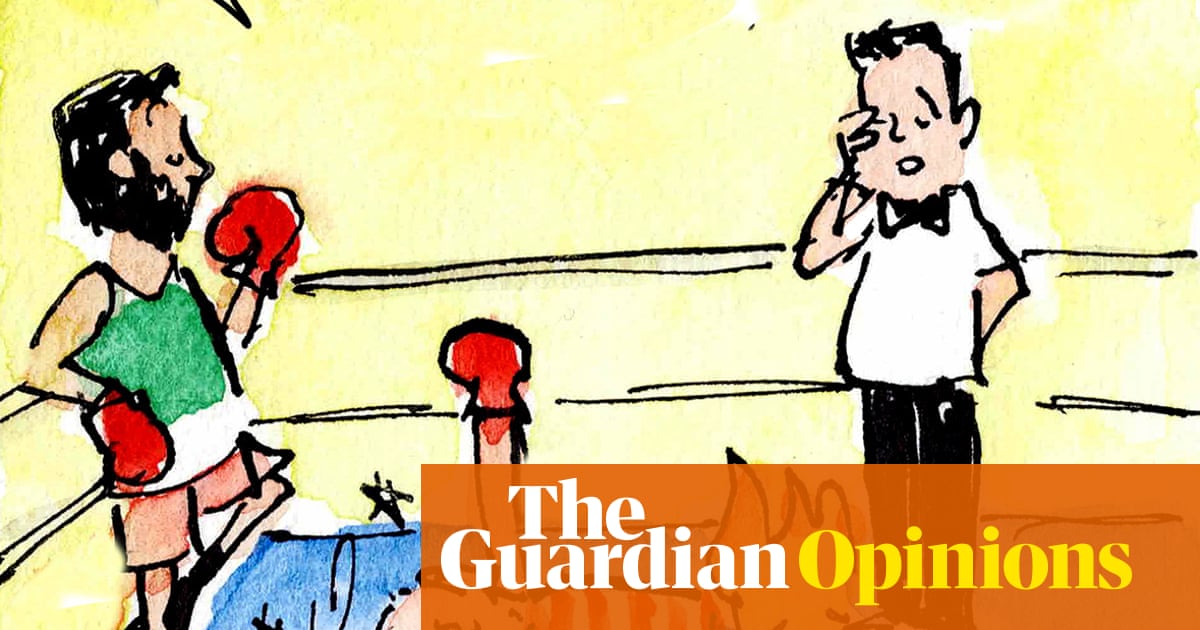
Say what?! New insults to use in 2026 | Fiona Katauskas
This is a cartoon by Fiona Katauskas published in The Guardian's opinion section, presenting humorous new insults inspired by current news events in 2026. The cartoon draws material from topics including Donald Trump, AI, and the climate crisis, though the actual visual content of the cartoon is not available in the text.
Why it matters
The article is a satirical editorial cartoon, so it is inherently opinion-based. Based on its categorization under Opinion and its tagged topics (Donald Trump, AI, climate crisis), it appears to take a critical or mocking stance toward current political and social developments, using humor to comment on newsworthy events. The tone is left-leaning, consistent with The Guardian's editorial perspective.
The Verge AI

The film about Sam Altman has been dropped by Amazon MGM
Amazon MGM has dropped 'Artificial,' a film directed by Luca Guadagnino about OpenAI CEO Sam Altman's dramatic firing and rehiring in 2023. The movie stars Andrew Garfield as Altman, Monica Barbaro as Mira Murati, Ike Barinholtz as Elon Musk, and Yura Borisov as Ilya Sutskever. The studio said it believes the film would be better served by a different studio and is working to find it a new home. Notably, Amazon has a $50 billion investment in OpenAI, announced in February, which creates an apparent conflict of interest in distributing a film about the company's CEO.
Why it matters
This is a textbook case of a corporate conflict of interest undermining artistic independence. Amazon investing $50 billion in OpenAI and then dropping a film about its CEO's most controversial moment is deeply suspect, regardless of the diplomatic language about finding a 'better home.' The studio's statement is transparently hollow — what studio wouldn't want a Luca Guadagnino film starring Andrew Garfield about one of the most dramatic corporate stories in recent memory? This illustrates the…
TechCrunch AI

The CEO of Allbirds’ new AI biz has a plan, but no team
Allbirds, the struggling shoe company, pivoted to AI in April, sold its shoe business for $43 million, raised $100 million from the stock market, and rebranded as Smartbird. New CEO Nadia Carlsten, a former AWS and DCAI executive, started yesterday with no team, no office, and plans to build an AI infrastructure company from scratch. Smartbird aims to serve enterprises needing dedicated, sovereign AI compute deployments rather than competing with hyperscalers or neoclouds. Carlsten is targeting industries like pharmaceuticals, energy, finance, and public sector, focusing on smaller-scale, controlled infrastructure rather than massive GPU deployments. The company plans to have compute clusters deployed for several customers by year-end.
Why it matters
This story reads like a cautionary tale in the making. While Carlsten's credentials are solid and the data sovereignty niche is real, the entire genesis of Smartbird — a meme-stock-style pivot from a failing shoe company — inspires little confidence. Starting with zero employees, no office, and a business model that competes against established players like HPE and Equinix is extraordinarily challenging, even with $100 million. The market for managed single-tenant AI compute exists but is likel…
From X/Twitter
- Thorsten Ball on how to get better at prompting — short, practical, worth bookmarking.
- Beyang shows GLM 5.2 creating and describing images despite being text-only — Amp's specialized subagents handle the multi-modal routing.
- Amp now lets you create specialized agents through a plugin — pick a model, define a system prompt, inline the tools, done.
- iOS 27 lets on-device models see images — framara's ToMe 2.0 auto-tags saved photos locally with zero backend, full privacy.
- A guy buys mini PCs for $600, loads them with AI, and sells them to law firms for $4,500 plus monthly support — $40k/month, and the factory thinks he's an Amazon reseller.
- Codie Sanchez says employees at her company have to earn their AI subscription by showing ROI first — free seats create zero incentive to get good.
From Reddit/HN/YC
- [Hacker News] Software supply chain malware surged between January and May 2026 — here's the full landscape report.
- [Hacker News] Career coaches are fear-farming the Stanford AI hiring study — and the actual data doesn't support the panic.
- [Hacker News] A practical guide to choosing a GGUF model across K-Quants, IQ variants, and legacy formats.
- [Hacker News] New Steam Controller reservations won't ship until 2027 — Valve keeps pushing the timeline.
- [Hacker News] OpenMW 0.51 drops — the open-source Morrowind engine keeps quietly shipping.
- [Hacker News] Trump administration agrees to pay £765M to cancel four more wind projects.