Business, Deals & Funding
Claude Code Changelog
v2.1.187
Version 2.1.187 of Claude Code adds a sandbox.credentials setting to block sandboxed commands from accessing credential files and secret environment variables, adds organization-configured model restrictions to the model picker and related commands with appropriate messaging, adds mouse click support for select menus in fullscreen mode, and fixes a bug where --resume failed with 'No conversation found' error.
Why it matters
This is a solid incremental release with meaningful security and usability improvements. The sandbox.credentials setting is a welcome security enhancement for protecting sensitive data from sandboxed commands. Organization-level model restrictions show maturity in enterprise management capabilities. Mouse click support for select menus is a nice quality-of-life improvement. The changelog entry appears truncated, so there may be additional fixes or features not captured here.
Guardian AI

‘Who is going to pay us when we’re replaced by robots?’ The Indian factory workers told to film themselves for AI
Indian garment factory workers near Delhi were asked by management to wear head-mounted cameras while working. The article describes how worker Lalita and others initially found the cameras amusing, but their attitude shifted to concern as they realized the footage was likely being used to train AI and robotic systems that could eventually replace them. The workers raised questions about their future livelihoods and compensation if automation takes over their jobs, highlighting the tension between technological advancement and labor rights in India's manufacturing sector.
Why it matters
This article highlights a deeply troubling and exploitative practice where vulnerable workers are essentially being coerced into participating in their own obsolescence. The power imbalance is stark — factory workers in precarious employment are unlikely to feel they can refuse management's instructions to wear cameras, even when they suspect the footage will be used to automate their roles. It raises serious ethical questions about informed consent, fair compensation for data contribution, and…
Guardian AI

Chinese supercomputer leapfrogs best US machines to be ranked world’s fastest
China's LineShine supercomputer, located in Shenzhen, has debuted at number one on the Top500 rankings, displacing the US computer El Capitan as the world's fastest supercomputer. This marks the first time since 2017 that a Chinese machine has topped the list, which is often viewed as a benchmark for national technological prowess.
Why it matters
This is a significant milestone that underscores China's continued investment and progress in high-performance computing despite ongoing US export controls on advanced chips. The achievement highlights the intensifying US-China tech rivalry and suggests that export restrictions may have motivated rather than prevented China's domestic computing advances. While the Top500 list is just one metric and doesn't capture the full picture of a nation's computing ecosystem, it carries symbolic weight an…
Dagster
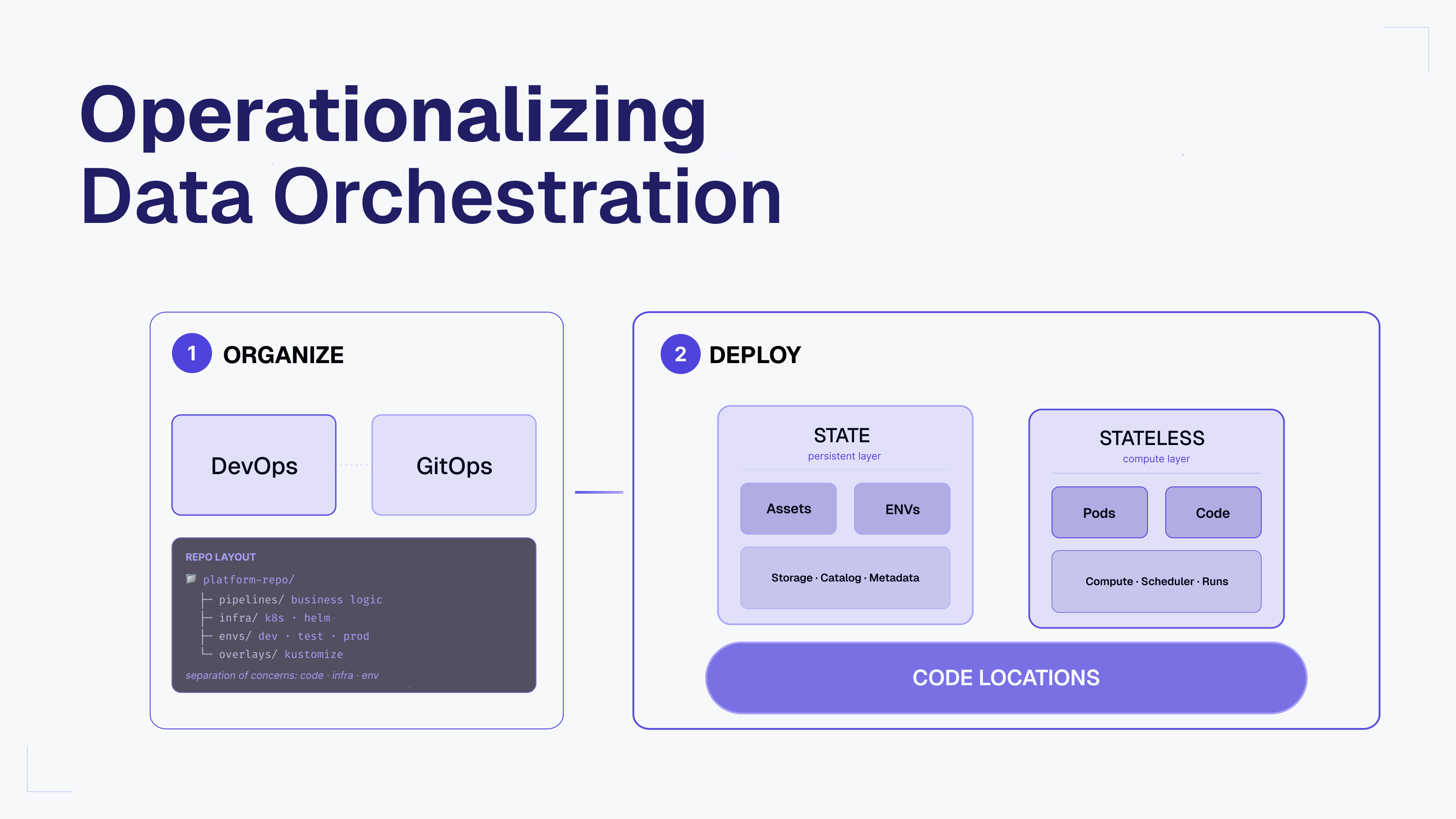
Operationalizing Data Orchestration: Best Practices for DevOps, Infra, and Code Locations
This blog post, part of a series aimed at data platform engineers, discusses best practices for operationalizing data orchestration with a focus on DevOps, GitOps, infrastructure management, and code organization. The author argues that DevOps has become the most critical and underappreciated aspect of data engineering, similar to how data engineering itself was overshadowed by data science a decade ago. Key topics include the importance of GitOps for automating deployments across environments (dev, test, production), separating infrastructure code from business logic/ETL pipeline code, using Infrastructure as Code (IaC) with tools like Kubernetes and Kustomize, and standardizing deployment patterns. The post emphasizes that as AI and generative AI increase the volume and importance of data, the orchestration layer becomes as critical as source OLTP databases, making reliable deployment…
Why it matters
The article addresses a genuinely important and often neglected topic—the operational side of data orchestration—which many data teams struggle with as they scale. The comparison of DevOps' current underappreciation to data engineering's past obscurity behind data science is an insightful observation. However, the content appears truncated and incomplete, cutting off just as it promises to deliver the actual best practices for operationalizing data orchestration. What is present reads more like…
TechCrunch AI

India’s MoEngage bets that the future of marketing is millions of AI agents
Indian customer engagement software firm MoEngage has acquired San Francisco-based startup Aampe in an all-cash deal worth tens of millions of dollars. Aampe, founded in 2020, develops technology that assigns a dedicated AI agent to each individual customer, enabling personalized messaging based on individual behavior rather than traditional audience segments. Aampe has over 30 customers, grew ARR by 150% over the past year, and has raised about $28 million from investors including Peak XV Partners, Z47, and Theory Ventures. MoEngage CEO Raviteja Dodda said the acquisition will help the company compete against rivals like Salesforce Marketing Cloud and Adobe Experience Cloud, noting that MoEngage has recently signed several multimillion-dollar deals with customers migrating from those platforms. Around 20 Aampe employees will join MoEngage, bringing its workforce to roughly 820 people.…
Why it matters
This is a strategically sound acquisition that positions MoEngage at the forefront of the shift from campaign-based marketing to autonomous, agent-driven personalization. The concept of assigning individual AI agents to each customer represents a genuinely meaningful evolution in martech — moving beyond segmentation to true 1:1 personalization at scale. Aampe's 150% ARR growth validates market demand, and the overlap in customers (like Swiggy) suggests integration should be relatively smooth. M…
Ars Technica AI

White House drastically shortens deadline for dropping quantum-vulnerable crypto
The White House has issued an executive order titled 'Securing the Nation against Advanced Cryptographic Attacks' that drastically shortens the deadline for government agencies and organizations to adopt post-quantum cryptography (PQC). High-value assets and high-impact systems must transition to quantum-resistant key establishment schemes by December 31, 2030, and quantum-safe digital signatures by December 31, 2031—roughly 4-5 years sooner than the previous 2035 timeline. The accelerated deadline follows recent research suggesting cryptographically relevant quantum computers may be achievable with fewer resources than previously estimated, and mirrors similar timeline changes by Google and Cloudflare. The order also establishes government-wide transition coordination, directs diplomatic engagement to encourage international PQC adoption, mandates guidance on cryptographic bills of mat…
Why it matters
This is a significant and arguably overdue policy move. The 'harvest now, decrypt later' threat has been well-understood for years, and the previous 2035 deadline always felt dangerously complacent given the pace of quantum computing research. Shortening the timeline to 2030-2031 is aggressive but reflects the reality that adversaries are almost certainly already stockpiling encrypted data. The inclusion of CBOMs and contractor requirements shows a maturing understanding that cryptographic agil…
The Verge AI

Google Home will soon get better at recognizing you
Google Home is expanding its Familiar Faces facial recognition feature starting June 23rd to identify people even when their faces aren't clearly visible, using non-biometric signals like body size and clothing color. The Familiar Faces library will also auto-update with recent images to reduce inaccurate notifications. Additionally, Google's AI-generated video event descriptions can now identify specific sounds like dogs barking, alarms, or footsteps from off-camera audio. A Google Home app update also adds System Health alerts for Nest thermostats detecting HVAC issues.
Why it matters
This is a practical improvement that addresses real usability frustrations with smart home cameras, but it also raises significant privacy concerns. Using body size and clothing to track and identify people goes beyond facial recognition into broader surveillance territory, and the automatic updating of the Familiar Faces library means the system is continuously learning and storing more data about household members and visitors. While the sound identification feature is useful, the combination…
The Verge AI

Hollywood is bending the knee to OpenAI
Multiple major studios including Netflix, A24, Focus Features, and Warner Bros.' Clockwork have passed on distributing 'Artificial,' director Luca Guadagnino's biographical drama about OpenAI CEO Sam Altman. Amazon MGM, which had nearly completed postproduction on the film and planned an Oscar-qualifying theatrical run, unexpectedly dropped it last week, citing that the film would be 'better served' by a different studio. This decision followed Amazon's $50 billion investment into OpenAI earlier in the year. While Neon and Mubi are reportedly still interested, the widespread reluctance to pick up the film suggests Hollywood may be unwilling to tell critical stories about Big Tech companies it increasingly depends on for business partnerships and investment.
Why it matters
This situation is deeply concerning for creative freedom and journalistic storytelling in Hollywood. When a major studio drops a nearly finished film by an acclaimed director like Guadagnino — and then other major distributors follow suit — it strongly suggests that financial entanglements with Big Tech are chilling the entertainment industry's willingness to engage critically with powerful companies like OpenAI. Amazon's $50 billion investment in OpenAI makes its motivations transparent, but t…
From X/Twitter
- Hermes' new /learn skill pointed at a codebase and turned the entire repo into a reusable playbook in minutes — files, patterns, architecture, all of it.
- Santiago Valdarrama shows Claude Code parsing the whole internet using Apify actors and MCP connectors to operate behind paywalls.
- Sam Hogan switched back to Cursor after six months on Codex — says the agent is on par with CC, and the inapp browser plus design mode is the best front-end dev experience he's used.
- DeepSeek is now showing as a preview model in the Microsoft 365 admin center, alongside the upcoming Cowork 1 model tuned for cheaper everyday tasks.
- Cathryn Lavery's X-Twitter CLI hit a bug, so the agent filed its own improvement PR — the agent-improvement-loop in action.
- Noah Zweben walks through the key decisions behind configuring agent identity in Claude Tag.
From Reddit/HN/YC
- [Hacker News] Supabase published its State of Startups 2026 survey results.
- [Hacker News] DataBridge, an open-source SQL MCP server, hits 61.37% on DataAgentBench with GLM-5.2.
- [Hacker News] GloriousEggroll's custom Proton has been rebased on Proton 11, bringing a wave of compatibility fixes for Linux gaming.
- [Hacker News] Cloudflare found a bug in the hyper HTTP library — here's how they tracked it down.
- [Hacker News] YouTube settles a social media addiction case brought by a teen.
- [Hacker News] Stealing 1Password keys by breaking DOM boundaries — a lesson in establishing limits with your browser.