Business, Deals & Funding
NY Times
The Real A.I. Race Isn’t America vs. China
The article argues that the real A.I. race is not between the United States and China as commonly framed, but rather highlights how Washington is increasingly adopting policy approaches to artificial intelligence that mirror Beijing's strategies, suggesting the two nations are converging in their regulatory and strategic playbooks rather than diverging.
Why it matters
The author appears critical of the prevailing narrative that frames A.I. development as a straightforward geopolitical competition between the U.S. and China. Instead, the piece seems to warn that the U.S. is emulating China's top-down, state-driven approach to A.I. governance, implying this convergence may undermine values like openness and innovation that supposedly distinguish American tech policy. The opinion likely suggests that the more important contest is not between nations but between…
Guardian AI

David Sedaris on his Duolingo obsession: ‘“Today is the last day,” I told myself – but I was powerless to stop’
David Sedaris writes about his obsessive relationship with the language-learning app Duolingo, describing how his competitive drive to top the leader table led him to combine the habit with his daily walking routine, resulting in him walking 10 miles a day while practicing sentences in Japanese, German, Spanish, and French. The piece, characteristic of Sedaris's humorous memoir style, also touches on a road trip with his partner Hugh from Washington, DC, to their North Carolina coastal home.
Why it matters
This appears to be a typically entertaining David Sedaris essay that blends his well-known humor with relatable modern obsessions like app-based language learning. The combination of his competitive streak with Duolingo's gamification elements seems like perfect material for his self-deprecating comedic style. The snippet is too brief to fully judge, but the juxtaposition of mundane moments (a tick on his shirt) with his app addiction suggests the kind of sharp, observational writing Sedaris is…
TechCrunch AI
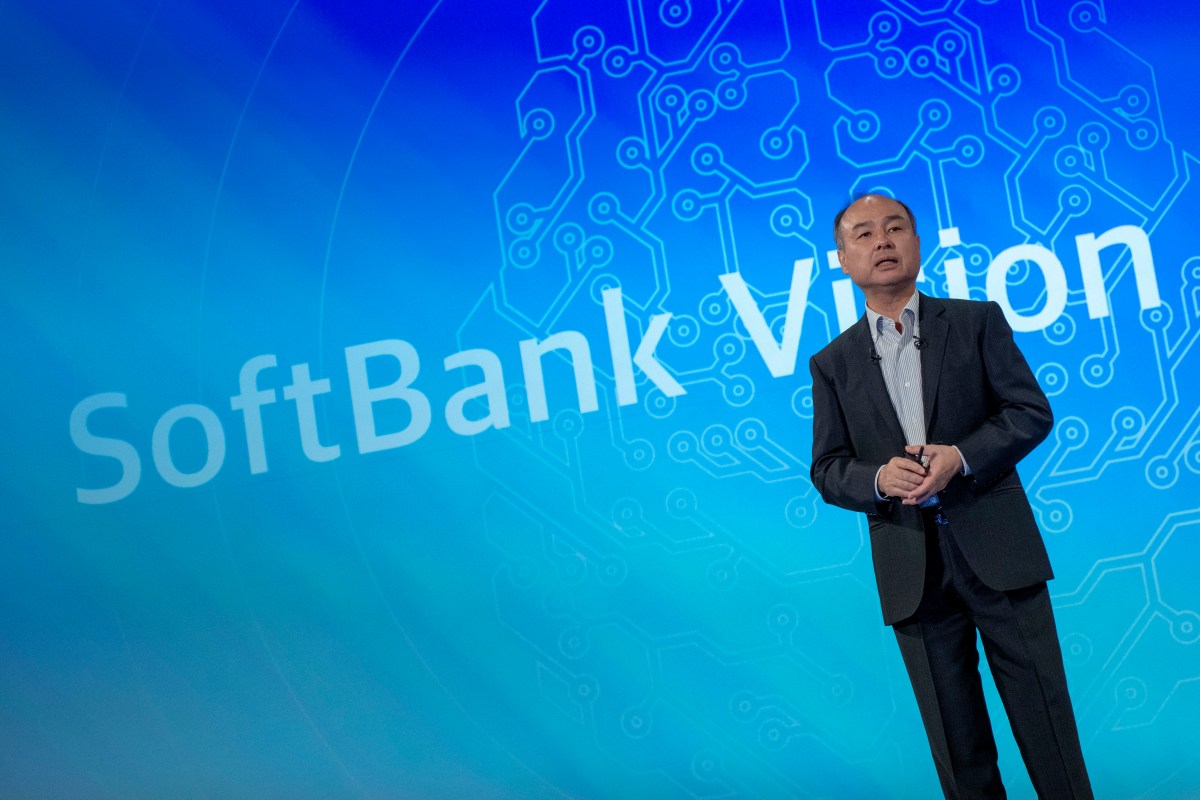
SoftBank’s CEO isn’t the only one with questions about Elon Musk’s orbital data center hype
SoftBank CEO Masayoshi Son publicly questioned Elon Musk's vision for orbital data centers, arguing they won't significantly cut costs and will take too long to build when the critical AI infrastructure battle is happening in the next few years. TechCrunch's Equity podcast discussed Son's remarks alongside broader AI infrastructure trends, including the 'neo-cloud' boom where companies like Groq, SpaceX, and even former shoe company Allbirds are pivoting to lease out compute capacity. Podcast hosts noted the irony of SoftBank playing skeptic given its history of wild bets, and observed that Musk's orbital data center plans conveniently guarantee more business for SpaceX. The discussion highlighted the industry's extreme compute constraints driving unconventional solutions, while questioning the long-term durability of many of these ventures.
Why it matters
Son's skepticism seems well-founded. Orbital data centers face enormous practical challenges — the cost of launching and regularly replacing satellite constellations, latency issues, power constraints, and cooling in space — all for infrastructure that wouldn't be operational for years. The observation that this conveniently funnels more revenue to SpaceX is particularly sharp. The broader neo-cloud gold rush described in the article, where seemingly any company pivots to leasing compute, has c…
The Verge AI

Margaret Atwood says the problem with AI is ‘garbage in, garbage out’
Margaret Atwood, author of The Handmaid's Tale, shared her views on AI at the Babell Literary and Cultural Festival in Porto, Portugal. She recounted her single experience using Anthropic's Claude chatbot, which gave her incorrect information about the British detective series Father Brown. She explained that the AI was misled because online reviews it was trained on don't reveal plot endings. Atwood called people who rely on AI 'opportunists' looking for shortcuts and emphasized that LLMs are only as good as their training data, summarizing the core issue as 'garbage in, garbage out.' She noted that even business users must verify AI outputs because it makes mistakes.
Why it matters
Atwood's critique is both fair and somewhat reductive. Her specific example of Claude failing on Father Brown trivia is a legitimate illustration of how LLMs can confidently produce wrong answers due to gaps or biases in their training data. The 'garbage in, garbage out' framing is a classic computing principle that applies here, though it slightly undersells the more nuanced problem: LLMs can produce garbage even from good data through hallucination and confabulation, which is arguably worse t…
TechCrunch AI

Apple Vision Pro exec is reportedly leaving for OpenAI
Paul Meade, Apple's vice president overseeing the Vision Pro headset and the development of AI-powered smart glasses, is reportedly leaving Apple to join OpenAI's hardware team. According to Bloomberg's Mark Gurman, the departure is linked to incoming Apple CEO John Ternus' decision to shake up the hardware engineering team, which left some vice presidents feeling demoted. At OpenAI, Meade would join a hardware effort that already includes former Apple chief design officer Jony Ive, who is working on an AI device that Sam Altman has described as more peaceful and calm than an iPhone, though reports have suggested the project has faced challenges.
Why it matters
This is a significant talent acquisition for OpenAI and a notable loss for Apple, particularly as Apple prepares to launch more affordable smart glasses to compete with Meta. Meade's experience leading both the Vision Pro and the upcoming smart glasses project makes him a highly valuable hire for OpenAI's nascent hardware ambitions. The fact that this departure stems from internal organizational upheaval under incoming CEO John Ternus suggests that leadership transitions can have real consequen…
Guardian AI
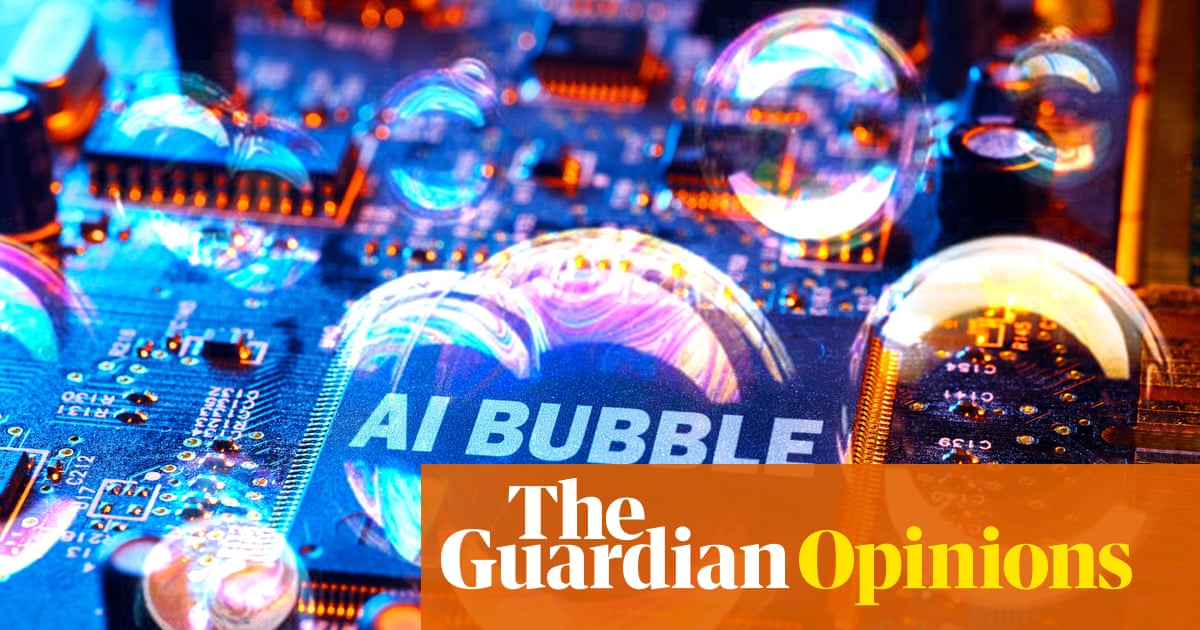
The AI bubble has further to run despite the looming crash
The article discusses the ongoing AI investment bubble, noting that despite warnings of a looming crash, the bubble has further to run as tech firms continue making huge profits and investors fear missing out. Both companies and investors are working to delay a reckoning, while stock markets have risen to historically high levels, prompting questions about portfolio vulnerability and the sustainability of current valuations.
Why it matters
This article raises valid concerns about the cyclical nature of speculative bubbles in technology. The AI sector has seen extraordinary investment and valuation growth, and history shows that such periods of exuberance often end in painful corrections. However, the observation that the bubble 'has further to run' is also plausible — bubbles can persist longer than skeptics expect, driven by genuine profit generation and FOMO among investors. The tension between real technological advancement an…
TechCrunch AI

The fittest founder in the room got cancer. Here’s how he used AI to fight back.
Connor Christou, a health-obsessed 35-year-old founder who meticulously tracked his biomarkers and followed longevity protocols, was unexpectedly diagnosed with an aggressive form of non-Hodgkin's lymphoma after a routine arm swelling led to the discovery of a large tumor behind his sternum. Despite his optimized health regimen, the cancer was caused by a random genetic mutation unrelated to lifestyle. Facing conflicting medical advice — one oncologist recommended a lighter chemotherapy regimen with ~60% success rate while another recommended an aggressive continuous infusion protocol with ~85% success rate — Christou gathered 12 medical opinions total, with 11 favoring the harder treatment. He chose the aggressive path and, true to his data-driven founder mentality, fed all his medical data including blood results, scan data, wearable output, and journal entries into Claude (Anthropic'…
Why it matters
This is a compelling and important story that highlights both the promise and the nuances of AI-assisted healthcare decision-making. Christou's approach of gathering 12 opinions before making a treatment decision is genuinely admirable and underscores a real problem in medicine: that even world-class specialists can give diametrically opposed recommendations for the same patient. Using AI tools like Claude to synthesize and cross-reference medical data, research, and personal health metrics see…
The Verge AI

Why is Apple asking me to pay more for Big Tech’s AI obsession?
Apple has raised prices across multiple product lines, including a $300 increase on the 16-inch MacBook Pro, a $150 increase on the 11-inch iPad Air, and a $30 bump on the HomePod Mini. Tim Cook called the increases 'unavoidable' and blamed the AI industry. The article explains that memory manufacturers have shifted production from consumer DDR5 RAM to HBM memory for AI data centers, causing RAM prices to skyrocket — a phenomenon dubbed 'RAMageddon.' This has affected not just Apple but also Xbox consoles and other consumer electronics. Experts note that memory chips earn far more in AI servers than in consumer devices, so manufacturers are prioritizing data center clients. The article frames this as consumers being forced to subsidize Big Tech's AI ambitions despite not asking for it, even as these companies report record earnings.
Why it matters
This article highlights a genuinely troubling dynamic where the costs of the AI arms race are being externalized onto everyday consumers. The framing is somewhat one-sided — it positions consumers purely as victims without fully exploring whether AI investments might eventually benefit them — but the core economic argument is sound. Memory manufacturers rationally follow higher margins, and companies like Apple rationally pass costs along. The real frustration is valid: consumers are paying mor…
From X/Twitter
- A leaked Claude.md file from Karpathy's team at Anthropic is circulating — users say it transforms how Claude responds from the first message.
- Anthropic is advancing how it studies Claude's economic impact with hourly sampling and survey data on real usage patterns.
- Anthropic says the US government has cleared Claude Mythos 5 for redeployment to organizations defending critical infrastructure.
- Matt Cassinelli shares the introduction of the Siri AI system prompt.
- Anthropic published a PDF showing how their own teams use Claude Code — the workflow boils down to Spec → Dispatch → Verify → Systemize.
- Apple's M6 chip is expected to hit ~200GB/s memory bandwidth, with the base M7 arriving H1 2027 at around 240GB/s.
From Reddit/HN/YC
- [Hacker News] ITCSS remains a solid approach to scalable and maintainable CSS architecture — a 2021 guide worth revisiting.
- [Hacker News] Hikaru Labs offers a private, fully local alternative to iLoveIMG for image editing.
- [Hacker News] Core-1 is a distributed C++ framework designed for trillion-parameter-scale AGI workloads.
- [Hacker News] A look at how US jurisdiction creates a quiet lock on the open web through infrastructure and policy.
- [Hacker News] A walkthrough of how a transformer becomes an LLM — from architecture to training to alignment.
- [Hacker News] A framework for how policymakers can prep for a potential AI job apocalypse before it arrives.