Business, Deals & Funding
Guardian AI

Boost City regulator’s powers to help protect UK consumers from AI, says watchdog
The UK's Financial Conduct Authority (FCA) has published a landmark review (the Mills review) examining how AI will reshape financial services from 2030 onward. The review urges ministers to strengthen the City regulator's powers to protect consumers against potential risks posed by AI, including amplified threats from cyber-crime and fraud. The review found that companies are already beginning to shift from human-led activities toward AI-driven processes, raising concerns about consumer protection in an increasingly automated financial landscape.
Why it matters
This is a significant and timely development. As AI becomes more deeply embedded in financial services, the risks to consumers — from algorithmic bias in lending decisions to sophisticated AI-powered fraud and cyber-attacks — are very real and growing. Strengthening the FCA's regulatory powers proactively, rather than waiting for a major crisis, seems like a prudent approach. The UK has generally taken a lighter-touch, pro-innovation stance on AI regulation compared to the EU's AI Act, so this…
Guardian AI

AI altering meaning of users’ drafts on issues from abortion to climate, study finds
A study has found that AI tools used for drafting and summarizing messages are subtly altering the meaning of users' content on politically sensitive topics such as abortion and climate change. Researchers warn that these small changes inject political biases—some leaning distinctly right-wing—and could spread rapidly across online communications, potentially creating long-term shifts in public opinion as tech companies increasingly promote AI-assisted writing tools.
Why it matters
This is a deeply concerning finding that highlights one of the most insidious risks of widespread AI adoption. When AI tools subtly reshape the language people use to express their views on politically charged topics, it amounts to a form of invisible ideological manipulation at massive scale. Unlike overt censorship, these small nudges in wording can fly under users' radar while cumulatively shifting the tone and framing of public discourse. The fact that some tools lean in particular politica…
The Rundown AI

Meta sizes up GPT-5.5 with 'Watermelon'
Meta's superintelligence chief Alexandr Wang reportedly told employees that their model currently in training, codenamed 'Watermelon,' has matched OpenAI's GPT-5.5 in performance. Watermelon uses roughly 10x the compute of its predecessor Muse Spark, which launched in April 2025. Wang also teased an upcoming Opus-level coding model and a Muse Spark update with significant coding and agentic improvements. However, CEO Mark Zuckerberg noted that industry-wide agent progress hasn't accelerated as expected. The competitive landscape remains challenging, as other frontier models continue advancing rapidly.
Why it matters
This article reads as a fairly standard AI industry hype piece, reporting internal claims from Meta leadership without independent benchmarks or verification. The claim that Watermelon matches GPT-5.5 comes from an internal town hall, not from published evaluations, so it should be taken with significant skepticism. The article itself acknowledges the key problem: even if Watermelon reaches GPT-5.5 parity, the frontier keeps moving, with competitors already pushing beyond that level. Zuckerberg…
Guardian AI

Israeli command system identified 850,000 targets in Gaza and Lebanon wars, says supplier
Elbit Systems, Israel's largest arms supplier, revealed in a presentation that the Israeli Tzayad digital army command and control system identified approximately 850,000 targets in real time during the wars in Gaza and Lebanon. The system mapped people, vehicles, and other objects, detecting roughly 1,000 potential targets per day over the first two years of conflict starting from October 7th. The Tzayad programme operated across all of the Israeli military's theatres of war.
Why it matters
This report is deeply alarming and raises profound ethical and legal concerns. The sheer scale of 850,000 identified 'targets' — averaging 1,000 per day — in densely populated areas like Gaza is staggering and raises serious questions about how broadly 'target' is being defined. The fact that an arms company is essentially boasting about this capability in a corporate presentation is disturbing, as it frames mass surveillance and targeting of a civilian population as a product feature rather th…
Guardian AI

‘It’s smoke and mirrors’: hope turns to fear in Scottish village chosen for AI datacentre
A Scottish village in Lanarkshire, chosen as the site for a large AI datacentre, is experiencing growing disillusionment as initial promises of economic transformation and future jobs give way to fears among residents. Local people suspect they have been misled about the benefits of the development, with some fearing they may have to sell their properties. Related reporting suggests the project has no realistic prospect of meeting its renewable energy commitments, raising broader questions about the feasibility of Britain's AI growth zone plans.
Why it matters
This story highlights a recurring pattern in large-scale tech infrastructure projects: grand promises of economic revitalization are made to gain community buy-in, but the reality often falls short, leaving local residents bearing the costs. The characterization as 'smoke and mirrors' suggests a troubling lack of transparency from developers and possibly from government officials who championed the project. AI datacentres are enormous energy consumers, and the revelation that renewables promise…
Guardian AI
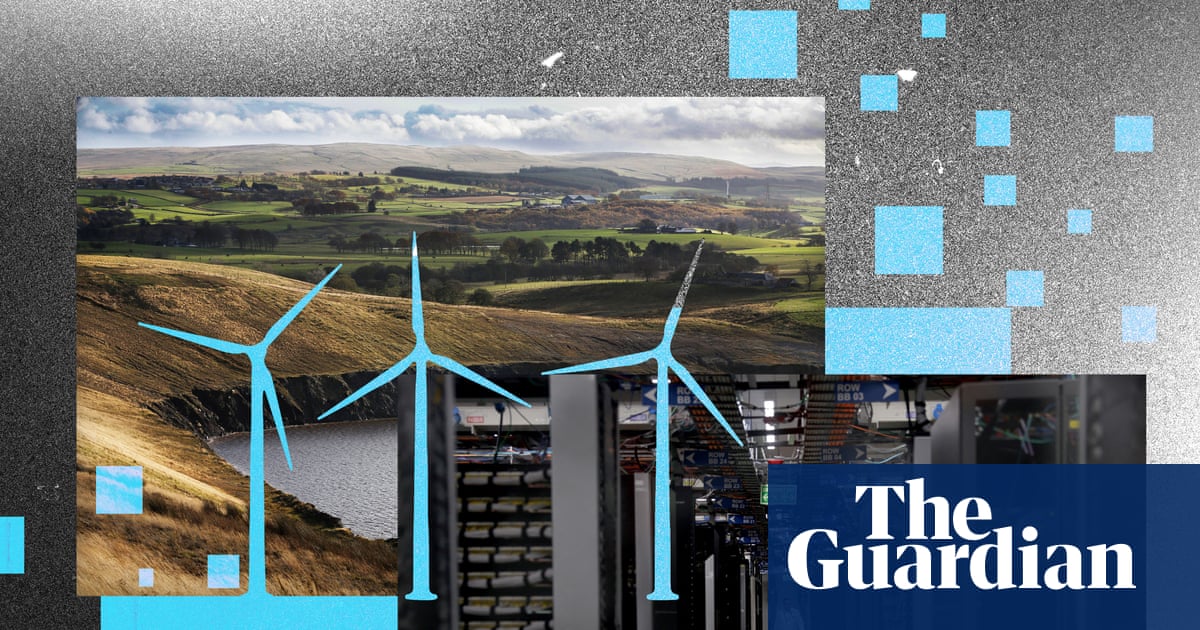
Revealed: landmark Scottish AI project has no prospect of meeting renewables promise
A Guardian investigation has revealed that a major AI datacentre project planned for Lanarkshire, Scotland, has misrepresented its renewable energy plans. The project, which promised to bring jobs and prosperity to the rural area, claimed it would channel the equivalent of a nuclear reactor's worth of power to the site using renewables. However, government officials and developers have privately acknowledged there is a significant 'issue' with power provision, and the project has no realistic prospect of meeting its renewable energy commitments. The investigation suggests the renewable energy promises were described as 'smoke and mirrors,' turning local hope into fear in the Scottish village chosen for the development.
Why it matters
This report highlights a deeply troubling pattern in the AI infrastructure boom: companies and governments making grandiose promises about green energy to win public support for massive datacentre projects, while privately knowing those commitments are unachievable. The energy demands of AI are enormous and growing rapidly, and it is dishonest to dress up these developments as environmentally sustainable when the renewable infrastructure simply doesn't exist to support them. Rural communities d…
Guardian AI

What are Britain’s AI growth zones and are the plans feasible or ‘complete bunk’?
The Guardian investigated Britain's AI growth zones, including a landmark Scottish AI datacentre project in Lanarkshire intended to run on renewables and create thousands of jobs. The investigation found that the project has no prospect of meeting its renewables promise by 2030. Sources described the government's plans as at best unclear and at worst 'complete bunk' and 'smoke and mirrors,' with local hope turning to fear in the Scottish village chosen for the AI datacentre.
Why it matters
The article appears to be a well-sourced investigative piece that critically examines the feasibility of the UK government's AI infrastructure ambitions. The use of strong language from sources like 'complete bunk' and 'smoke and mirrors' suggests significant skepticism about whether these plans are realistic or primarily political announcements. The focus on the gap between renewable energy promises and practical reality is a legitimate and important line of inquiry, as governments worldwide o…
Guardian AI

I don't want a US tech bro as a patron - which is why artists must defend our copyright in the age of AI | Anna Funder
Anna Funder argues that Australian artists and creators must defend their copyright against US tech companies seeking to use their creative works for free or cheaply to train AI systems. She recounts visiting Canberra with fellow creators to advocate for stronger copyright protections, emphasizing that creative works are the property of their makers and should not be surrendered to foreign corporations seeking to profit from AI without fair compensation.
Why it matters
I find Funder's argument compelling and important. The framing of AI training on copyrighted works as a form of digital colonialism—where powerful US tech companies extract creative value from other countries without compensation—is apt. Copyright exists precisely to ensure creators can sustain themselves, and the 'move fast and break things' ethos of Silicon Valley shouldn't override those rights. However, the debate is nuanced: there are legitimate questions about fair use, transformative wor…
From X/Twitter
- Addy Osmani, Google's Gemini engineering lead, open-sourced his personal Claude setup — 68,925 stars and counting on "agent-skills."
- David Zhang built a Fable skill that scans your codebase and interviews you to close known unknowns — then sweeps for the ones you never thought of.
- Siri AI needs better app data handling — Matt Cassinelli breaks down all the Entity Enhancements Apple made to App Intents.
From Reddit/HN/YC
- [Hacker News] Cloud-V ships prebuilt RISC-V64 binaries for GCC, PyTorch, Kubernetes, and more so you can skip the cross-compilation pain.
- [Hacker News] Oh Dear analyzed 1.8M outages and published what they've learned about real-world downtime patterns and alerting.
- [Hacker News] Gustav Hartz analyzed 650k commits to map how crypto bugs evolve over a codebase's lifetime.
- [Hacker News] New paper makes the economic case for taxing artificial intelligence — and how to structure it without killing adoption.
- [Hacker News] Terence Eden makes the case many are thinking but few will say: I'm just so bored of AI.
- [Hacker News] Surrey astrophysicists show how the world's darkest coating could reduce satellite light pollution threatening ground-based astronomy.