Business, Deals & Funding
Guardian AI

The rapid rise of housefishing: are AI-enhanced property listings helpful – or sinister?
The article discusses the growing trend of 'housefishing' – the use of AI-enhanced photos in property listings by estate agents. These modifications range from digitally repainted walls to entirely fabricated features like lawns. While agents argue the enhancements help buyers visualize a property's potential, the practice raises concerns about deception. The piece explores perspectives from estate agents, property viewers, and trading standards experts on where the line should be drawn between helpful visualization and misleading advertising.
Why it matters
This article highlights a genuinely important and emerging consumer protection issue. As AI image manipulation becomes trivially easy, the real estate industry faces a credibility crisis if enhanced listings mislead buyers into wasting time on properties that don't match their expectations – or worse, influencing purchasing decisions based on fabricated features. The term 'housefishing' is apt and evocative, drawing a clear parallel to catfishing in dating. While some degree of staging and flat…
The Rundown AI
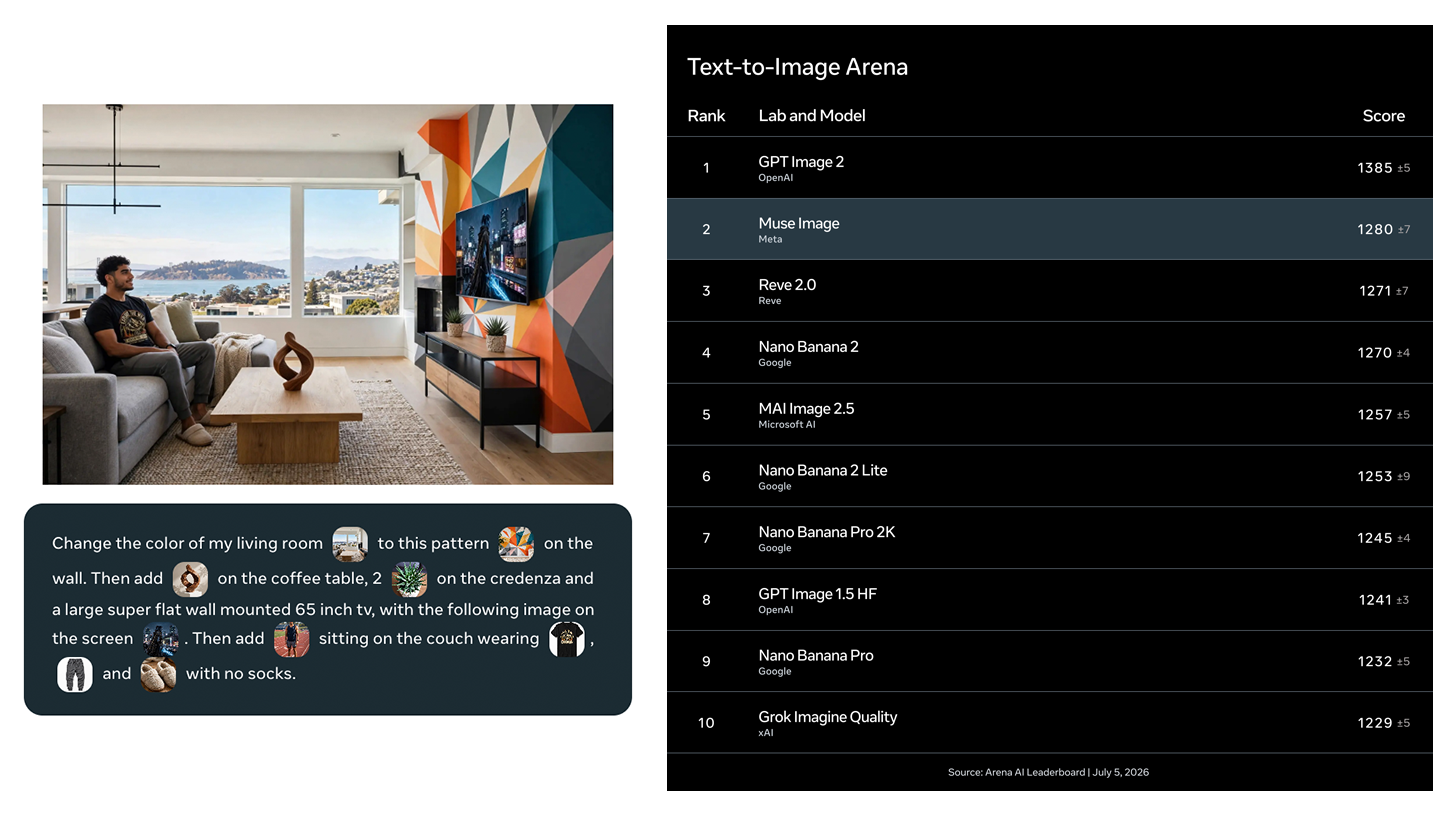
Meta climbs the AI image leaderboard
Meta released Muse Image, the first image model from Alexandr Wang's Meta Superintelligence Labs (MSL), which debuted at No. 2 on Arena's text-to-image and editing leaderboards behind only OpenAI's GPT Image 2. The model is free inside Meta AI and rolling out across Instagram and WhatsApp, with Facebook, Messenger, and the Meta ads platform coming later. Muse Image combines with Muse Spark for agentic capabilities like web search and tool use, and can edit its own outputs. Meta also teased a Muse Video model coming soon, which previewed at No. 3 on Arena's video leaderboard. This marks a shift from Meta previously outsourcing creative AI to Midjourney and Black Forest Labs. Other news covered includes Beijing reportedly considering restrictions on exporting top Chinese AI models from ByteDance, Alibaba, and Zhipu AI outside China, mirroring US export controls on Anthropic models.
Why it matters
Meta's move to develop competitive in-house image generation is strategically significant and unsurprising given their massive user base across social media and advertising platforms. Debuting at No. 2 on the leaderboards is genuinely impressive for a first release, and having a free, integrated image model across Instagram and WhatsApp gives Meta enormous distribution advantages that standalone image generators simply cannot match. The combination with agentic capabilities through Muse Spark s…
TechCrunch AI

Hot French startup ZML releases free product to speed inference across lots of AI chips
ZML, a French AI startup founded by former Zenly VP Steeve Morin and endorsed by Yann LeCun, has released ZML/LLMD, a free inference server that enables open-source large language models to run at maximum speed across multiple chip architectures including Nvidia, AMD, Google TPU, Apple Metal, and Intel Arc. The company aims to break vendor lock-in and reduce AI inference costs by allowing enterprises to use a mix of chips. ZML has raised $20 million from investors including 20VC, Kima Ventures, and LocalGlobe, and operates with a lean team of 20 people in Paris. The product competes with inference platforms like Baseten (valued at $13 billion), Inferact (from vLLM creators), and RadixArk (behind SGLang), but ZML claims broader ambitions including co-designing silicon with emerging European chipmakers. LLMD launches free to gather usage data before eventually becoming a paid product.
Why it matters
This is a strategically smart move in a rapidly growing market. Inference optimization is indeed becoming more important than training as AI deployment scales, and chip-agnostic solutions address a real pain point around vendor lock-in and cost optimization. ZML's positioning is compelling — sitting at the intersection of the inference gold rush and the push for chip diversity beyond Nvidia. However, the competitive landscape is fierce, with well-funded competitors like Baseten and strong open-…
TechCrunch AI

AI chip maker SambaNova raises $1B at $11B valuation, 5 months after last mega round
AI chip maker SambaNova Systems has raised $1 billion at an $11 billion valuation in the first close of its Series F round, led by General Atlantic, with more investors expected soon. This comes just five months after a $350 million Series E and follows failed acquisition talks with Intel that valued the company at roughly $1.6 billion. CEO Rodrigo Liang said the company is likely headed toward going public but remains open to acquisition offers. Intel, a backer since Series C, participated in this round and has a multi-year co-development partnership with SambaNova. The company also announced JPMorganChase as an inference-infrastructure partner, deploying SN40L and SN50 systems for secure on-premises AI inference. SambaNova's next-generation SN50 chip, unveiled in February 2026, is set to begin shipping in the second half of 2026, with SoftBank as its first deployment partner. The comp…
Why it matters
SambaNova's valuation leap from roughly $1.6 billion (Intel acquisition talks) to $11 billion in under a year is remarkable and reflects the intense investor appetite for AI infrastructure alternatives to Nvidia. The JPMorgan partnership is a significant validation, signaling that major financial institutions are serious about building private, on-premises AI inference capabilities rather than relying solely on cloud providers. However, the company's rapid fundraising pace raises questions abou…
Ars Technica AI

Hackers can use 9 of the most popular AI tools to assemble massive botnets
Researchers have discovered a new attack called 'HalluSquatting' that exploits AI coding assistants' tendency to hallucinate package and resource names. By predicting which non-existent package identifiers LLMs are most likely to fabricate and then registering those names in real repositories seeded with malicious code, attackers can create a scalable pull-based prompt injection attack. Unlike previous prompt injections that required targeting individual victims, HalluSquatting can indiscriminately compromise large numbers of devices as AI coding tools like Cursor, Gemini CLI, Windsurf, GitHub Copilot, Cline, and others automatically fetch and execute the malicious packages. This could enable massive botnets, large-scale DDoS attacks, ransomware campaigns, and cryptocurrency mining operations. The attack leverages the fundamental inability of LLMs to distinguish between real and halluci…
Why it matters
This is a genuinely alarming and clever attack vector that represents a significant escalation in AI security threats. It elegantly combines two known problems — LLM hallucinations and dependency confusion/typosquatting — into something far more dangerous than either alone. The fact that it works against nine major AI coding tools suggests this is a systemic vulnerability rather than an implementation bug in any single product. What makes this particularly concerning is the scalability: unlike…
NY Times
Fax and Telegram? New York’s Archaic Requirements Get an A.I. Overhaul.
Governor Kathy Hochul is directing New York state agencies to eliminate or modernize outdated bureaucratic requirements, such as those involving fax machines and telegrams, using AI-driven approaches. The initiative also includes examining whether existing task forces or councils have outlived their purpose and should be disbanded or restructured.
Why it matters
This is a sensible and overdue modernization effort. Many government agencies across the country still cling to archaic processes that waste time and resources. Using AI to identify and streamline outdated regulations is a practical application of the technology. However, the real test will be in execution — bureaucratic inertia is powerful, and simply directing agencies to modernize doesn't guarantee meaningful change. The review of task forces and councils is also welcome, as government bodie…
Guardian AI

‘Absolutely bananas’: San Francisco homes sell for $1m above asking price amid AI boom
A Compass real-estate analysis found that in the first half of 2026, over 140 homes in San Francisco sold for at least $1 million above their asking price, with 44 of those occurring in June alone. The surge in overbidding is attributed to the city's AI boom, which has generated significant new wealth among tech workers and entrepreneurs, intensifying competition in an already housing-scarce market.
Why it matters
This report highlights a familiar and troubling pattern in San Francisco: a tech-driven wealth surge colliding with chronic housing scarcity, producing extreme price distortions. While the AI boom is generating enormous economic value, the fact that homes routinely sell for $1 million or more above asking price underscores a deep structural failure in housing supply. Overbidding at this scale effectively locks out all but the wealthiest buyers and exacerbates inequality. San Francisco has long…
TechCrunch AI

Meta just launched a new AI generator, Muse Image, and users are already pushing back over use of their photos
Meta has launched Muse Image, a new AI image generator built by Meta Superintelligence Labs, available through the Meta AI app, Instagram Stories, and WhatsApp. The tool allows users to create AI-generated images, custom ads, interior decorating visualizations integrated with Facebook Marketplace, and prompt-based image editing. However, a controversial feature allows users to manipulate another Instagram user's public photos with AI by simply tagging them, without requiring explicit consent or notification. Users can disable this in settings, but it is enabled by default. Meta says the tool is free for everyday use but will require a subscription beyond certain limits. A video generation model called Muse Video is also in development.
Why it matters
This launch exemplifies Meta's pattern of prioritizing engagement and feature adoption over user privacy and consent. The opt-out rather than opt-in approach to allowing strangers to manipulate your photos with AI is deeply problematic and feels like a deliberate design choice to maximize usage at the expense of user autonomy. While the decorating and advertising use cases are genuinely useful, the photo-tagging feature is a serious privacy concern that could enable harassment, deepfakes, and n…
From X/Twitter
- Your Claude Code project supports five types of configuration files — commands, rules, skills, agents, and settings — and you're probably only using one.
- Lenny Rachitsky surveyed tech workers: more than half would actively steer a newcomer away from their own career path. Founders are the happiest outliers.
- Corey Haines figured out how to get Claude to record his screen and build silky smooth tutorials by controlling apps directly.
- Akshay Pachaar breaks down the real bottleneck when an interviewer asks how to make token generation 5x faster — and it's not "use a better GPU."
- In a blind test judged by 9 designers across 90 matchups, Fable's best brief won 88.9% of head-to-heads against Opus 4.8 on real landing page builds.
- Paul Solt is using 5.3-Codex-Spark for manual testing of his Mac app after agents kept consistently breaking things.
From Reddit/HN/YC
- [Hacker News] Google drops the Gemma 4 technical report — full architecture and benchmark details in the open.
- [Hacker News] An AI-discovered CVSS 9.8 RCE chain in Cisco CUCM — full writeup on how the bug was found and exploited.
- [Hacker News] Token-saviour distills an agent skill from benchmarking 9 token-saving tools so your LLM calls cost less.
- [Hacker News] Diagraw lets you sketch hand-drawn diagrams with real-time collab and an AI assistant baked in.
- [Hacker News] Comcent CE is an open-source, self-hosted voice infrastructure platform you can run on your own metal.
- [Hacker News] Mat Duggan makes the case that ClickHouse is winning the observability wars against purpose-built competitors.