Business, Deals & Funding
NY Times
How the Platner Campaign Imploded, and New Questions About Trump’s Qatari-Donated Jet
The article covers three main topics: the collapse of the Platner political campaign, emerging questions about a jet donated to Trump by Qatar, and Meta's new AI initiative that will affect users' Instagram photos.
Why it matters
The headline combines several significant political and technology stories. The juxtaposition of a campaign implosion with questions about foreign gifts to Trump suggests ongoing concerns about political ethics and foreign influence. The inclusion of Meta's AI push affecting Instagram photos reflects the growing intersection of AI technology with everyday social media use. Without access to the full article content, it's difficult to assess the depth of reporting, but the topics chosen reflect…
Claude Code Changelog
v2.1.205
Version 2.1.205 of Claude Code includes several bug fixes and one addition: an auto mode rule to block tampering with session transcript files, a fix for --json-schema silently producing unstructured output with invalid schemas or rejecting schemas using the 'format' keyword, a fix for messages sent while Claude was working being lost when reaching the --max-turns limit, a fix for Windows worktree removal deleting files outside the worktree when NTFS junctions or directory symlinks existed inside it, and a fix for background agents staying shown as running (the changelog entry appears truncated).
Why it matters
This is a solid maintenance release with important bug fixes. The Windows worktree deletion bug sounds particularly dangerous as it could lead to data loss. The --json-schema fix is also significant since silently producing unstructured output defeats the purpose of schema validation. The auto mode rule blocking transcript tampering is a good security measure. The truncated changelog entry is unfortunate as it leaves one fix incomplete, but overall these are meaningful improvements to reliabili…
The Rundown AI
SpaceXAI, Cursor release the strongest Grok yet
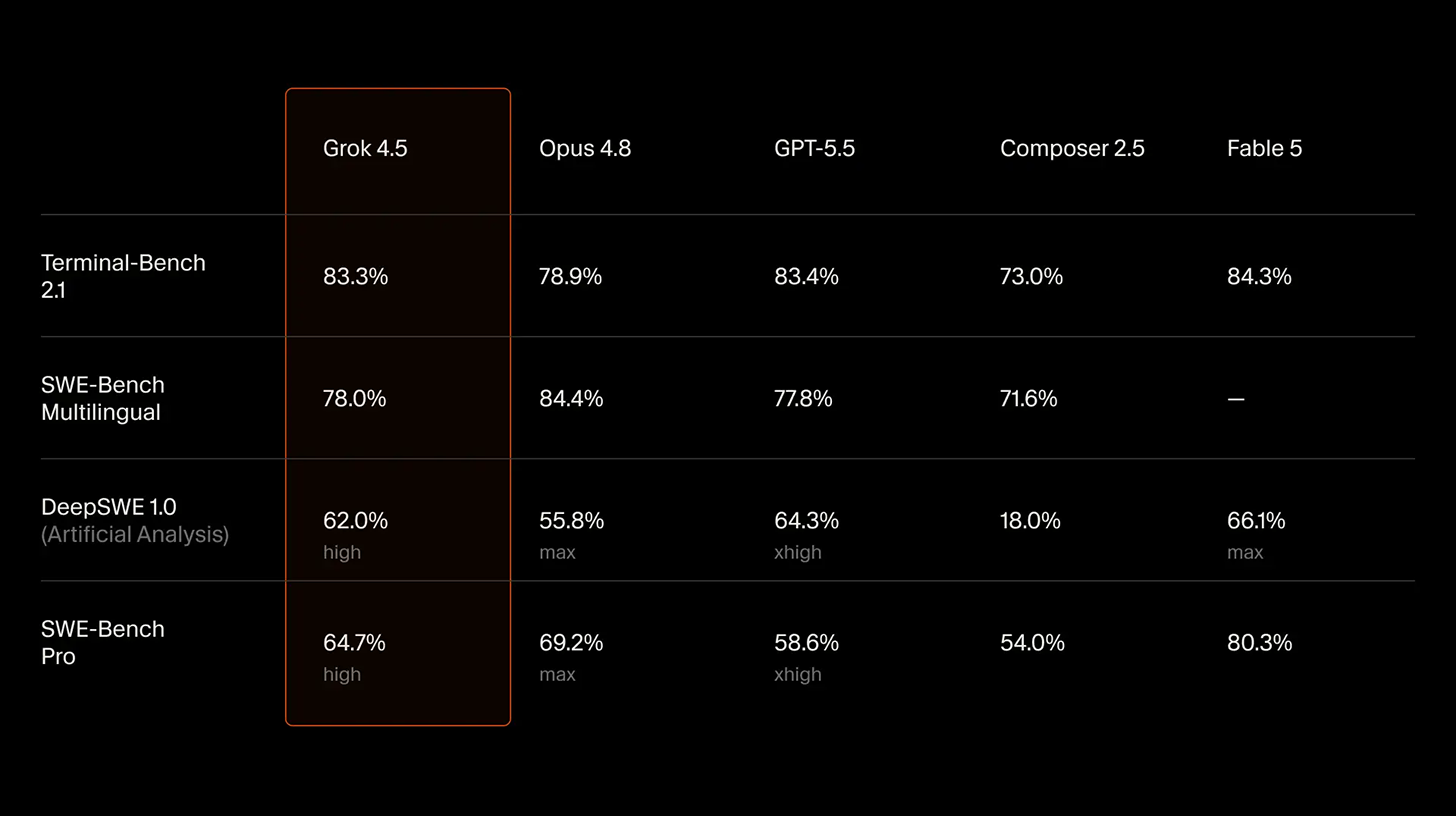
SpaceXAI and Cursor have jointly released Grok 4.5, the first model built together following SpaceXAI's $60B acquisition of Cursor. The model demonstrates strong performance on coding, agentic, and knowledge tasks, with benchmarks comparable to Claude Opus 4.8 and GPT 5.5. Key highlights include 80 tokens per second speed, a claimed 4x efficiency gain over competitors like Opus 4.8, and aggressive pricing at $2/$6 per million input/output tokens compared to Opus 4.8's $5/$25. The model is temporarily free inside Cursor and Grok Build. Elon Musk described it as 'an Opus-class model, but faster, more token-efficient and lower cost' with a bigger model promised next month. The article also covers OpenAI's GPT-Live, a next-gen full-duplex voice model that processes inputs continuously for more natural conversations, and mentions Higgsfield for adding CGI to videos.
Why it matters
This is a significant development that suggests the SpaceXAI-Cursor acquisition is already bearing fruit. If the benchmarks hold up in real-world usage, Grok 4.5 represents a compelling value proposition — offering frontier-level performance at substantially lower prices and higher speeds. The aggressive pricing strategy seems designed to capture market share at a time when token costs are becoming a major consideration for developers and enterprises. However, some skepticism is warranted: Grok…
DATAVERSITY Smart Data

AI Doesn’t Create Better Insights – Fixing Your Data Does
The article argues that AI doesn't automatically generate better business insights; instead, organizations must first fix their underlying data foundations. It identifies key resets leaders should pursue: automating and stabilizing data pipelines to eliminate brittle, manually-maintained systems; unlocking and disciplining unstructured data (PDFs, emails, contracts, etc.) that large language models can now process but which still requires governance; and establishing proper data quality, validation, and trust frameworks. The author contends that most enterprises rushed into AI experimentation without addressing incomplete, inconsistent, or poorly governed data, which causes AI to amplify existing problems rather than solve them. The piece emphasizes that CIOs and CTOs need to focus on fundamentals—how data is created, validated, automated, and governed—before expecting AI tools like cop…
Why it matters
This article states what should be obvious but clearly still needs repeating: garbage in, garbage out applies to AI just as much as any prior technology. The core message is sound and important—organizations that skip data quality fundamentals will find AI amplifies their problems rather than solving them. However, the article reads more like a well-structured reminder than a genuinely novel insight. The 'reset' framework is practical and useful for executive audiences, though it could benefit…
TechCrunch AI

Lovable reportedly in talks to double its valuation to $13.2B
Lovable, a Swedish vibe-coding startup less than three years old, is reportedly in talks to raise $300 million at a $13.2 billion valuation, doubling its $6.6 billion valuation from December 2025. The round is expected to be led by Menlo Ventures. The company hit $500 million in annualized revenue run rate in June 2026, serving both individual users building websites and large enterprises like Workday, Asana, and Nvidia. The article also notes the broader vibe-coding market, with Replit valued at $9 billion, Factory raising at $1.5 billion, and Cursor being acquired by SpaceX for $60 billion.
Why it matters
Lovable's trajectory is genuinely impressive — reaching $500 million ARR in under three years is remarkable by any standard, and it validates vibe coding as a massive market category rather than a passing trend. The $13.2 billion valuation at roughly 26x ARR is rich but not absurd given the growth rate and the broader market context. What's most striking about this article is the buried lede: Cursor was apparently acquired by SpaceX for $60 billion, which is a staggering number that raises ques…
TechCrunch AI

Google’s deepfake detector system used to debunk McConnell hoax pic
Google's SynthID watermark system successfully debunked a viral AI-generated hoax image purporting to show Senator Mitch McConnell in extreme distress in a hospital bed. The fake image circulated widely on Reddit and X before Snopes verified it contained the SynthID watermark, confirming it was AI-generated. SynthID, launched at Google I/O 2025, embeds an invisible signature into AI-generated images that survives screencaptures across platforms. The system's main limitation is that it only works when image-generation tools participate; Gemini models include it since 2025, OpenAI joined in May 2026, but Anthropic does not participate. Users can verify images through Gemini or OpenAI's public verification tool.
Why it matters
This is a genuinely encouraging development for AI safety and content authenticity. The fact that SynthID worked exactly as intended in a high-profile, politically charged scenario demonstrates that invisible watermarking can be a practical tool against deepfakes. However, the article rightly highlights the critical limitation: the system only works when AI providers opt in. Anthropic's non-participation is a notable gap. Moreover, watermarking only catches images generated by participating too…
TechCrunch AI

SpaceXAI releases Grok 4.5, which Elon describes as an ‘Opus-class model’
SpaceXAI has released Grok 4.5, its latest AI model, which Elon Musk describes as an 'Opus-class model' comparable to Anthropic's Opus 4.7 but faster and more cost-efficient. The model is priced at $2 per million input tokens and $6 per million output tokens, significantly undercutting competitors like Anthropic's Opus 4.7 ($5/$25) and OpenAI's Sol ($5/$30). SpaceXAI claims the model has 'twice greater token efficiency' than leading competitors and can handle coding, office work, research, and writing tasks. Benchmark metrics show Grok 4.5 is competitive with top models but just short of best-in-class. The release comes shortly after SpaceXAI went public and coincides with OpenAI's planned release of GPT 5.6, which had been delayed by the Trump administration over security concerns.
Why it matters
This article should be treated with significant skepticism. It is dated July 8, 2026, which is in the future, making it either speculative fiction, a fabrication, or a test article. Several details are suspect: SpaceXAI does not currently exist as a public company (xAI is Musk's AI company, separate from SpaceX), X being described as a 'subsidiary of SpaceXAI' doesn't match current corporate structures, and model names like 'Opus 4.7,' 'GPT 5.6,' 'Sol,' and 'Luna' don't correspond to any known…
TechCrunch AI

This startup thinks robotics is about to have its ChatGPT moment
General Intuition, led by CEO Pim de Witte, has raised $320 million at a $2.3 billion valuation for its thesis that robotics is approaching a foundation-model moment similar to what ChatGPT did for NLP. The startup trains its foundation model on millions of hours of video game data—including human controller inputs—to develop spatial-temporal reasoning. Rather than requiring massive real-world datasets, the company claims its model can be fine-tuned with just minutes of real-world robotics data. It demonstrated a quadrupedal robot operating with only eight minutes of fine-tuning data using a single front camera. General Intuition's goal is not to build robots itself but to become the base foundation model for physical AI that other robotics companies build upon, much like GPT serves as a starting point for NLP applications.
Why it matters
This is a compelling and ambitious thesis, and the video game data angle is genuinely clever—game environments provide rich, diverse spatial-temporal interaction data with precise action labels at a scale that's nearly impossible to replicate in the real world. The demo of a quadrupedal robot working with just eight minutes of fine-tuning is impressive if it holds up under scrutiny. However, there are reasons for skepticism. The sim-to-real gap remains a fundamental challenge, and video games,…
From X/Twitter
- Claire Vo's early take on GPT-5.6-Sol: significantly better at browser use, writing like a human, and video editing than anything else out there.
- Kanika dropped Andrej Karpathy's LOOPS.md file into her Claude setup and says it immediately outperformed months of manual prompt tweaking.
- Richard Seroter explores whether it's time to replace product requirements docs with formats better suited to how teams actually ship now.
- Nir Eyal makes the case that distraction isn't a technology problem — it's a discomfort problem, and the phone is the cope, not the cause.
- Santiago Valdarrama on building a moat: ship agents that get better every time people use them by learning from both traces and in-browser behavior.
- Notion's data science lead built a Chief of Staff agent that replaced 30–45 minutes of daily morning triage — more useful than any paid AI productivity course.
From Reddit/HN/YC
- [Hacker News] i18nstack is an open-source tool that fixes AI localization bugs in Claude Code workflows.
- [Hacker News] A study of websites finds 97% expose zero tools an AI agent can actually use.
- [Hacker News] Grok 4.5 benchmark results are out — see where xAI's latest model lands.
- [Hacker News] Forgix is a $50 FPGA dev board aiming to make hardware prototyping more accessible.
- [Hacker News] 404 Media says we're living in a ChatGPT flyer pandemic — AI-generated posters are flooding real-world bulletin boards.
- [Hacker News] Ben Kuhn's 2020 essay still holds: you don't need to work on hard problems to do meaningful work.