Business, Deals & Funding
NY Times
What the Fight With Anthropic Reveals About Free Speech in America
The article discusses a legal or public dispute involving Anthropic and argues that the debate over AI regulation is fundamentally tied to how society conceptualizes coding as a form of free speech. It contends that meaningful AI regulation will remain elusive until there is a shift in how the right to write and distribute code is understood within the framework of First Amendment protections in America.
Why it matters
The article appears to take the position that current free speech frameworks are inadequate for addressing the challenges posed by AI, and that treating code purely as protected speech hinders necessary regulation. The author seems to advocate for rethinking the legal and cultural status of code so that more effective AI governance can be implemented, suggesting that the fight with Anthropic exemplifies broader tensions between technological freedom and public accountability.
The Rundown AI

Apple takes OpenAI to court
Apple has filed a lawsuit against OpenAI, its hardware chief Tang Tan, and its io devices unit, alleging that OpenAI systematically poached over 400 Apple employees and used them as a pipeline for stealing confidential hardware trade secrets. Apple claims Tang Tan, who spent 24 years at Apple before joining OpenAI, conducted interviews where candidates were told to bring 'actual parts,' and that ex-iPhone engineer Chang Liu exploited a bug to access confidential files after joining OpenAI. Apple is asking the court to force a redesign of OpenAI's unreleased Jony Ive-designed hardware device expected in 2027. OpenAI responded by saying it has 'no interest in other companies' trade secrets.' Apple says it flagged the suspected theft in a February letter and received no response.
Why it matters
This lawsuit represents a dramatic escalation in the deteriorating relationship between Apple and OpenAI, two companies that were recently partners on Siri integration. The allegations are quite serious — if true, the claim that a hardware chief instructed interview candidates to bring 'actual parts' and that an engineer exploited a security bug to access confidential files suggests a systematic rather than incidental pattern of trade secret misappropriation. The sheer number of 400+ former App…
The Verge AI

Waze is getting a bunch of new AI-powered features
Waze is integrating Google's Gemini AI into its driving app with four new updates. Two AI-powered features include conversational voice commands for reporting traffic incidents and suggesting map updates, and a Destination Search feature allowing natural language queries like finding nearby coffee shops or cheap gas stations. Non-AI updates include a 'less chatty' mode for voice prompts to reduce interruptions during music or podcasts, a Motorcycle Mode with two-wheeled shortcuts and better ETAs, and personalized route suggestions based on past trip history and local traffic patterns.
Why it matters
These updates seem like practical, incremental improvements rather than a revolutionary overhaul. The conversational voice reporting and destination search are natural applications of AI that could genuinely improve the hands-free driving experience. The 'less chatty' mode addresses a real user pain point, and the personalized routing based on past behavior is a smart quality-of-life feature. However, calling this an 'AI makeover' feels like marketing overreach when only two of four features ac…
DATAVERSITY Smart Data

Ask a Data Ethicist: How Do Metaphors Structure Our Thoughts on AI Governance?
The article by Katrina Ingram explores how metaphors shape our thinking about AI governance. It examines several common AI metaphors — AI as a tool, AI as electricity, AI as a toxic substance, and AI as an agent — and discusses how each frames our understanding of risks, benefits, and responsibility differently. The piece references George Lakoff's work on metaphors and presents an expansive definition of governance from the Commission on Global Governance that emphasizes governance as a continuously negotiated process involving diverse interests, not just static rules. The 'AI as a tool' metaphor is analyzed in detail, noting that it emphasizes individual responsibility and personal control but may be limiting in how it frames accountability. The article suggests that the metaphors we choose directly influence how we envision managing AI's risks and benefits, and that being aware of th…
Why it matters
This is a thoughtful and intellectually rich article that addresses an often-overlooked dimension of AI governance discourse. The insight that metaphors aren't just rhetorical flourishes but actively structure policy thinking is valuable and well-grounded in Lakoff's foundational work. The expansive governance definition cited is refreshing and challenges the narrow compliance-focused view that dominates most AI governance conversations. The analysis of the 'AI as a tool' metaphor is particular…
Guardian AI

Is the most popular song played on Australian radio stations the product of generative AI?
Josh Fawaz, a little-known Australian producer, has become a viral sensation with his cover of Madonna's 'Like a Prayer,' which has topped radio charts and received thousands of spins. However, music experts and other musicians are questioning whether the song was produced using generative AI, raising broader questions about AI's role in music production and whether AI-generated content should be disclosed.
Why it matters
The article raises legitimate and timely questions about AI transparency in the music industry. While the article is truncated and doesn't provide a definitive answer about whether the song is AI-generated, the concerns raised by music experts deserve serious investigation. If the song is indeed AI-generated, it highlights a growing need for disclosure standards in the music industry. The claim is plausible given rapid advances in generative AI music tools, but without full evidence presented i…
Guardian AI

‘Navigating the unknown together’: me and my idiot AI boyfriend – podcast
This Guardian podcast features an essay by Lauren Oyler, read by Kate Handford, in which the author—who professes to believe chatbots have no place in decent society and is generally repelled by AI—explores whether she could be seduced by an AI boyfriend. The piece, which previously appeared in the Yale Review, examines her personal experience navigating a relationship with an AI chatbot, humorously dubbed her 'idiot AI boyfriend,' while grappling with broader questions about AI companionship, technology, and human connection.
Why it matters
The framing is characteristically Lauren Oyler: intellectually skeptical, self-aware, and laced with irony. The piece appears to approach AI companionship from a position of declared hostility ('no place in a decent society') while simultaneously engaging with it deeply enough to write a long-form essay about the experience. This tension between disdain and curiosity is the engine of the piece. The title's use of 'idiot' signals a dismissive yet affectionate tone, suggesting the author found so…
Guardian AI
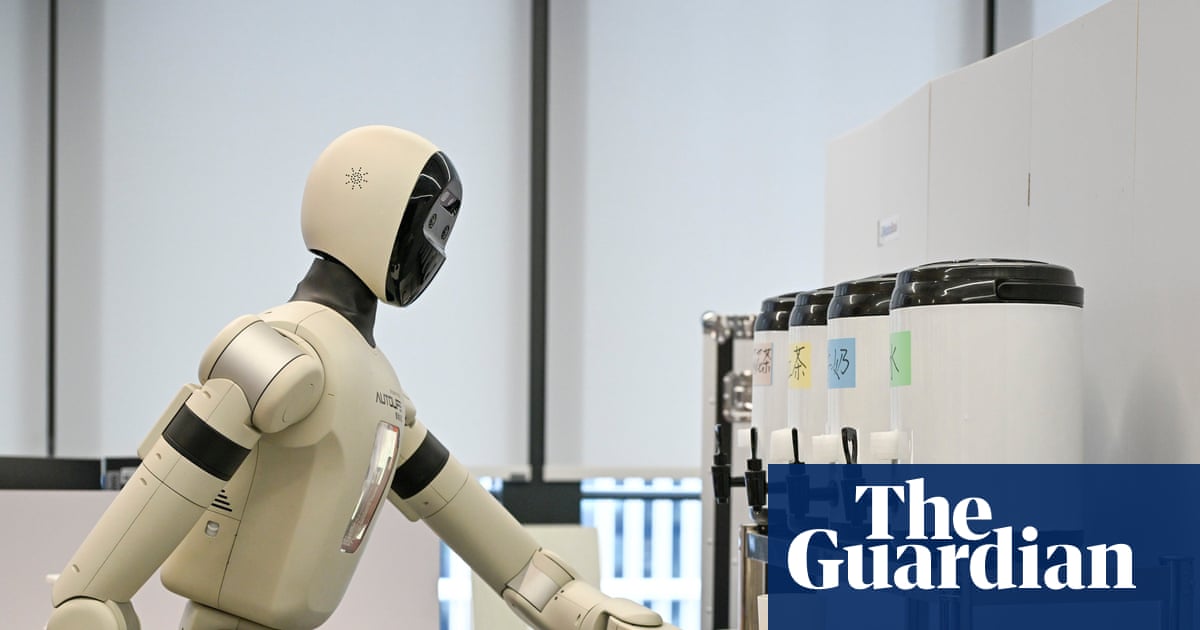
China’s massive AI rollout - podcast
The Guardian podcast features senior China correspondent Amy Hawkins discussing China's widespread embrace of AI technology. Unlike the skepticism seen in the West, China has fully integrated AI across many sectors, including medical avatars where millions of users consult AI doctors, intelligent robots in factories, and drones delivering food even on the Great Wall of China. The podcast also addresses how the Chinese state has eagerly adopted AI, particularly for surveillance purposes, highlighting both the technological advancements and the implications of such pervasive AI deployment.
Why it matters
This podcast touches on a critically important geopolitical and technological topic. China's rapid and enthusiastic AI adoption across civilian and state sectors presents a stark contrast to the more cautious Western approach, and this divergence will likely have significant implications for global AI development, competition, and governance. The mention of state surveillance is particularly noteworthy, as it raises serious concerns about civil liberties and the potential for AI to be used as a…
Guardian AI

Christopher Nolan says people ‘disdain’ AI and the idea it will replace humans is ‘nonsense’
Christopher Nolan, while promoting his latest film 'Odyssey,' stated that the idea of AI replacing humans in filmmaking is 'nonsense' and that many people 'disdain' the technology. He expressed confidence that big-budget action films shot on location would survive the spread of AI. He also dismissed rightwing criticism of Lupita Nyong'o being cast as Helen of Troy as 'irrelevant.'
Why it matters
Nolan's perspective on AI is understandable given his well-known preference for practical effects and in-camera filmmaking, but his dismissal may be somewhat oversimplified. While AI is unlikely to fully replace the creative vision and human artistry behind major films, it is already transforming many aspects of the industry, from visual effects to scriptwriting assistance. His confidence in the resilience of his style of filmmaking is warranted, but the broader industry impact of AI deserves m…
From X/Twitter
- Ramp cofounder Eric Glyman argues there's a distorted reality around AI — and says air conditioning explains why you should build anyway.
- Andrew Ng says 100% of his tasks are done by AI agents and believes prompting will be gone within 3–6 months.
- Anthropic engineer explains how to build AI agents that prompt themselves, remember past work, and improve with every run.
- Anthropic's new doc on loop engineering defines four autonomy levels — from turn-based at 25% to fully hands-off while you sleep.
- Elvis Saravia open-sourced the prompt engineering guide that 76K devs learned LLM prompting from — zero-shot to advanced, all free.
- Mason James compared Codex, Claude Code, Pi, Amp, and Hermes across the design choices that make coding agents trustworthy.
From Reddit/HN/YC
- [Hacker News] LLM-mock lets you record and replay OpenAI/Anthropic calls in pytest — deterministic LLM tests without burning tokens.
- [Hacker News] Benchmarking TLS handshake performance across 4 cryptography libraries — the gaps are wider than you'd think.
- [Hacker News] An agent framework where the entire agent is just one file — no scaffolding, no framework bloat.
- [Hacker News] Debian hands Bookworm security support over to the LTS team — end-of-era for the current stable release.
- [Hacker News] Xbox CEO Asha Sharma, who just laid off 3,200 employees, tapped by the Fed to lead a task force on jobs.