Business, Deals & Funding
NY Times
Can Democrats Harness the Data Center Backlash?
David Wallace-Wells and Robinson Meyer discuss the growing coalition of Americans opposing data centers and whether Democrats can politically harness this backlash, comparing its potential to movements like Occupy Wall Street or the Tea Party.
Why it matters
The article appears to be an opinion/discussion piece exploring the political dimensions of anti-data center sentiment in the US. It frames the backlash against AI data centers as a potentially significant political movement that Democrats might capitalize on, drawing parallels to past grassroots movements. The framing suggests the authors see real political energy in this issue but are debating whether it can be effectively organized and channeled into lasting political power.
The Rundown AI
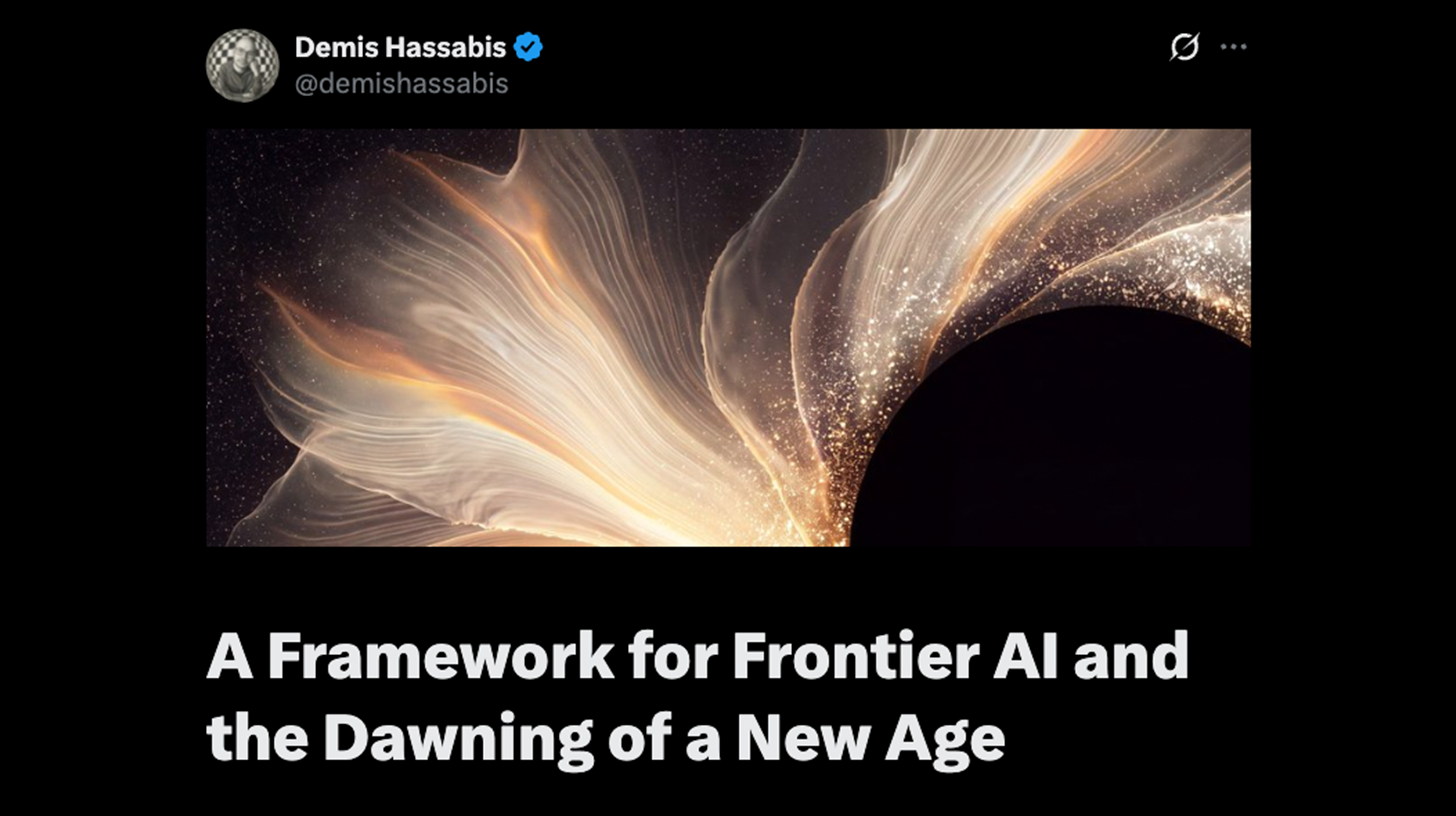
Demis Hassabis puts a clock on AI oversight
Google DeepMind CEO Demis Hassabis has published a proposal for a U.S.-led independent body that would safety-test advanced AI models before public release, modeled after FINRA (the financial industry's self-regulatory organization). The proposed body would screen frontier models for dangerous capabilities such as deception, bioweapons creation, and malicious hacking, with labs voluntarily submitting models for review 30 days before release. Hassabis wants the body operational before the end of 2026, warning that open-source AI capabilities could enter dangerous territory within 18 months. The proposal comes after the U.S. government's improvised handling of a recent Mythos and Fable AI ban. The article also covers reports that OpenAI's first hardware device, designed by Jony Ive, will be a screen-free AI speaker with cameras and sensors, facing an Apple trade-secrets lawsuit ahead of a…
Why it matters
Hassabis's proposal is the most concrete AI oversight framework to come from a major lab leader, and the urgency he attaches — operational this year, with a stated 18-month window before open-source models could become dangerous — signals genuine concern rather than mere positioning. However, the fundamental tension is glaring: a self-regulatory body funded by the very labs it oversees, answerable to a government that has already demonstrated it will use AI regulation powers opportunistically,…
Claude Code Changelog
v2.1.209
This patch release (v2.1.209) fixes a bug where the /model command and other dialog interfaces were being blocked in `claude agents` background sessions. The fix reverts an overly broad guard that was preventing these dialogs from functioning properly in background agent sessions.
Why it matters
This is a straightforward bugfix release that addresses a regression caused by an overly broad guard condition. It's a minor but important fix for users running Claude agents in background sessions, as being unable to switch models or interact with dialogs would significantly hamper usability. The fact that it's a revert suggests the original guard was well-intentioned but had unintended side effects that weren't caught before release.
Claude Code Changelog
v2.1.210
Version 2.1.210 of Claude Code adds a live elapsed-time counter to collapsed tool summary lines so long-running tool calls visibly tick instead of appearing stuck. It adds startup warnings for deprecated permission rules (Write, NotebookEdit, Glob) recommending Edit or Read instead. It fixes a bug where 'isolation: worktree' subagents could run git-mutating commands against the main repo instead of their isolated worktree. It also fixes the 'ultracode' keyword opt-in incorrectly firing on non-human-originated input (the changelog entry appears truncated).
Why it matters
This is a solid incremental release with meaningful quality-of-life and correctness improvements. The elapsed-time counter is a nice UX touch that addresses a real user frustration with long-running operations appearing frozen. The worktree isolation fix is important for security and correctness — subagents escaping their sandbox to mutate the main repo is a significant bug. The deprecation warnings for permission rules show good forward-thinking API hygiene. Overall a well-focused maintenance…
NY Times
China’s Chip Champion to Raise Billions in Race for A.I. Control
CXMT, a key player in China's effort to develop domestic AI technology, is planning to raise nearly $10 billion through a major IPO in Shanghai, as part of China's broader push for semiconductor self-sufficiency and AI competitiveness.
Why it matters
This massive IPO underscores the intensifying global race for AI and semiconductor dominance. China's determination to build a self-reliant chip industry, despite U.S. export controls, is clearly accelerating. A $10 billion raise would be a significant milestone, signaling strong state and investor backing. However, the real test will be whether CXMT can deliver chips competitive with leading-edge Western and Asian manufacturers. This move will likely further escalate geopolitical tensions arou…
Guardian AI

‘Not up for grabs’: Albanese establishes AI office and vows to protect Australian creatives from copyright ‘theft’
Australian Prime Minister Anthony Albanese has announced the establishment of an Office of AI and pledged strong protections for Australian creatives against unauthorized use of their work by AI models. He characterized the use of creative works without consent or compensation as 'theft,' vowing that Australian content is 'not up for grabs' for tech companies. The plan also includes a framework for datacentre development while rejecting the idea that tech companies should have free access to Australian creative content for AI training purposes.
Why it matters
This is a significant and commendable policy stance that prioritizes the rights of creators in the AI era. Albanese's framing of unauthorized AI training on creative works as 'theft' sends a strong signal and aligns Australia with growing global sentiment that AI companies should not be able to freely exploit copyrighted material. Establishing a dedicated Office of AI suggests a serious, structured approach to governance rather than ad hoc regulation. However, the real test will be in the imple…
Guardian AI
Once again we are told AI may be conscious – I study consciousness, and I have my doubts | Anil Seth
Anil Seth, a consciousness researcher, responds to claims by Anthropic that their AI Claude may be conscious. He expresses skepticism, arguing that AI systems like Claude are no more likely to achieve genuine sentience than a weather simulation is to produce a real hurricane. The article situates the debate within the long history of human fascination with creating artificial minds, while maintaining that current AI, despite impressive capabilities, falls short of true consciousness.
Why it matters
Seth's skepticism appears well-grounded in the distinction between simulating a process and instantiating it. The weather simulation analogy is particularly apt—just as modeling atmospheric dynamics doesn't create actual storms, modeling language and reasoning patterns doesn't necessarily create subjective experience. However, the article's full argument is truncated, so it's hard to evaluate the completeness of his reasoning. The consciousness debate around AI is genuinely difficult because we…
Guardian AI

I investigated Palantir’s foothold in the British state – and what I found should worry us all | Peter Geoghegan
The article by Peter Geoghegan investigates Palantir's growing presence within the British state, particularly its controversial £330m NHS contract. It highlights how paid-for political access and weak regulations have helped embed the US defense and surveillance tech company in UK public services. The piece is set against the backdrop of Andy Burnham becoming prime minister and facing decisions about Palantir's role. Geoghegan argues that the company's deep integration into British public infrastructure should be a cause for concern and suggests there are ways to disentangle from this dependency.
Why it matters
This article raises important and legitimate concerns about the outsourcing of critical public infrastructure to a private US defense and surveillance company. Palantir's deep ties to intelligence agencies and its opaque business practices make its embedding in the NHS and other British public services genuinely worrying from both a data privacy and sovereignty perspective. The point about paid-for political access enabling these contracts is particularly troubling, as it suggests democratic ac…
From X/Twitter
- Eric Osiu tested GPT-5.6 Sol against Claude Fable 5 on YouTube thumbnails — Sol crushes it in one pass, and the bottleneck is now taste, not skill.
- Bloomberg's Mark Gurman reports Apple is building an M7 Ultra chip designed to run AI models locally — the laptop selling point is shifting from display to on-device inference.
- Hiten Shah makes the case that seat-based pricing is dying — value is reorganizing around where it accumulates in the stack, not around headcount.
- An Anthropic engineer says they cut agent costs from $90 on Opus to $20 — Sonnet 5 hits Opus-class coding at one-quarter the price.
- Google Voice gets a Gemini upgrade: it can now record calls, transcribe, summarize, and pull action items automatically.
- Workspaces interviewed 500+ creators and broke down 3,795 items across their setups — full report is free.
From Reddit/HN/YC
- [Hacker News] HN asks how people are actually productive with GPT 5.6 Sol — workflows, not hype.
- [Hacker News] ASML's Q2 2026 results hint at what's real and what's froth — what the numbers tell us about the AI boom.
- [Hacker News] Marketing in the age of slop — HN asks how you cut through when everything looks AI-generated.
- [Hacker News] Python 3.15 adds an ultra-low-overhead interpreter profiling mode that finally makes tracing cheap enough to leave on.
- [Hacker News] Rekal makes the case that Git is the memory layer the AI development lifecycle has been missing.
- [Hacker News] America pays workers just 27% of what its wealth allows — dead last in the OECD.