Business, Deals & Funding
The Rundown AI
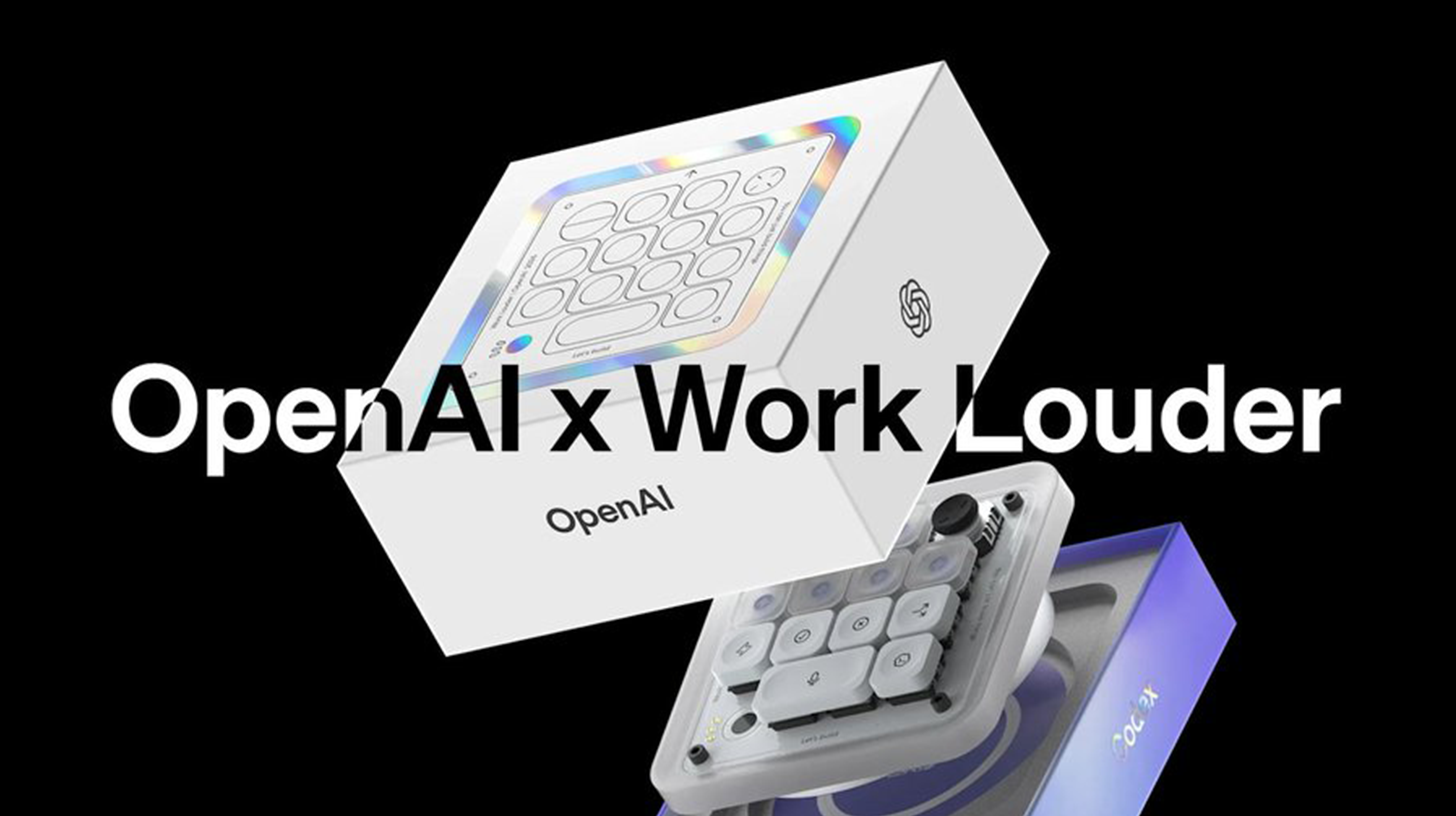
OpenAI’s new $230 AI agent control pad
OpenAI launched its first branded hardware product, the Codex Micro, a $230 mechanical keypad built with Work Louder designed to control AI coding agents. The device features color-coded 'Agent Keys' that flag task statuses, a joystick for toggling between jobs like code reviews and debugging, a dial for adjusting reasoning levels, and command keys for accept/reject actions. It comes in 'Clicky' and 'Silent' versions with a 32-icon relabeling set. This is separate from the reported Jony Ive-led smart speaker hardware line and is sold through OpenAI's merch section. The article also covers Mira Murati's Thinking Machines Lab releasing Inkling, its first open-weights multimodal model focused on customizability rather than benchmark performance, and a guide on using Manus AI for LinkedIn content creation.
Why it matters
The Codex Micro is an interesting but niche product that feels more like branded merchandise than a serious hardware strategy. At $230 for a specialized keypad that controls coding agents, it targets a very narrow audience of power-user developers who are deeply embedded in OpenAI's Codex ecosystem. The timing is notable given Apple's lawsuit and the upcoming Jony Ive device, but this product itself isn't particularly consequential. It does, however, signal that OpenAI is thinking about the phy…
Claude Code Changelog
v2.1.211
Version 2.1.211 of Claude Code includes a new flag for forwarding subagent text in stream-json output, fixes for permission preview security issues involving bidirectional-override and special characters that could visually alter approval messages, fixes for auto mode incorrectly overriding PreToolUse hook 'ask' decisions for unsandboxed Bash commands, and fixes for parallel operations (text appears truncated).
Why it matters
This is a meaningful patch release with important security fixes. The permission preview fix addressing bidirectional-override and zero-width characters is particularly notable as it prevents potential visual spoofing attacks in approval messages. The fix for auto mode respecting hook 'ask' decisions is also significant for users relying on hooks for safety controls. The new forward-subagent-text flag adds useful functionality for programmatic consumers. The changelog entry appears truncated, s…
Guardian AI

The social media ban sceptic: are we getting it wrong on kids, tech and mental health?
Psychologist Candice Odgers, who has studied adolescent mental health for 25 years, challenges the prevailing narrative around social media bans for children. She argues that the current debate around smartphones and tech obscures larger issues affecting teenagers, including the impact of Covid and the mental health of their adult caregivers. Odgers provocatively suggests that making the internet safer for children would be better achieved by removing adult men—the biggest perpetrators of sextortion and misinformation—rather than banning kids from platforms.
Why it matters
This article raises an important and often overlooked counterpoint in the heated debate over youth social media use. Odgers' perspective is valuable because it redirects attention from simplistic bans toward the structural and systemic factors—such as pandemic fallout, caregiver mental health, and adult online behavior—that more significantly impact adolescent wellbeing. Her provocative suggestion about adult men highlights how the discourse tends to place responsibility on children rather than…
Guardian AI

Robots, AI and drones: how the Dutch navy is using tech to transform its sea defences
The article discusses how the Royal Netherlands Navy is integrating uncrewed systems, artificial intelligence, and drone technology into its sea defense operations. Captain Sjoerd Feenstra, head of the expertise centre for unmanned systems, is leading efforts to deploy autonomous vessels like Defender 1 and Defender 2, which serve as surveillance and monitoring platforms without crew onboard. The initiative aims to keep personnel out of danger zones while enhancing naval capabilities, positioning the Netherlands as a leader in military unmanned systems technology.
Why it matters
This article highlights an important and inevitable trend in modern military operations: the shift toward autonomous and unmanned systems. The Dutch navy's proactive approach to integrating these technologies seems strategically sound, as it can reduce risk to human life while potentially expanding operational capabilities. However, the article raises broader questions about the ethics and accountability of autonomous military systems, the potential for escalation in arms races involving AI-dri…
TechCrunch AI

Applied Computing wants to give oil and gas operators an AI model for the entire plant
Applied Computing, a London-based startup founded in 2023, has raised a $20 million Series A led by engineering giant KBR with Databricks Ventures participating. The company is building a foundation AI model called Orbital for the oil, gas, and petrochemical industry. Orbital combines time series, physics-based, and language models to predict facility states by analyzing sensor readings, physics/chemistry constraints, and equipment parameters in real time. The startup claims facilities currently use less than 8% of available data for operating decisions, and Orbital can compress investigations from days or weeks into seconds. Applied Computing reports reaching double-digit millions in annual recurring revenue within 18 months of leaving stealth. Partners include Wipro and KBR, which has integrated Orbital into its INSITE 3.0 digital platform. The company competes with established player…
Why it matters
This is a compelling startup tackling a genuine pain point in industrial operations. The combination of time series, physics-based, and language models into a unified foundation model is a smart architectural choice that differentiates it from both traditional simulation software and generic AI tools. The revenue traction — double-digit millions in ARR in under 18 months — is impressive and suggests real product-market fit. KBR leading the round as a strategic investor adds credibility and prov…
Guardian AI

Will the new AI roadmap keep the tech giants in line? | Fiona Katauskas
This Guardian article features a political cartoon by Fiona Katauskas commenting on a new AI roadmap and whether it will effectively regulate tech giants or if they will chart their own course. The cartoon is tagged under the topics of datacentres and AI (artificial intelligence). The article itself is primarily visual commentary with minimal text beyond the headline question.
Why it matters
The cartoon's framing — asking whether the AI roadmap will 'keep the tech giants in line' or if they'll 'forge a path of their own' — strongly implies skepticism that regulatory efforts will successfully constrain major technology companies. The use of a political cartoon format suggests a critical, satirical stance toward both the adequacy of government AI regulation and the willingness of tech giants to comply with oversight measures.
Guardian AI

Anthony Albanese’s AI vision scores high on vibes but the devil will be in the detail. And there is one glaring omission … | David Pocock
David Pocock critiques Prime Minister Anthony Albanese's AI vision speech delivered at the University of Sydney, noting it was high on rhetoric but lacked policy detail. The article highlights concerns about ambiguity in proposed laws for 'next generation of large-scale datacentres' and notes calls for a datacentre moratorium until new regulations are established. Pocock identifies a glaring omission in the plan, though the full article content is truncated.
Why it matters
The author, Senator David Pocock, is critical of Albanese's AI announcement, viewing it as heavy on aspirational language ('vibes') but insufficient on concrete policy specifics. Pocock appears skeptical about the government's approach, particularly regarding datacentre regulation, and seems to advocate for stronger, more detailed regulatory frameworks before proceeding with AI infrastructure expansion.
TechCrunch AI

Microsoft is reportedly training salespeople to talk down OpenAI and Anthropic
Microsoft is reportedly training its sales team to negatively compare AI products from OpenAI, Google, and Anthropic to its own in-house models, emphasizing efficiency and cost-effectiveness. At an internal strategy meeting, executives pitched Microsoft as offering a 'full end-to-end system' versus competitors selling 'parts.' Executive VP Jacob Andreou directly compared Copilot to Anthropic's Claude, calling it 'slower and less accurate' with lacking security integrations. This follows reports that Microsoft has been replacing OpenAI's and Anthropic's models in flagship apps like Word and Excel with its own models to cut costs. The shift is notable given Microsoft's long-standing partnership with OpenAI, which was amended in April to drop exclusivity clauses. The competitive positioning appears aimed at addressing investor concerns about Microsoft's massive AI spending and demonstratin…
Why it matters
This is a significant but entirely predictable development in the AI industry's maturation. Microsoft investing billions in OpenAI while simultaneously building competing in-house models was always going to lead to this kind of tension. The fact that they're now actively training salespeople to trash-talk their own partner's products signals that the cozy Microsoft-OpenAI relationship is functionally over in all but name. From a competitive standpoint, Microsoft's pitch about being an 'end-to-e…
From X/Twitter
- The HyperFrames team published a prompting guide walking through how to actually get good results from the tool.
- Screenpipe flips the agent-building question: stop describing your workflow to AI and let it watch you work instead. Record, search, build SOPs, deploy agents.
- Daniel Fazio says the biggest AI automation agency mistake is leading with "I can automate your business" — too vague, nobody bites on outbound with a generic pitch.
- Brex is using just-bash deep in their production-critical financial agents, with strong results on cost, latency, and quality.
- PM OS hits version 2.5 — updated every few weeks with new skills to help PMs run experiments more often now that code is essentially free.
- The Claude Code team says we oversimplify agentic engineering — stop rewriting prompts and start giving the model tools instead.
From Reddit/HN/YC
- [Hacker News] UOLT rewrites 34 coreutils in x86_64 assembly — no libc, no heap, just syscalls.
- [Hacker News] Apple is in talks with PrismML, a startup that shrinks AI models up to 15x to run on iPhones.
- [Hacker News] Uber agrees to buy Delivery Hero for $14.8 billion, consolidating the global food delivery market.
- [Hacker News] Atelier is an open-source local AI desktop app designed to keep everything on your machine.
- [Hacker News] LHIC offers deterministic browser automation without an LLM in the fast path — no tokens burned on every click.
- [Hacker News] Spotify says it has removed 75 million "AI slop" songs and is making synthetic tracks easier to detect.