Business, Deals & Funding
Guardian AI
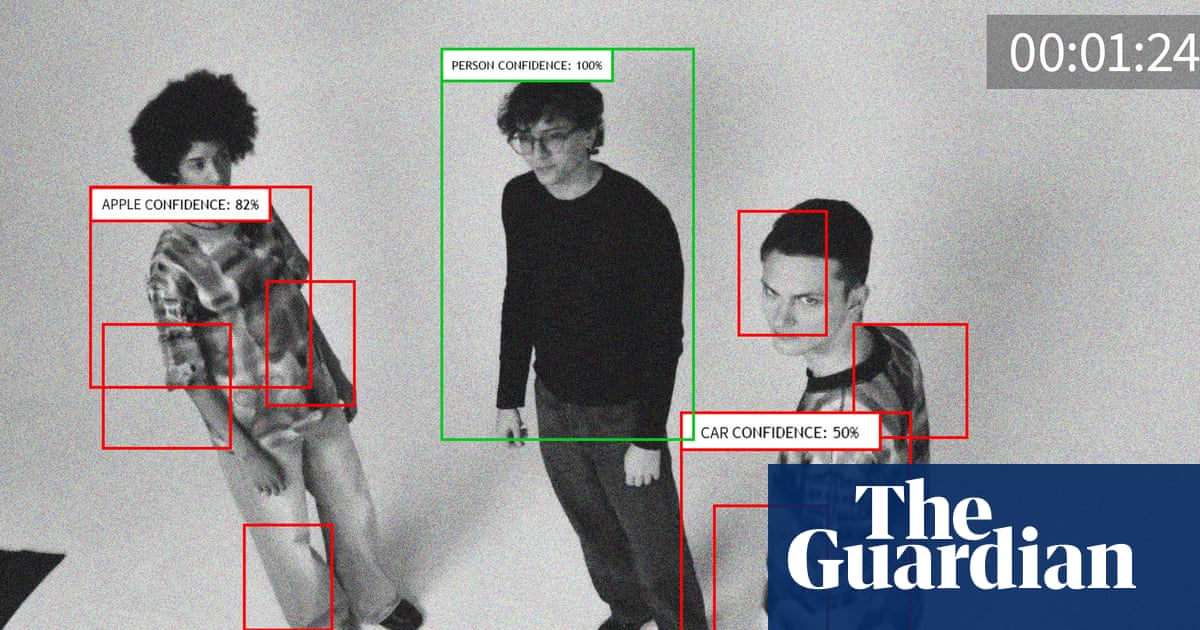
‘Adversarial clothing’: are garments designed to confuse facial recognition systems about to go mainstream?
The article discusses the emerging trend of 'adversarial clothing' – garments designed with specific patterns, shapes, and colors intended to confuse and defeat facial recognition surveillance systems. As facial recognition technology expands across Britain's public spaces, designers are creating these garments that incorporate 'adversarial patterns' exploiting weaknesses in AI recognition systems. The designers frame these clothes as both functional privacy protection tools and fashion statements about the importance of personal privacy in an increasingly surveilled society, suggesting that privacy-focused fashion could become a mainstream trend.
Why it matters
This is a fascinating intersection of technology, fashion, and civil liberties. The concept of adversarial clothing represents a creative grassroots response to the expanding surveillance state, turning everyday garments into tools of resistance. However, I'm skeptical about both the long-term effectiveness and mainstream viability of such clothing. Facial recognition systems are constantly improving, and any specific adversarial pattern that works today could be rendered ineffective by algorit…
The Rundown AI
Moonshot’s Kimi K3 closes the frontier gap
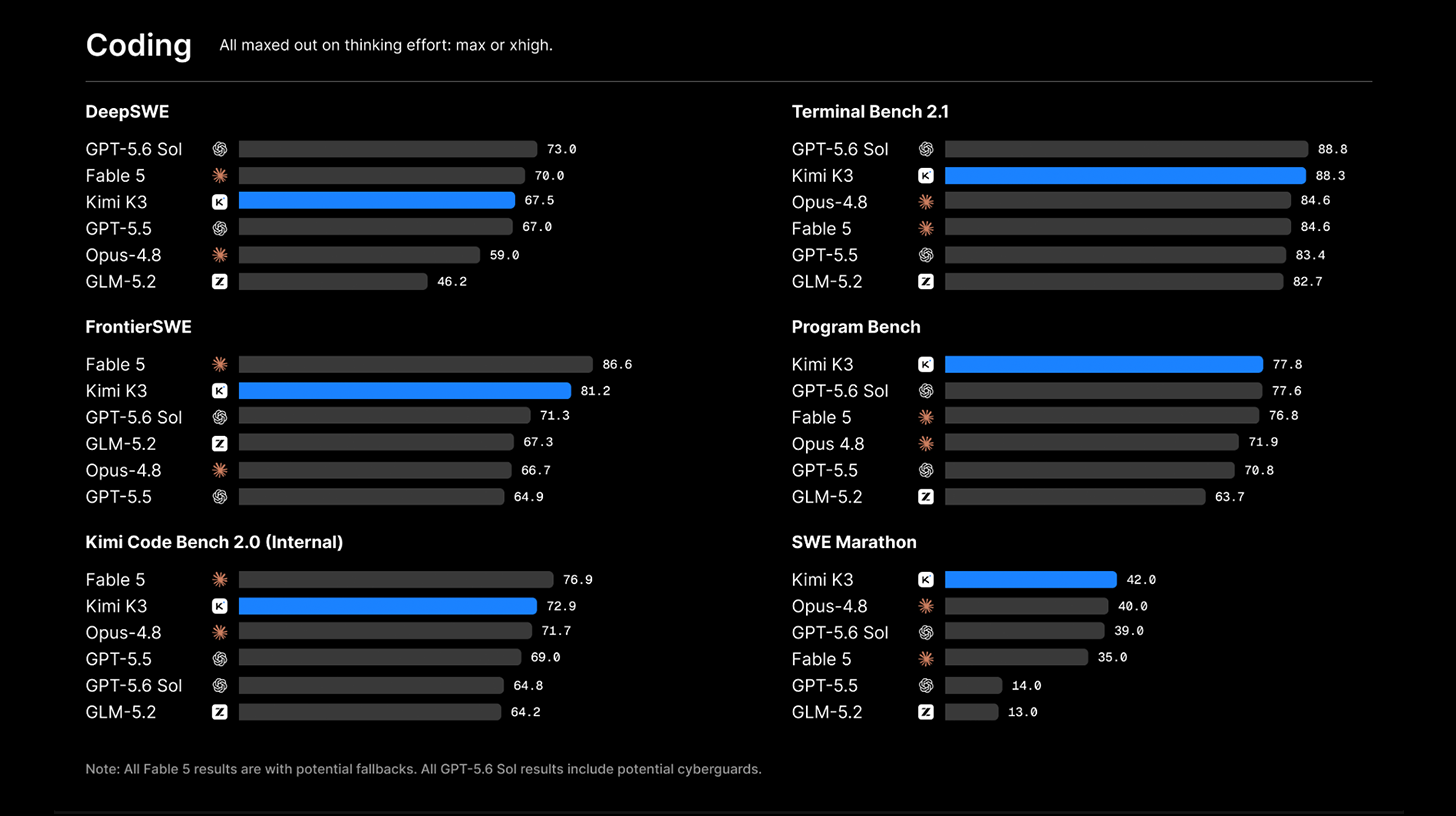
Chinese AI lab Moonshot AI has released Kimi K3, an open-weights model that closely rivals frontier models Claude Fable 5 and GPT-5.6 Sol on benchmarks, scoring 57 on AA's Intelligence Index compared to Fable's 60 and Sol's 59. K3 features a 1M context window, beats both frontier models on specific tasks like web research, spreadsheet work, frontend design, and long coding, and is priced at $3/$15 per million tokens. The model's weights will be published by July 27, 2025. In a demo, K3 autonomously worked for 48 hours to design and verify a chip capable of running a mini version of itself. The article frames this as a potential 'DeepSeek moment' for 2026, challenging Dario Amodei's estimate that Chinese and open-source AI trails frontier labs by 6-12 months. The article also covers Rowan Cheung's concept of 'AI intuition' — knowing when to use AI and when not to — as the most important…
Why it matters
This is a significant development if the benchmarks hold up in real-world usage. The pattern of Chinese open-source/open-weight models rapidly closing the gap with Western frontier labs continues to accelerate, following the trajectory set by DeepSeek. The fact that K3 beats Fable 5 and Sol on specific practical tasks while being open-weight and competitively priced undermines the narrative that frontier capability requires massive closed-lab resources. However, benchmark performance should alw…
MIT Tech Review AI

The risk of weather data sabotage is rising
The article discusses the growing risk of weather data sabotage, driven by the rise of prediction markets and the shift toward AI-based weather forecasting. Weather forecasts underpin critical decisions in agriculture, energy, aviation, and emergency response. Traditional forecasting systems have built-in safeguards like data assimilation that weigh measurements against physical models and nearby stations. However, recent incidents—such as the manipulation of a weather station at Paris Charles de Gaulle Airport in April 2026, where someone used a heat source to create false temperature spikes and profit from prediction market bets—highlight new vulnerabilities. The authors warn that while single-station tampering can often be detected, coordinated subtle manipulation across multiple stations could evade current detection methods. As AI weather models increasingly rely on observational d…
Why it matters
This is a genuinely important and forward-looking piece that identifies a vulnerability most people would never consider. The intersection of prediction markets, AI forecasting, and weather data integrity creates a novel attack surface that deserves serious attention. The CDG airport incident is a perfect illustrative case—someone literally used a hairdryer to win $20,000 on a prediction market, which is both absurd and alarming. The deeper concern about coordinated, subtle manipulation across…
NY Times
Philippines Condemns AI Video Posted by Chinese State Media Depicting It as a Monkey
The Philippines has lodged a diplomatic complaint with Beijing after Chinese state media posted an AI-generated video related to South China Sea territorial disputes that depicted the Philippines as a monkey, which the Philippines condemned as racist.
Why it matters
This incident represents a deeply troubling escalation in the use of AI-generated content for state-level propaganda and racial denigration. Using AI to create dehumanizing depictions of another nation is not only diplomatically reckless but morally reprehensible. It highlights the dangerous intersection of AI technology, state media, and geopolitical tensions. Such content serves no constructive purpose and only inflames racial hostility while undermining any possibility of peaceful dialogue o…
Claude Code Changelog
v2.1.212
Version 2.1.212 of Claude Code introduces several changes: the /fork command now copies conversations into a new background session (visible in 'claude agents') instead of launching an in-session subagent, with the old behavior moved to /subtask. It adds 'claude auto-mode reset' to restore default auto-mode configuration with a confirmation prompt (skippable with --yes). A session-wide limit on WebSearch tool calls was added (default 200, configurable via CLAUDE_CODE_MAX_WEB_SEARCHES_PER_SESSION) to prevent runaway search loops. A per-session cap on subagent spawning was also added, though the changelog text appears truncated.
Why it matters
This is a solid quality-of-life and safety update. The /fork change to background sessions is a meaningful workflow improvement, letting users continue working while a forked conversation runs independently. The web search and subagent caps are sensible guardrails against runaway resource consumption. The auto-mode reset command is a nice convenience feature. Overall, these are practical, well-thought-out improvements that address real usage concerns.
DATAVERSITY Smart Data

Privacy-Preserving Access: The Architecture Behind Enterprise AI Adoption
This article discusses the architectural challenges of enterprise AI adoption, focusing on privacy-preserving access to sensitive data. It argues that the biggest barrier to AI adoption is not model capability but trust, and that data masking is a mature mechanism to bridge the gap between AI capability and enterprise governance requirements. The piece covers the shift from AI answering questions to initiating actions, the structural conflicts between security/governance/privacy/legal teams that block AI access to production data, and the role of the Model Context Protocol (MCP) as an integration pattern. Key takeaways emphasize that privacy-preserving controls are strategic enablers rather than compliance afterthoughts, and that AI-assisted stewardship should separate recommendations from execution through policy, workflow, validation, and audit layers.
Why it matters
The article addresses a genuinely important and timely topic — the tension between AI's need for data access and enterprise privacy/governance requirements. The framing of trust as the primary barrier rather than model capability is insightful and well-articulated. However, the article reads more like a thought leadership piece or vendor-adjacent positioning than a deep technical architecture guide. The content available is mostly high-level framing with limited concrete architectural detail, i…
Guardian AI

Robert Laidlow: Reality Eaters album review
This review covers Robert Laidlow's debut NMC album 'Reality Eaters,' featuring ambitious orchestral works performed by the BBC Philharmonic, Havlat, Kaziboni, and the Piatti Quartet. The album draws on subjects like Einstein's field equations, Newton's universal law, and artificial intelligence. The review highlights Laidlow's ability to bridge science/technology and classical music, describing his work as intricate and wildly imaginative yet approachable despite complex core concepts. The album includes 'Warp,' a 12-minute piano concerto.
Why it matters
The reviewer is clearly impressed by Laidlow's work, praising it as ambitious, intricate, and wildly imaginative while remaining eminently approachable. The tone is enthusiastic and admiring, suggesting this is a strong and noteworthy debut album that successfully translates complex scientific and technological concepts into compelling orchestral music.
Guardian AI

‘There’s this deep mystery of what, actually, is this thing?’: the philosopher inside Google DeepMind AI – podcast
This Guardian podcast features a long-read article about Iason Gabriel, a philosopher who has worked at Google DeepMind since 2017, attempting to anticipate and think through the ethical and societal impact of artificial intelligence. The piece explores the fundamental mystery of what AI actually is and questions whether ethicists embedded within major tech companies can make a meaningful difference as commercial pressures and geopolitical competition around AI continue to intensify.
Why it matters
This is an important and timely topic — the role of in-house ethicists at major AI companies is one of the most consequential questions in tech governance today. The framing around whether philosophers can actually influence corporate AI development is compelling, especially given the well-documented pattern of ethics teams being sidelined or disbanded at major tech firms when their recommendations conflict with business objectives. The piece seems to take a thoughtful, nuanced approach rather…
From X/Twitter
- Marc Andreessen calls something ultra amazing — link dropped with zero context, peak cryptic VC energy.
From Reddit/HN/YC
- [Hacker News] A triple-threaded x86-64 assembly static HTTP server called Deadwire, because sometimes you just want to write raw asm.
- [Hacker News] Trump's teleprompter aide reportedly made $100k betting on what Trump would say during speeches.
- [Hacker News] Tony Alicea makes the case that AI-assisted development causes single-mode burnout — and explains why it's more exhausting than it should be.
- [Hacker News] Velyr validates LLM code edits without running the code, using static analysis to catch errors before they ship.
- [Hacker News] One developer replaced 10 years of Keyboard Maestro with a single Lua script.
- [Hacker News] A dev argues JavaScript sucks and walks through building with Vite and Gleam as the alternative stack.