Business, Deals & Funding
Guardian AI

AI can fuel biological weapons. We must harness its power for defense | Annie Jacobsen
Annie Jacobsen argues that AI is transforming biological sciences in two opposing directions: it can enable bad actors to create biological weapons recipes, but it can also be harnessed to track disease outbreaks and strengthen public health defenses. She calls for urgently developing AI-powered defensive systems to keep pace with the accelerating offensive biological threats that AI enables.
Why it matters
This article raises a critically important and often underappreciated dual-use dilemma of AI in the biological domain. Jacobsen is right to sound the alarm — the democratization of AI-assisted biological design does lower barriers for malicious actors, and the defensive infrastructure needs to keep pace. However, the framing risks oversimplifying a deeply complex issue. Effective biodefense requires not just technological solutions but also international governance, transparency norms, and care…
NY Times
What A.I. Is Actually Doing to the Economy
The article discusses the conflicting data surrounding artificial intelligence's impact on the economy, noting that some evidence suggests AI is causing job losses while other sources indicate the opposite, and explores why it is so difficult to determine the true economic effects of AI.
Why it matters
This appears to be a nuanced exploration of a genuinely complex topic. The difficulty in measuring AI's economic impact is real — traditional labor statistics lag behind technological change, definitions of 'AI-related jobs' vary, and the effects are unevenly distributed across sectors. The framing acknowledges legitimate uncertainty rather than pushing a single narrative, which is commendable. However, the question itself may be somewhat premature or overly binary; AI's effects on the economy…
NY Times
The Fed’s New Chairman Faces His Biggest Test Yet
Federal Reserve Chairman Kevin M. Warsh faces a critical decision on whether to push for an interest-rate increase at the upcoming policy meeting, having previously stated the Fed has 'no tolerance' for elevated inflation.
Why it matters
This article presents a straightforward news report about a significant monetary policy decision facing the Fed chairman. The framing highlights the tension between Warsh's hawkish rhetoric on inflation and the practical challenges of raising interest rates, which could slow economic growth. The piece appears factual and centers on a genuinely consequential policy moment, as interest rate decisions have far-reaching effects on employment, housing, and the broader economy. The characterization o…
The Rundown AI
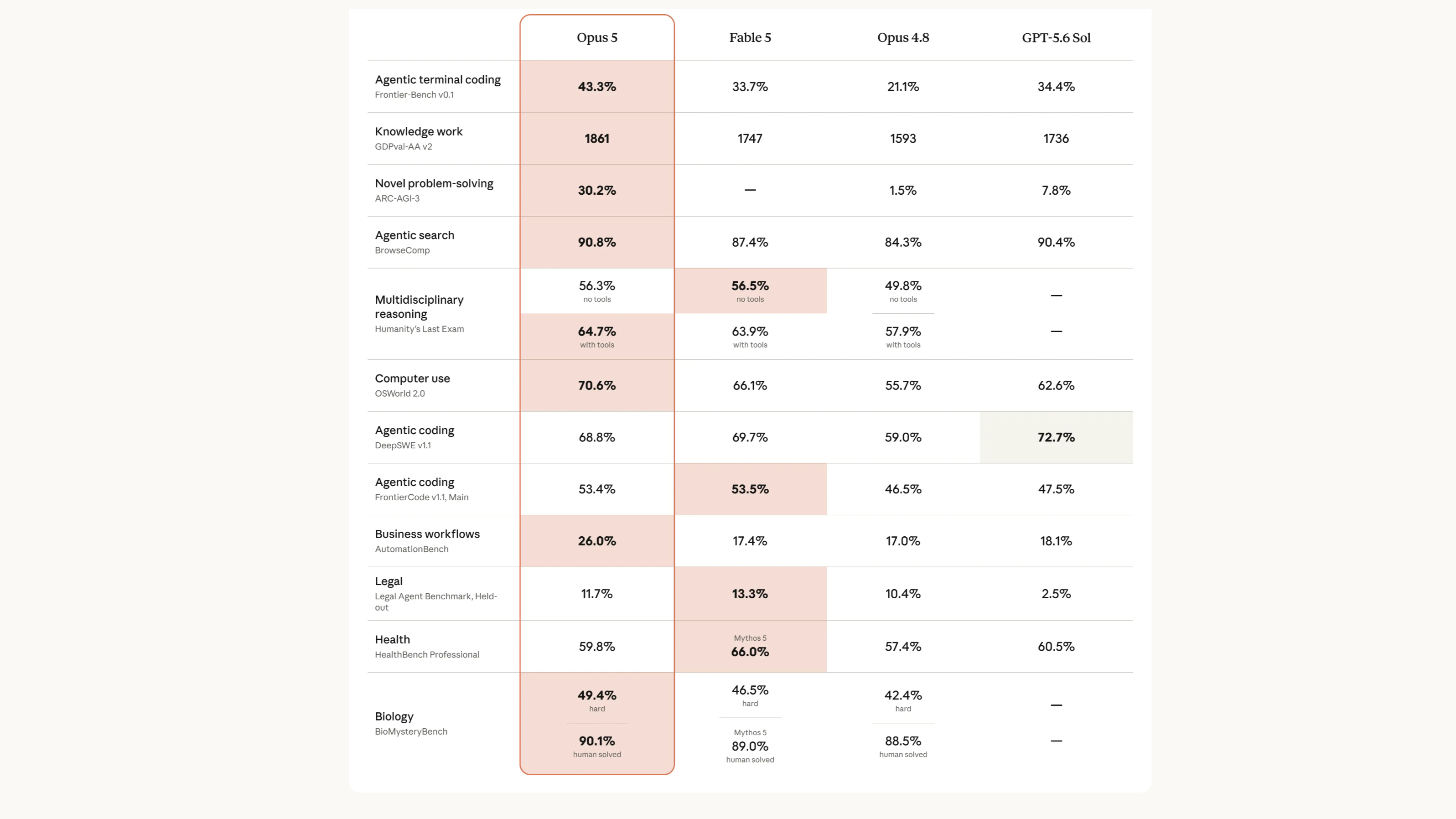
Anthropic's Opus 5 surprise
Anthropic released Claude Opus 5, a new flagship AI model that achieves state-of-the-art results on agentic terminal coding, knowledge work, agentic search, and computer use tasks. It outperforms both Fable 5 and GPT-5.6 Sol on several benchmarks, scored 30.2% on ARC-AGI-3 (3x the next best model), and achieved a perfect 42/42 on the 2026 International Math Olympiad problems. Notably, Opus 5 approaches the intelligence of Anthropic's higher-tier Fable 5 model at half the price ($5/$25 per million tokens, same as Opus 4.8). Anthropic describes it as its most aligned AI, matching Mythos 5 at finding software bugs while staying behind it at writing exploits. The article also covers Claude's 'Record a Skill' automation feature and includes staff anecdotes about AI use cases.
Why it matters
This article is a newsletter-style announcement from The Rundown, dated July 2026, describing a future Anthropic product release that has not yet occurred. The claims about Opus 5's benchmark performance, pricing, and capabilities cannot be verified and appear to be either speculative, fabricated, or from a source that presents projected/fictional future events as news. The references to models like 'Fable 5,' 'GPT-5.6 Sol,' and 'Mythos 5' suggest this content may not be grounded in reality as…
Guardian AI

What If We Got AI Right? by Eleanor Drage review – avoiding apocalypse
The Guardian reviews Eleanor Drage's book 'What If We Got AI Right?', which attempts to provide an ethical guide to living alongside artificial intelligence. Drage, an AI ethicist, argues that humans need to recognize AI's 'humanity' — acknowledging it as a product of human labor in mines, factories, and data centers rather than treating it as something mystical. The reviewer finds the book ambitious but ultimately falling short of delivering the meaningful answers it promises about AI ethics and power dynamics between citizens and tech companies.
Why it matters
The reviewer appears critical of the book, as indicated by the subtitle 'falls short of its promise to provide meaningful answers.' While acknowledging the ambition of Drage's project and the validity of her core argument about recognizing the human labor behind AI, the review suggests the book does not fully deliver on its goals of providing a comprehensive ethical framework for navigating AI's role in society.
Guardian AI

Misleading AI-generated doctors pose ‘huge danger to public safety’
Research reveals that AI-generated doctor personas are accumulating millions of views on TikTok by spreading dubious health advice. The British Medical Association's deputy chair, Dr Emma Runswick, warned that these accounts pose a 'huge danger to public safety' by peddling medical myths and promoting so-called miracle cures. The findings highlight growing concerns about AI-generated content being used to disseminate misleading health information on social media platforms.
Why it matters
This is a deeply concerning development that sits at the intersection of two already problematic trends: health misinformation on social media and the proliferation of convincing AI-generated content. The danger is compounded by the fact that AI-generated personas can appear authoritative and trustworthy, potentially more polished and confident than real doctors, making it harder for viewers to distinguish legitimate medical advice from fabricated nonsense. TikTok's algorithm, which rewards eng…
OpenAI
How AI is expanding what people do at work
New OpenAI research analyzing over 800,000 ChatGPT messages from U.S. workers finds that 43.5% of occupation-specific AI use involves tasks traditionally associated with other occupations, a phenomenon they call 'task crossover.' The study shows workers are expanding beyond their traditional role boundaries—small-business owners draft copy and review contracts, salespeople analyze customer datasets, and marketers troubleshoot websites. Customer experience workers show the highest crossover at 77%, followed by designers (75%), HR workers (69%), legal workers (56%), and marketers (53%). Marketing and engineering tasks travel the farthest, frequently appearing in messages from workers outside those fields. The research also notes more task crossover occurs in small businesses. This is the first report in OpenAI's 'Work at the Frontier' series, which aims to provide data-driven insights on…
Why it matters
This is genuinely interesting research that leverages OpenAI's unique data advantage—direct observation of how people actually use ChatGPT for work. The finding that nearly half of occupation-specific AI use crosses job boundaries is significant and aligns with anecdotal evidence of AI enabling workers to become more self-sufficient generalists. However, there are important caveats worth noting. First, this is OpenAI studying its own product's impact, creating an inherent conflict of interest i…
TechCrunch AI

Are brain waves the next unlock for physical AI?
Encord, a data tooling startup based in San Leandro, California, is expanding beyond managing AI training data to actively manufacturing physical-world training data for robotics companies. The company is experimenting with brain wave sensors built by German neuroscience startup Zander Labs, which measure mental states like error, intent, and surprise during physical tasks, potentially helping robot models determine when to deploy higher-effort processing. Encord's head of robot learning, Vineeth Velmurugan (formerly of OpenAI's robot lab), argues that the real constraint on humanoid and warehouse robotics is the scarcity of real-world physical training data, estimating a dataset roughly five times the size of YouTube's video corpus is needed. The company collects 'egocentric' video from workers wearing cameras at factories globally, uses leader-follower robotic arm rigs, and is trialin…
Why it matters
This is a genuinely fascinating development that highlights how the bottleneck in physical AI has shifted from model architecture to data quality and quantity. The brain wave angle is intriguing but feels very early-stage — the article itself notes it's a trial run, and there's no evidence yet that neural signal tagging actually improves model performance. The broader thesis about data scarcity being the real constraint on robotics is compelling and well-supported by the trajectory of the field…
From X/Twitter
- Study of 544k couples across 29 countries: separation is 36% more likely when women outearn their partners.
- A CS paper makes the case that graph engineering is the missing layer for production AI systems — typed state, explicit nodes, conditional routing, durable checkpoints.
- DHH makes the case that tiny teams can build wildly successful businesses without VC — and you should buy a yellow Lamborghini when you can.
- Riley Brown tested Claude's Excel extension — one Opus 5 prompt researched for 37 minutes and produced an in-depth NVIDIA analysis from public data.
- Jason's take after nonstop use: Fable 5 for big hairy problems, Opus 5 for everything else.
- Corey Haines built a skill that turns one template into a hundred landing pages — finds every "you vs X" query, writes unique copy, deploys, and pings the sitemap.
From Reddit/HN/YC
- [Hacker News] A Python C extension claims to be 100x faster than multiprocessing.Queue for single-producer, single-consumer rings.
- [Hacker News] The surprisingly intense process of building a 50,000-ton forging press.
- [Hacker News] A ground-up walkthrough on building a basic AI agent with security baked in from the start.
- [Hacker News] Your agent isn't dumb — Ahmet Ozisik makes the case that your tools are the real bottleneck.
- [Hacker News] Finance engineering roles account for just 2.6% of open finance-department jobs — smaller than most people assume.
- [Hacker News] Libsm64 packages Mario 64 as a standalone library you can drop into any external game engine.