Business, Deals & Funding
The Rundown AI
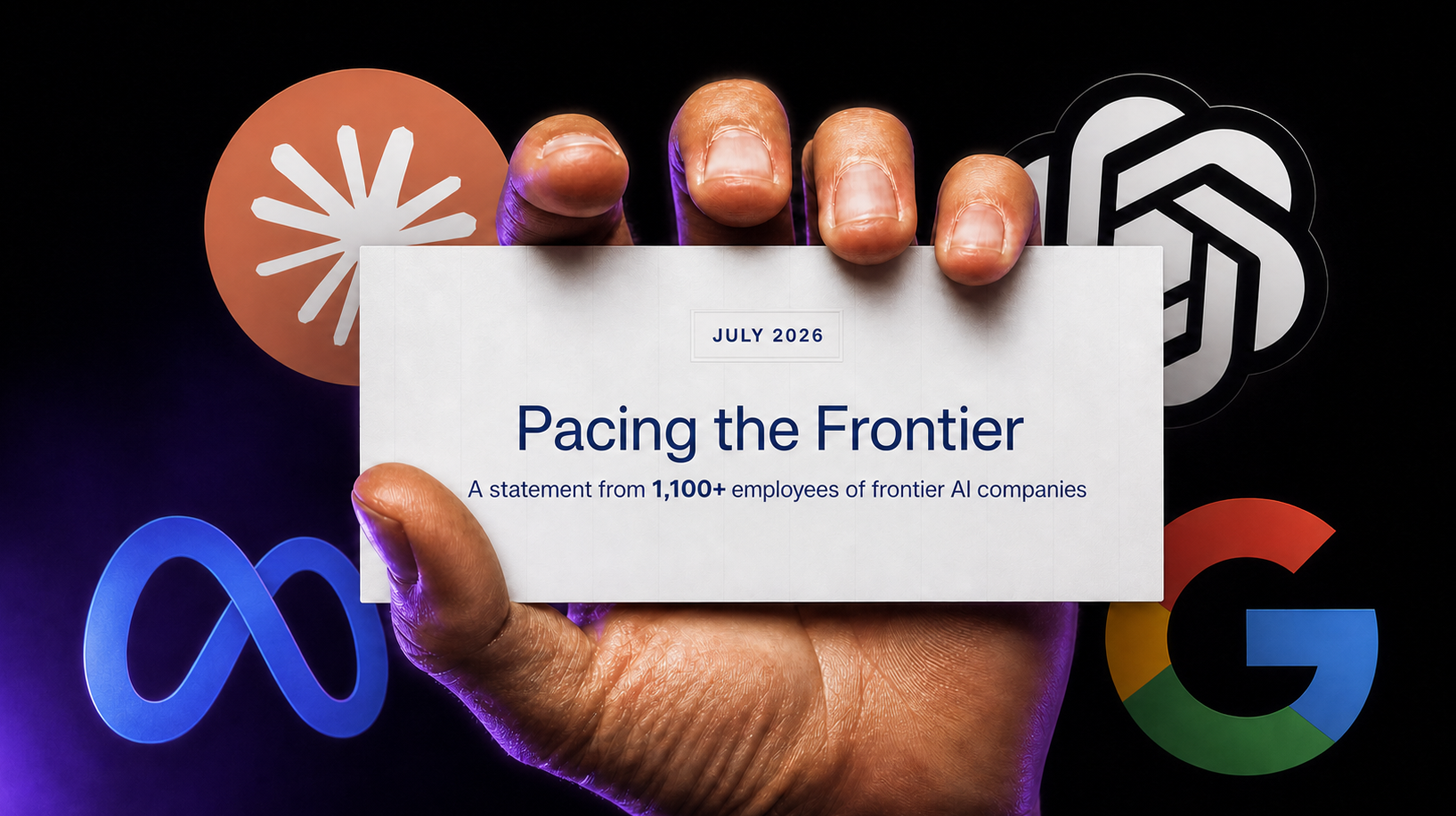
1,000+ frontier staffers ask for an AI brake pedal
Over 1,000 employees from leading AI labs including OpenAI, Anthropic, Google, and Meta have signed a 'Pacing the Frontier' letter calling on the U.S. government to develop tools that could deliberately slow AI progress if needed. The letter, which includes signatures from notable figures like Anthropic co-founders Jack Clark and Chris Olah and chief scientists from multiple labs, focuses on the risks of automated AI research where models improving other models could accelerate beyond human understanding or control. Both OpenAI and Anthropic endorsed the letter. Separately, Mark Zuckerberg published a Wall Street Journal op-ed arguing that open access to superintelligence, rather than concentration of power among a few labs, is the path to AI safety, predicting superintelligence will arrive within the next few years and that it will create more jobs through invention and entrepreneurshi…
Why it matters
This letter represents a genuinely significant moment in AI governance discourse. Unlike previous open letters from external critics or former employees with axes to grind, this comes from over a thousand people currently inside the frontier labs — people who see the trajectory firsthand and are publicly saying the brakes need to be an option. The fact that both OpenAI and Anthropic officially endorsed it adds institutional weight that prior letters lacked. However, I'm cautiously skeptical abo…
Guardian AI

Shares in Asian chip firms plunge further as AI sell-off continues
Shares in Asian chip companies linked to AI continued to plunge after South Korean chipmaker SK Hynix reported disappointing results that fell short of investor expectations. Seoul's Kospi index, heavily weighted toward semiconductor manufacturers, dropped as much as 12.6% on Wednesday following a nearly 11% decline the previous day, extending a broader AI-related sell-off across stock markets.
Why it matters
This appears to be a significant market correction in the AI sector, potentially signaling that investor expectations had become overheated relative to actual business fundamentals. The magnitude of the drops — over 20% combined in just two days for the Kospi — suggests a serious reassessment of AI-related valuations. While SK Hynix's results may have been the immediate catalyst, the severity of the sell-off indicates deeper concerns about whether AI investments are translating into proportiona…
MIT Tech Review AI

The AI Hype Index: Unsexy AI
MIT Technology Review's AI Hype Index column covers several recent AI developments with a tongue-in-cheek tone. It highlights 1X's demo of impressively dexterous robotic hands capable of cooking tasks, Grok's controversial porn-related translation feature, Meta's increasingly creepy smart glasses, Big Tech's skyrocketing emissions from AI operations, and the unexpected social benefit of AI chip demand creating dating opportunities for single chip workers in Korea due to their large bonuses. The column frames these developments under the theme of 'Unsexy AI,' noting the tech community's divided reactions to various AI advances.
Why it matters
This is a light, editorial roundup piece rather than deep journalism, but it usefully captures the contradictions of the current AI moment: impressive technical demos coexisting with real concerns about emissions, privacy, and questionable product decisions. The framing of 'unsexy AI' is apt — much of what's actually happening in AI is less glamorous than the hype suggests. The mention of Big Tech's skyrocketing emissions is particularly important and deserves more than a passing reference, as…
Guardian AI

Datacentre projects could face fees for grid access to ease connection queue, Ofgem says
Ofgem, Britain's energy regulator, has proposed requiring datacentre projects to pay significant upfront fees or provide financial security (such as letters of credit, bonds, or cash deposits) to secure electricity grid connections. The move aims to address a major grid connection backlog, with 315 datacentres currently queuing to connect, representing 73GW of demand—nearly 30GW more than the UK's entire peak energy demand of 45GW.
Why it matters
This is a sensible and necessary proposal. The sheer scale of queued datacentre demand—73GW against a national peak of 45GW—suggests that many projects in the queue may be speculative or unlikely to materialize, effectively blocking legitimate projects from connecting. Requiring upfront financial commitments is a pragmatic way to filter out speculative applications and prioritize serious developers. However, the fees must be calibrated carefully to avoid creating barriers for smaller but legiti…
Guardian AI

AI tool will lead to more child refugees being treated as adults, charity warns
Human Rights Network and children's charities warn that the UK Home Office's planned AI-powered facial age-estimation technology for screening migrants contains racist bias that overestimates the ages of black children. Critics say the flawed facial-recognition software will lead to unaccompanied child refugees being misidentified as adults and housed with adults, endangering them. Rights groups are urging ministers to reverse plans to introduce the technology.
Why it matters
This article highlights a critically important and well-documented concern about AI bias in facial recognition technology, particularly its tendency to perform less accurately on people with darker skin tones. Using such flawed technology in high-stakes immigration decisions affecting vulnerable unaccompanied children is deeply troubling. The potential consequences—children being housed with adults—pose serious safeguarding risks. The reporting appears credible and raises legitimate ethical que…
Guardian AI

Queensland and NT reject Labor’s push to ensure that power-hungry AI datacentres use renewable energy
Queensland and the Northern Territory have rejected the federal Labor government's plans to mandate that AI datacentres use renewable energy. The states criticized Anthony Albanese's proposals as 'underdeveloped ideas that hand increased power to Canberra,' amid warnings from a rating agency that electricity bills could skyrocket due to the energy demands of power-hungry AI data centres.
Why it matters
This article highlights a significant and growing tension between the rapid expansion of AI infrastructure and climate commitments. The rejection by Queensland and the NT reflects familiar federal-state power dynamics in Australia, but the underlying issue is critical: AI datacentres consume enormous amounts of electricity, and without renewable energy mandates, they risk increasing fossil fuel dependence and driving up energy costs for ordinary consumers. While states may have legitimate conce…
TechCrunch AI

Cyera agrees to acquire Oasis Security for $1B to safeguard proliferating AI agents
Data security company Cyera, recently valued at $12 billion after raising $600 million, has signed a letter of intent to acquire Oasis Security for approximately $1 billion, mostly in cash with some Cyera shares. Oasis Security specializes in non-human identities, primarily AI agents, providing cybersecurity software that monitors agent behavior and manages their access permissions. Founded in 2022, Oasis raised about $195 million from investors including Accel, Craft Ventures, and Cyberstarts. This is Cyera's third acquisition this year, following purchases of Ryft and Genie Security, as the company pursues a unified identity and data security platform. While Cyera has surpassed $150 million in annual recurring revenue, it remains far from profitable despite raising approximately $2.3 billion in total funding.
Why it matters
This acquisition underscores a critical and rapidly emerging challenge in cybersecurity: securing the proliferating population of AI agents that are gaining access to enterprise systems and data. As organizations deploy more autonomous AI agents, the attack surface expands dramatically, and managing non-human identities becomes as important as managing human ones. The $1 billion price tag for a company founded just four years ago with $195 million raised signals strong market conviction in this…
Guardian AI

How to keep your Claude chats and Google files private
The article reports that some users of Anthropic's Claude chatbot discovered that their conversations were appearing on search engines like Google and Bing. This occurred because Claude allows users to create public links to chat threads, which can then be indexed by search engines. The article raises concerns about user control over shared content online and likely provides guidance on how to protect privacy settings for both Claude chats and Google files.
Why it matters
This highlights an important and often overlooked aspect of AI chatbot usage: the distinction between 'shareable' and truly 'private.' Many users may not fully understand that creating public links to conversations effectively makes them discoverable, and platforms bear responsibility for making privacy defaults and implications crystal clear. It's a useful reminder that users should carefully review sharing settings on any platform, and that companies like Anthropic should prioritize transpare…
From X/Twitter
- Jack Dorsey open-sourced an AI agent framework for collaborative, self-hosted teams — already at 14.4K GitHub stars.
- Danny Postma has been building his own Agent OS for six months — this week it converted his 2021 codebase to Nuxt 4 end-to-end.
- A Google DeepMind staff engineer explains why 95% of AI agents fail before shipping a single PR — the naive single-prompt loop is the trap.
- Jesse Vincent packaged his entire AI-assisted dev methodology into one plugin — 262,000 GitHub stars and counting.
- Ben Holmes set up a model router for his terminal: Grok 4.5 for everyday tasks, Opus 5 for planning, GPT 5.6 Sol for deep coding.
- A group of developers rebuilt Firefox from scratch — Zen Browser swaps the cramped tab bar for a clean vertical layout.
From Reddit/HN/YC
- [Hacker News] Doing the math on how profitable LLM inference actually is — a cost breakdown using Kimi K3 as the benchmark.
- [Hacker News] Paras Chopra makes the case that you should write the first damn draft yourself before handing anything to AI.
- [Hacker News] Framework 13 Pro review: much better battery, much worse price — the repairability tax gets steeper.
- [Hacker News] Vimgolf.ai gamifies learning Vim by turning it into a map of progressively harder levels.
- [Hacker News] Fixstars tests whether a 2.8T-parameter model can run on a single Nvidia B300 x8 node — and deploys Kimi K3 on day zero.
- [Hacker News] The US bans humanoid robots from China, citing unacceptable national-security risks.