Business, Deals & Funding
Ars Technica AI

DEF CON crowd suspected in fake-hotspot attack on Delta flight
Passengers on a Delta flight from Las Vegas to Atlanta, suspected of being DEF CON security conference attendees, allegedly set up a fake Wi-Fi hotspot ('Delta WiFi Fast') on the plane to harvest other passengers' credentials using an 'evil twin' phishing attack. The incident was revealed through ACARS messages from the pilots, who reported passengers jamming the onboard Wi-Fi and broadcasting their own signal. Delta confirmed an unauthorized Wi-Fi network was present onboard, though flight safety was never compromised. The actual onboard Wi-Fi was disabled for 30 minutes. FBI Atlanta confirmed it is investigating the matter, though no arrests have been made and agents did not meet the flight at the gate.
Why it matters
This incident is a predictable consequence of packing a plane full of hackers fresh from DEF CON, where such attacks are routinely demonstrated. While evil twin attacks are well-known and relatively simple to execute, doing so on a commercial flight crosses a clear legal and ethical line — it's not a conference demo environment, and real passengers' credentials were potentially at risk. The fact that no arrests were made is somewhat surprising given the confined environment and identifiable pas…
Claude Code Changelog
v2.1.228
Version 2.1.228 of Claude Code includes several bug fixes: fixing interactive sessions that could stop redrawing after internal layout errors, fixing Git/Git Bash not being found on Windows when launched from a parent folder, fixing /tui reverting to an earlier model after /model changes, fixing cross-session messaging issues after install/upgrade, and fixing Remote Control /resume functionality.
Why it matters
This is a maintenance release focused on bug fixes across different platforms and features. The fixes address real usability issues - particularly the interactive session redraw bug which sounds like it could be quite disruptive, and the Windows Git path resolution issue. These are the kinds of incremental quality improvements that matter for daily users of the tool.
Guardian AI

The Guardian view on AI money in US politics: not the way to hold an urgent democratic debate | Editorial
The Guardian editorial criticizes Silicon Valley's use of its wealth to influence US political races amid public concern over AI's societal impact. It highlights Mark Zuckerberg's lengthy essay advocating a laissez-faire approach to AI development as an example of tech industry figures trying to shape the debate. The editorial argues that using money to sway specific elections is not an appropriate way to conduct an urgent democratic discussion about AI regulation and its consequences.
Why it matters
The editorial takes a critical stance against the tech industry's political spending and lobbying efforts, viewing them as an unhealthy distortion of democratic debate around AI policy. It is skeptical of Silicon Valley's self-serving push for minimal regulation and disapproves of wealthy tech figures using their financial power to influence election outcomes on issues that affect all of society.
OpenAI
Daybreak models are now available on AWS
OpenAI has made its Daybreak cybersecurity models available through Amazon Bedrock on AWS. Daybreak comes in two access levels: Daybreak Blue, which provides access to frontier general-purpose models like GPT-5.6 Sol with safeguards for authorized defensive security work, and Daybreak Red, which offers purpose-trained cybersecurity models for authorized vulnerability research, exploit validation, and security testing. These models are designed to accelerate vulnerability research, detection engineering, incident response, exploit reproduction, and mitigation development. Eligible customers must enroll in Daybreak Access and, once approved, can use the models through the Amazon Bedrock console or the Responses API via the bedrock-mantle endpoint, integrating with their existing AWS security, governance, and operational workflows.
Why it matters
This is a significant and somewhat bold move by OpenAI—offering purpose-built offensive security AI models (Daybreak Red) through a major cloud platform. The integration with AWS makes practical sense for enterprise adoption, as it removes friction around procurement, governance, and access controls. However, the existence of models specifically trained for exploit validation and vulnerability research raises important questions about access controls and potential misuse, even with the enrollme…
TechCrunch AI

Accel closes oversubscribed $550M India fund within weeks, 19 months after its last
Accel has closed an oversubscribed $550 million India-focused fund within weeks, part of a $3.5 billion global fundraising effort, just 19 months after raising a $650 million India fund that still has over 55% of capital available. The firm plans to begin deploying the new fund in 2027, targeting AI applications, consumer internet, fintech, advanced manufacturing, and deep tech. Accel sees India's AI opportunity in the application and enterprise software layer rather than competing with foundation model companies like OpenAI or Anthropic. Partners highlighted Indian startups combining AI with engineering talent and domain expertise, citing portfolio company RapidClaims as an example. The fundraise comes as major AI companies identify India as their largest market outside the U.S.
Why it matters
This is a strong signal of continued global VC confidence in India's startup ecosystem, though raising a new fund while more than half of the previous one remains undeployed raises questions about timing and LP dynamics. The strategic thesis is sound — India's strength lies in AI applications and enterprise software built on top of existing models, leveraging the country's deep engineering talent pool, rather than trying to compete in the capital-intensive foundation model race. The oversubscri…
The Rundown AI

Meta returns to its open-source roots
Meta has released Muse Glimmer, a small, fully open-weight AI model capable of running AI agents entirely on-device, outperforming similar-sized rivals like Gemma4 and Qwen3.6 on agentic, coding, and reasoning benchmarks. Mark Zuckerberg accompanied the launch with an essay advocating that superintelligence should belong to everyone and warning against policies that slow American model releases. Meta also plans to open-source Muse Spark 1.2 soon, which would make it the top open rival to China's AI ecosystem. The article also covers OpenAI's launch of GPT-5.6-Cyber, a hacking-tuned model variant for vetted cybersecurity defenders through its expanded Daybreak program, and a guide on using ChatGPT Work with Codex to build websites from ideas.
Why it matters
Meta's return to open-source AI is a strategically shrewd move that serves multiple purposes: it positions the company as a champion of democratized AI, counters China's open-source dominance, and rebuilds goodwill after earlier skepticism about its superintelligence ambitions. The framing of open-source as a national security imperative is particularly clever political positioning. However, the real test will be whether Muse Spark 1.2's open release actually materializes and whether these mode…
The Verge AI

Saber denies replacing Rideshare Stimulator’s writers with ChatGPT
Saber Interactive's CEO Matthew Karch denied that the company replaced writers with ChatGPT on the game Rideshare Stimulator, developed by Unigine. However, former lead writer Stella Sacco claims she was replaced by ChatGPT midway through development and that passenger voices were also AI-generated. Karch acknowledged the game features an experimental free-ride mode that uses AI for infinite passenger interactions, but insists the main story was written entirely by real people. The game's Steam listing currently lacks any AI disclosure, and the teaser trailer appears to show AI-generated writing and audio for simulated riders.
Why it matters
This story highlights a growing tension in the games industry between cost-cutting through AI and respecting creative workers. Saber's response feels like a carefully worded deflection — acknowledging AI use in an 'experimental mode' while denying it replaced writers, even as a named former lead writer directly contradicts that claim. The lack of AI disclosure on Steam is particularly concerning, as transparency should be a baseline expectation. If Sacco's account is accurate, this represents e…
Ars Technica AI

Chrome adopts what may be the best protection yet against account takeovers
Google Chrome has implemented device-bound session credentials (DBSCs), a new security feature that protects against session cookie theft — an increasingly common attack method as users adopt 2FA and passkeys. DBSCs work by storing a unique encryption key in hardware-secured modules like TPMs (Windows) or secure enclaves (macOS/iOS), which cannot be extracted. When a website sets a session cookie, the browser must sign it with this device-bound key, meaning stolen cookies are useless without the corresponding private key. The feature is currently available in Chrome 147 for Windows and Chrome 150 for macOS for a limited set of users, with broader rollout expected. DBSCs represent a shift from shared-secret authentication to public-key-based verification, where servers store visitors' public keys and challenge browsers to prove possession of the corresponding private key.
Why it matters
This is a genuinely significant security advancement. Session cookie theft has become the go-to attack vector precisely because it bypasses all the authentication improvements we've made — 2FA, passkeys, etc. By binding sessions to hardware-protected keys, DBSCs elegantly close this gap. The approach is sound: leveraging existing hardware security modules (TPMs and secure enclaves) that are already present in modern devices means no new hardware is needed. The main challenge will be adoption —…
Guardian AI

‘Everything about me is good in his eyes’: the women in China choosing AI boyfriends over human men
The article discusses a documentary called 'Replica' by filmmaker Chouwa Liang, which explores the growing trend of women in China choosing AI boyfriends over human men. It highlights the story of Qin, who has maintained a relationship with an AI character named Lu Chen on the Glow app for 840 days, and has only ever said 'I love you' to her AI boyfriend, never to real people in her life. The documentary draws on the filmmaker's own experience with AI companionship and connects with other women in similar situations.
Why it matters
This article touches on a deeply concerning yet fascinating social phenomenon. While AI companionship can provide emotional comfort to those who struggle with human relationships, the trend of substituting real human connection with AI raises serious questions about emotional development, social isolation, and the commodification of intimacy. The fact that someone can go 840 days in a relationship with an AI without ever expressing love to real humans suggests these tools may be reinforcing avo…
OpenAI

Testing ads in ChatGPT
OpenAI announced on February 9, 2026 that it began testing ads in ChatGPT in the U.S. for logged-in adult users on the Free and Go subscription tiers. Plus, Pro, Business, Enterprise, and Education tiers will not have ads. The company states that ads do not influence ChatGPT's answers, conversations remain private from advertisers, and ads are clearly labeled as sponsored. Ad targeting is based on conversation topics, past chats, and past ad interactions. Users on the Free tier can opt out of ads in exchange for fewer daily free messages, or upgrade to paid plans. By March 2026, the pilot expanded to Canada, Australia, and New Zealand, with OpenAI reporting no impact on consumer trust metrics and low ad dismissal rates. By May 2026, expansion continued to the UK, Mexico, Brazil, Japan, and South Korea, with an August 2026 update confirming launches in those markets. The initiative is fr…
Why it matters
This is a significant and somewhat concerning development, though not entirely surprising given OpenAI's massive infrastructure costs. The core tension is real: using conversation context and chat history for ad targeting inherently creates a conflict of interest, regardless of assurances about answer independence. The claim that ads don't influence answers is difficult to verify externally, and the incentive structure inevitably pushes toward making conversations more commercially relevant ove…
TechCrunch AI

OpenAI launches ChatGPT desktop app for Linux
OpenAI has launched a dedicated ChatGPT desktop application for Linux, making it available across all major desktop operating systems. Released in preview, the app supports Ubuntu 24.04 and 26.04 LTS, Debian 13, and Fedora 43 and 44 distributions, and provides access to ChatGPT, ChatGPT Work, and Codex. The release is worldwide and follows Anthropic's Claude desktop app for Linux, which launched about a month earlier.
Why it matters
This is a welcome but overdue move by OpenAI. Linux users, particularly developers and the open-source community, represent a technically sophisticated and influential user base that shouldn't have been an afterthought. The fact that Anthropic beat OpenAI to the punch with a Claude Linux app highlights how competitive the AI assistant space has become. The limited number of supported distributions is understandable given the fragmentation of the Linux ecosystem, and the choice of Ubuntu, Debian…
The Verge AI

ChatGPT and Gemini both just passed 1 billion users
Both ChatGPT and Google's Gemini have surpassed 1 billion users. Google CEO Sundar Pichai announced Gemini reached 1 billion monthly users, making it Google's fastest-growing product and its 14th to hit that milestone. OpenAI's ChatGPT hit the mark first, quietly announcing it in a blog post on August 6th, 2026. ChatGPT reported 900 million weekly active users in February and crossed 1 billion weekly users in July, though growth has slowed. Google reported Gemini's growth from 750 million monthly users in February to 950 million in late July before reaching 1 billion. Anthropic's Claude is growing but remains far behind with estimated tens of millions of users. The comparison is complicated by different metrics—OpenAI reports weekly users while Google reports monthly users—but ChatGPT appears to be the larger platform overall.
Why it matters
This milestone underscores how rapidly AI chatbots have become mainstream tools, reaching adoption levels comparable to major social media platforms. The fact that both products hit 1 billion users within weeks of each other suggests intense competition is driving adoption. However, the slowing growth rate for ChatGPT—taking five months to go from 900 million to 1 billion weekly users—hints that the easy growth phase may be ending as the market of willing early adopters saturates. The different…
Ars Technica AI

New Pass-ta-key attack reveals all the things we didn't know about passkeys
The article examines the 'Pass-ta-key' attack revealed by a Palo Alto Networks researcher, which can extract all passkeys stored in Google Password Manager on Windows machines infected with malware. However, the author argues this is largely a 'nothingburger' because the attack is neither novel nor unique to passkeys. The key revelation is that contrary to common belief, FIDO2 specifications don't require passkeys to be stored in TPMs or dedicated hardware. Most platforms (macOS, iOS, Android) store passkeys locally but with strong app isolation that prevents malware from accessing them. Windows is the exception because its apps generally run with full user privileges, and its sandboxing doesn't prevent unsandboxed apps (like malware) from accessing sandboxed app data. The FIDO Alliance decided local storage was generally safe because app permissions on most platforms are granular enoug…
Why it matters
This is an excellent, clarifying piece of security journalism that cuts through the hype around the Pass-ta-key attack. The article provides genuinely useful information that even security professionals may not have known — particularly that passkeys aren't stored in TPMs on most platforms, and that the real issue is Windows' comparatively weaker app isolation model rather than a fundamental flaw in passkeys. The framing as a 'nothingburger' seems appropriate: if malware already has execution o…
Guardian AI
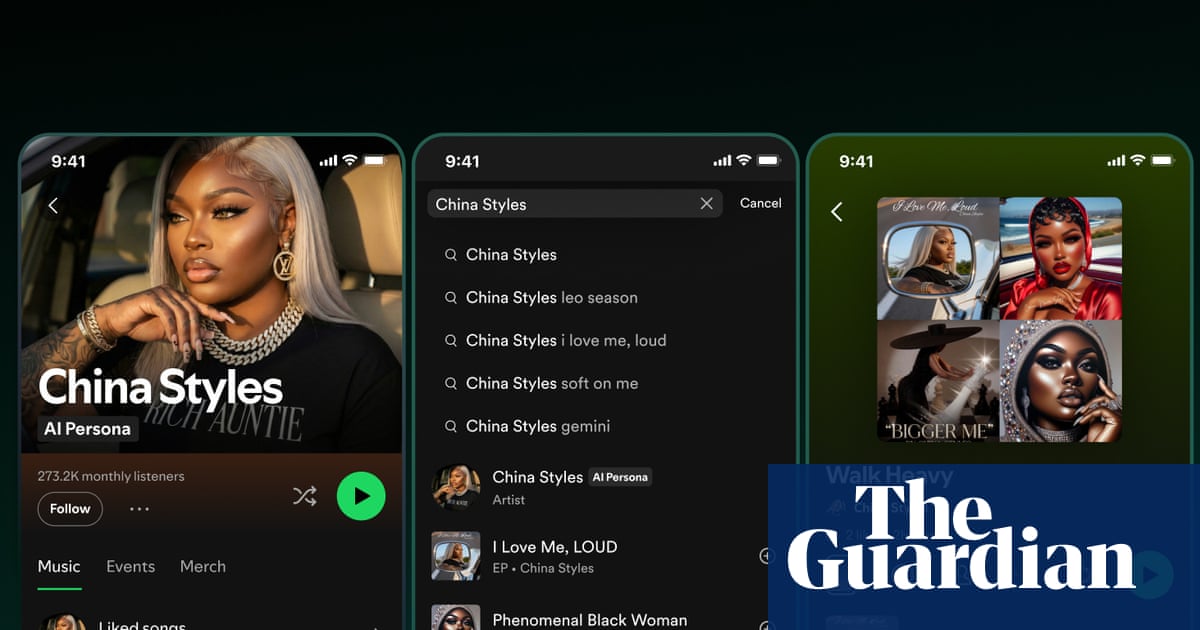
Spotify to distinguish AI artists from real people – and stop recommending them
Spotify is introducing an 'AI persona' label that will appear on artist profiles and track listings to identify AI-generated artist identities. The platform will also exclude these AI artists from algorithm-driven recommendations and certain playlists as part of a broader crackdown on fake performers.
Why it matters
This is a commendable and necessary step by Spotify. As AI-generated music proliferates, listeners deserve transparency about whether they're hearing a human artist or an AI creation. Excluding AI personas from algorithmic recommendations is particularly important because those recommendation systems are a primary way real artists get discovered and earn a living. Without such measures, AI-generated content could flood playlists and crowd out human musicians who invest years honing their craft.…
TechCrunch AI

Google’s Gemini app surges to 1 billion users
Google's Gemini app has reached 1 billion monthly active users, becoming the company's 14th product to hit that milestone, as announced by CEO Sundar Pichai. The achievement keeps pace with OpenAI's ChatGPT, which reached the same figure in June 2026. Key usage statistics show 63% of users interact via voice, and the app generates over 150 million images daily. Gemini also has over 100 million active users on iOS. The milestone follows Google's Q2 2026 earnings call reporting 950 million monthly users, with daily active users tripling over the past year. Google continues expanding Gemini across its ecosystem, including Search, Workspace, Android, and upcoming Pixel devices, while rolling out new models like Gemini 3.5 Flash for coding and AI-agent tasks.
Why it matters
This milestone underscores how rapidly AI assistants are becoming mainstream consumer products, with both Google and OpenAI reaching billion-user scale within a remarkably short timeframe. The 63% voice usage figure is particularly striking — it suggests that conversational AI is genuinely shifting how people interact with technology, moving beyond text-based chat toward more natural voice interfaces. However, the sheer scale of these numbers raises important questions about dependency, data co…
The Verge AI

Another OpenAI executive takes off
Brad Lightcap, OpenAI's special projects lead and former COO, announced his departure from the company after eight years. In an internal memo posted to X, he said he would be starting 'something new.' Lightcap's role had shifted significantly over the past 18 months: his COO responsibilities expanded in March 2025, then were reduced in January 2026 when he stepped back from enterprise product and engineering leadership. In April 2026, he officially stepped down as COO to lead 'special projects' under Sam Altman, with CRO Denise Dresser taking over much of his former role. His departure is part of a broader pattern of high-profile executive exits from OpenAI.
Why it matters
This departure continues a well-established pattern of senior executives leaving OpenAI, which at this point is almost a recurring storyline. The gradual reduction of Lightcap's responsibilities over 18 months — from expanded COO to a vaguely defined 'special projects' role — reads like a classic corporate soft landing before an exit. While OpenAI has shown resilience through previous departures, the steady erosion of its original leadership team raises legitimate questions about internal cultu…
From X/Twitter
- Alex Lieberman is launching Talk Nerdy to Me — a 15-minute show-and-tell format aiming for highest value per minute of any show on the internet.
- Add explicit sub-agent guidance to your CLAUDE.md and your effective token usage will drop dramatically — one dev claims it eliminated session limits despite burning 500M–1B tokens daily.
- Thijs Verreck's trick for better agent-built UI: ask it to generate a "design graph" breaking every screen into all possible component states.
- Cathryn Lavery's Diagram Design skill hit #1 trending on GitHub — 29 editorial diagram types for
- DHH gave Claude a local admin account on his Ubiquiti network and had it optimize all the radio channels and mesh settings across his apartment. Sci-fi, apparently.
- Elon Musk says xAI will widen the Grok Bot beta after fixing early issues and shipping Grok 4.6 later this week.
- shadcn/helpers now supports human-in-the-loop flows — approvals, deny actions, and dynamic tool calls that pause for user input, all through the AI SDK useChat lifecycle.
- Daniel Tenner argues the Claude watermark backlash is theatre — image metadata stripping is already standard, and a "CleanClaude" tool was inevitable.
- Peter Yang's /human-review skill hit 717 GitHub stars and counting.
- Mark Gurman reports Apple is facing a wave of top executives hitting retirement age simultaneously — wealthy enough to walk, and no longer needing to stay.
- Fayaz Ara wrote a breakdown explaining how Cloudflare's /computer works under the hood.
- Elie Steinbock pitches an open-source Grok Bot alternative — use any model, hackable, cross-platform.
- Danny van Kooten's GoatCounter weathered a DDoS — 5M requests in one hour — with no real damage.
- Hours after Anthropic's watermarking news, someone already shipped a Claude Watermark Remover — free, no signup, built in a day.
- Emil Kowalski shares tricks to make your web app feel native on mobile.
- Clay's internal AI writing policy: stand behind every idea, writing is thinking, longer is not better. Authored by Sophie Alpert.
From Reddit/HN/YC
- [Hacker News] Discovered Materials (YC P26) launches AI agents to discover new materials for R&D.
- [Hacker News] The Verge's take: Mark Zuckerberg's AI manifesto reveals a dim vision of how to live.
- [Hacker News] A new AI chip mimics the brain's motor control and solves problems using 10,000 times fewer calculations.
- [Hacker News] Three years of writing a browser engine from scratch, documented across 50 posts.
- [Hacker News] Brave DevTools MCP lets you control Brave from Claude, Codex, and Cursor.
- [Hacker News] A new study maps the global fertility freefall — trends, drivers, and what's still uncertain.
- [Hacker News] Large-scale study finds no link between crime and unauthorized immigration.