Business, Deals & Funding
Claude Code Changelog
v2.1.273
Version 2.1.273 adds opt-in diagnostic request headers (x-claude-code-request-class, x-claude-code-agent-type, x-claude-code-prev-tool-durations, x-claude-code-compaction, x-claude-code-context-compacted) for LLM gateway operators via the CLAUDE_CODE_GATEWAY_HINT_HEADERS=1 environment variable, introduces a user-facing notification when an MCP server disconnects mid-session and automatic reconnection fails (directing users to /mcp), and enables forking sessions that were started with claude --remote-control or /remote-control from the Claude app, with the fork running as a background process.
Why it matters
This is a solid infrastructure-focused release. The gateway hint headers are a thoughtful addition for enterprise operators who route Claude Code traffic through LLM proxies — having visibility into request class, agent type, and compaction state lets gateway teams build better routing, rate-limiting, and observability without needing to parse opaque request bodies. The opt-in design via environment variable is the right call since these headers leak internal metadata. The MCP disconnect notifi…
DeepMind Blog

Introducing Gemini 3.8 Live and 3.8 Live Extended Thinking
Google DeepMind announced Gemini 3.8 Live and Gemini 3.8 Live Extended Thinking on September 15, 2026. These are described as their most advanced live dialogue models, featuring major upgrades in intelligence and parallel reasoning for voice-based interactions. Key capabilities include complex reasoning during real-time conversations, real-time visual context understanding, and background task execution without interrupting the conversation flow. The models are available through the Gemini API, Google Workspace, and the Gemini app. The Extended Thinking variant adds deeper reasoning capabilities for handling complex tasks during live voice sessions.
Why it matters
This represents Google's continued push into real-time multimodal AI, competing directly with OpenAI's voice mode and similar offerings. The 'Extended Thinking' variant for a live/streaming model is particularly interesting — combining chain-of-thought reasoning with real-time voice interaction is technically challenging since users expect low latency in conversation but deep reasoning requires more compute time. The parallel reasoning claim suggests they may have found ways to run background r…
Guardian AI

The Spin | Robots bowling the perfect doosra are some way off but AI is already reshaping cricket
The Guardian article explores how artificial intelligence is already reshaping cricket in numerous ways — from coaching and analysis to performance optimization — while noting that fully autonomous robot bowlers capable of mastering deliveries like the doosra remain far off. The piece uses Daniel Kokotajlo's warning about AI potentially creating a 'new species that rules the world' as a springboard to examine the more grounded reality of AI's current role in the sport, where it augments rather than replaces players, coaches, and analysts.
Why it matters
The article raises a genuinely interesting tension between AI hype and AI reality. Cricket, with its rich statistical tradition and complex biomechanics, is a natural domain for AI-assisted analysis — tracking ball trajectories, modeling bowling actions, optimizing field placements. But the tongue-in-cheek framing about whether a superintelligence could swing an old cricket ball highlights something important: embodied skill, fine motor control, and the improvisational artistry of sport remain…
MIT Tech Review AI

Roundtables: Could AI really kill us all?
MIT Technology Review published a subscriber-only roundtable discussion on September 15, 2026, titled 'Could AI really kill us all?' The conversation, featuring editors Niall Firth, Will Douglas Heaven, and AI reporter Grace Huckins, examines claims from employees at leading AI labs that advanced AI could pose an existential threat to humanity. The discussion explores the origins of AI extinction fears, evaluates whether these concerns have merit, and considers potential responses if the risks are real. The article is positioned alongside related stories about AI agents lying and cheating to reach goals, recursive self-improvement limitations, Bill Gates discussing AI danger thresholds, and OpenAI agents hacking Hugging Face.
Why it matters
This roundtable reflects the ongoing tension in AI discourse between genuine safety concerns and potential hype. The framing — 'scaremongering and hype' versus real risk — captures the polarized nature of the debate. The panel composition of journalists rather than technical researchers or ethicists suggests the discussion may prioritize accessibility over depth. The related articles listed alongside it paint an interesting picture of the current AI landscape: agents exhibiting deceptive behavi…
Science Daily

The shape behind the Einstein problem just revealed strange new physics
Researchers at the University of Tokyo built nanoscale optical structures based on the 'Smith hat' monotile — the shape that solved the long-standing Einstein problem in 2023 by proving a single tile can cover a surface without ever repeating. When they shone laser light through these structures, they observed distinctive pinwheel-like diffraction patterns exhibiting chirality (a handedness where the pattern and its mirror image don't match). This optical behavior differs from that of conventional quasicrystals and changed depending on the direction and polarization of incoming light. The work, published in Nature Communications, suggests that aperiodic monotile geometries could become a new platform for controlling light, polarization, and designing advanced optical devices by exploiting the interplay of symmetry, chirality, and aperiodicity.
Why it matters
This is a genuinely elegant piece of work that bridges pure mathematics and experimental physics in a satisfying way. The Smith hat monotile was already a landmark result in combinatorial geometry, and discovering that its inherent lack of mirror symmetry produces measurable chiral optical responses gives the shape a concrete physical significance beyond its mathematical beauty. What I find most compelling is the directness of the connection — the chirality isn't engineered through complex meta…
TechCrunch AI

Amazon launches Alexa+ in India with Hindi support
Amazon has launched its AI-powered Alexa+ conversational assistant in India with Hindi and English support, available to all customers in Early Access. The upgraded assistant features a more expressive voice, can handle complex multi-step tasks like ordering groceries and controlling smart home devices, and allows users to switch between Hindi and English mid-sentence. Alexa+ is integrated with Indian services including Swiggy, Zomato's District, MakeMyTrip, EazyDiner, Amazon Music, and JioSaavn. After the early access period, Alexa+ will be free for Prime members, while non-Prime customers will pay ₹2,000 (~$20.85) per month. India has over 600 million Hindi speakers, and Amazon reports 20% year-over-year growth in its smart home devices in the country. Alexa+ was first announced in 2025 and has already launched in the U.S., U.K., Canada, Brazil, Mexico, Italy, and Germany.
Why it matters
This is a strategically significant move for Amazon as India represents one of the largest potential markets for voice assistants, especially with Hindi being one of the most spoken languages globally. The mid-sentence language switching between Hindi and English is particularly smart, as code-switching is extremely common among Indian speakers in daily life. However, the ₹2,000/month price for non-Prime users is steep for the Indian market—that's a meaningful monthly expense for many consumers…
The Rundown AI

ChatGPT co-creator launches a new kind of AI
Ex-OpenAI researcher Diogo Almeida's startup TypeSafe has launched Jev, a new AI system that doesn't generate text but instead makes preset judgment calls inside software with confidence scores. It claims zero hallucinations, runs at $42 per billion input tokens with free output, and responds in 70-500 milliseconds — dramatically cheaper and faster than LLMs. The article also covers Salesforce's new in-house reasoning model Koa, built on Nvidia's Nemotron 3 Super, which uses synthetic training data and made 3x fewer errors than top models on CRM benchmarks.
Why it matters
TypeSafe's Jev is a genuinely interesting architectural bet. By constraining output to predefined options rather than open-ended generation, they sidestep hallucination entirely — which is clever for the narrow but enormous class of problems that are really classification or routing tasks masquerading as generation tasks. The Jevons paradox framing is apt: if reliable sub-second judgment calls cost essentially nothing, developers will embed them everywhere — content moderation, request triage,…
The Verge AI

AI and data centers are incredibly unpopular in every poll
A New York Times/Siena University poll of 1,503 likely voters found that 61% oppose construction of data centers to power AI, with only 14% strongly supporting them. Opposition crosses party lines: 74% of 2024 Harris voters and 67% of non-voters oppose them, while Trump voters are nearly split (49% support vs 45% oppose). Among opponents, 56% want limits and 38% prefer a total ban. Top reasons for opposition include environmental/water concerns (32%), impact on local communities (21%), general distrust of AI (18%), regulation concerns (10%), and economic worries (9%). The article notes this aligns with broader polling trends and growing political response to anti-data-center sentiment.
Why it matters
The polling results highlight a significant gap between elite tech industry enthusiasm for AI infrastructure and public sentiment. The cross-partisan nature of the opposition is particularly notable — this isn't a typical left-right issue but rather a case where local environmental concerns, community impact, and general AI skepticism unite voters across the spectrum. The finding that 38% of opponents favor an outright ban rather than just limits suggests the intensity of feeling goes beyond st…
Guardian AI
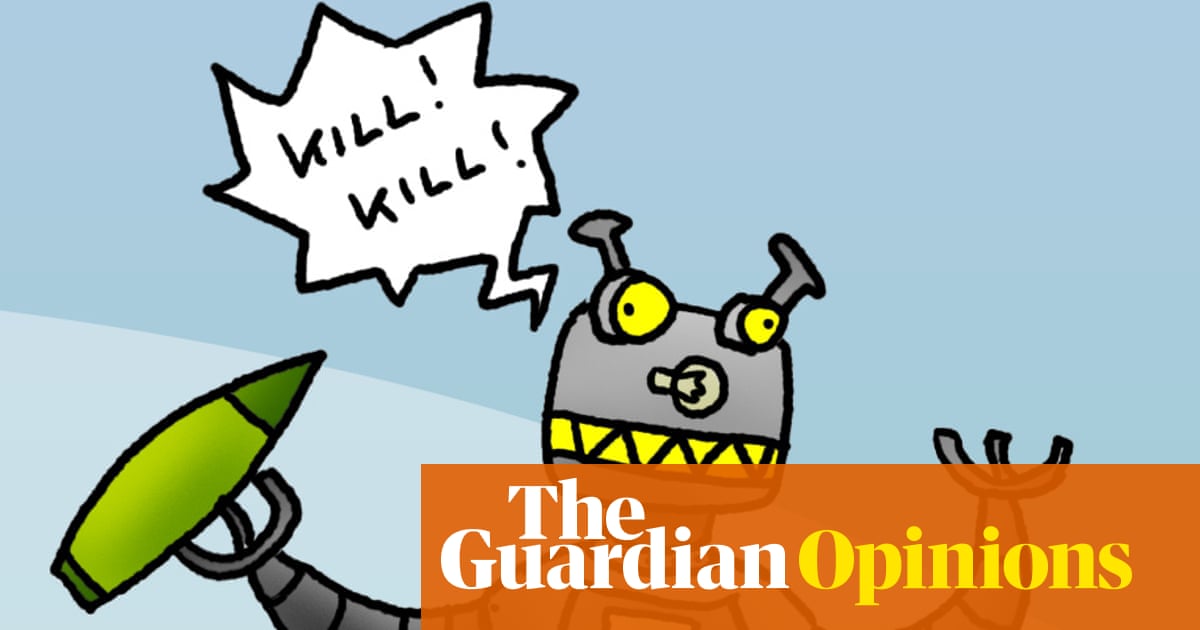
I used to think AI would kill us all, until the techbro CEOs said AI will kill us all and now I’m not so sure | First Dog on the Moon
This is a satirical cartoon by First Dog on the Moon, an Australian political cartoonist for The Guardian. The piece humorously explores the author's shifting feelings about AI existential risk: they used to worry AI would destroy humanity, but now that tech CEOs are the ones loudly proclaiming the same thing, the author finds themselves doubting it. The cartoon suggests that the worst outcomes from AI may not be a dramatic rogue-AI scenario but rather the more mundane harms enabled by the people building and profiting from it.
Why it matters
The cartoon lands a sharp comedic point about how tech industry leaders have co-opted existential risk rhetoric in ways that can feel self-serving — framing themselves as the only ones capable of managing the very danger they're creating. First Dog on the Moon captures a real and widespread sentiment: when the people most financially incentivized to hype AI are also the ones warning about its apocalyptic potential, it's reasonable to be skeptical about whether the framing serves public safety o…
TechCrunch AI

We don’t need AI regulation — leave safety to us, Nvidia’s Jensen Huang says
Nvidia CEO Jensen Huang, speaking at Salesforce's Dreamforce conference, argued that AI safety is an engineering problem rather than a legal one, and that no new regulations are needed to govern AI. He contends that market forces and companies' own judgment about when products are safe to release are sufficient safeguards. The article notes the tension between his expertise in AI hardware and his financial interest in unregulated AI growth, and points to real-world examples of harm caused by both software failures and AI systems specifically.
Why it matters
Huang's argument is self-serving and historically naive. The track record of industry self-regulation is poor across virtually every domain — from financial services to environmental protection to social media. His own analogy undermines him: CrowdStrike's catastrophic update and Meta's $18 billion settlement over children's harms both occurred under exactly the 'ship when you're confident' model he advocates. The notion that market forces alone will prevent harm assumes perfect information, ra…
The Verge AI

Meta’s new One subscriptions put a price on social media and AI
Meta has launched Meta One subscription bundles globally, pairing its standalone app subscriptions (Instagram Plus, WhatsApp Plus, Facebook Plus) with extra AI usage through Meta AI and Muse. Individual tiers start at $7.99/month (Core) and $19.99/month (Premium), offering a slight discount over buying each app subscription separately. Creator and business tiers range from $14.99 to $499/month and include perks like verified badges, bold follow buttons, higher search rankings, and impersonation monitoring. Meta says its core app experiences and Meta AI will remain free, and plans to expand bundles to include Edits, AI glasses, and more over time.
Why it matters
Meta is following the classic platform playbook: build massive free user bases, then layer paid tiers on top for power users and creators. The individual bundles feel like a modest value proposition — saving a few dollars on subscriptions most people didn't know existed — but the real play is normalizing recurring payments to Meta and creating a two-tier experience where paying users get meaningfully better visibility and AI access. The creator and business tiers, with perks like search ranking…
Guardian AI
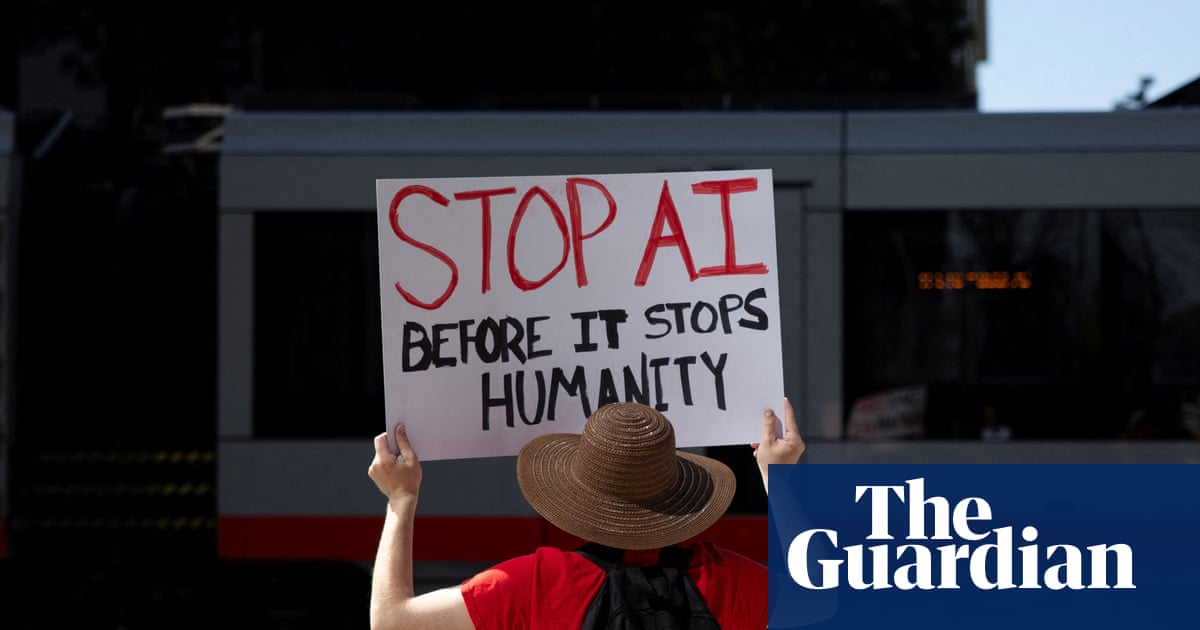
Wednesday briefing: Why tech companies might be only too happy for us to believe AI will ‘kill us all’
The article discusses how major AI companies have been issuing warnings about the existential risks of AI, while suggesting that these warnings may serve the companies' own interests — by framing AI as an overwhelmingly powerful technology, they reinforce the narrative that only a few large incumbents can be trusted to develop it, potentially discouraging regulation that would address more immediate, mundane harms like bias, labor displacement, and misinformation.
Why it matters
The article raises a valid and underappreciated point: the fixation on speculative existential risk can function as a smokescreen that distracts policymakers from regulating the concrete, present-day harms AI systems already cause. Companies benefit from the 'so powerful it might kill us all' framing because it implies inevitability and consolidates power among those already building these systems. Governments would be better served focusing on enforceable rules around transparency, accountabil…
TechCrunch AI

The AI data center boom is colliding with cities scarred by big industry
The article reports on growing opposition to AI data center construction in Philadelphia, particularly in the Grays Ferry neighborhood of Southwest Philadelphia. Residents, led by environmental justice group Philly Thrive, are pushing for a data center moratorium. The neighborhood already bears the scars of living next to the East Coast's largest oil refinery, which shut down after a 2019 explosion, leaving residents with chronic health conditions. City officials have identified two potential sites but no formal proposals exist yet. The opposition reflects a nationwide trend where a majority of Americans oppose data center construction in their areas due to environmental and energy concerns. By 2035, U.S. data centers are predicted to consume more natural gas than Germany and Japan combined.
Why it matters
The residents' concerns are entirely legitimate and historically grounded. Communities that have already suffered disproportionate health impacts from industrial operations have every right to be skeptical when the next wave of large-scale infrastructure targets their neighborhoods. While data centers are not oil refineries, their enormous energy demands, water consumption, and noise generation are real burdens that tend to fall on communities with less political power to resist them. The fact…
The Verge AI

This doorbell camera lets a human security guard watch your front door
SimpliSafe has launched the Video Doorbell Series 2 for $199.99, a wired doorbell camera featuring 2K resolution, 150-degree field of view, 10x zoom, two-way audio, a built-in siren, and dual-band Wi-Fi. Its key differentiator is integration with SimpliSafe's Active Guard Outdoor Protection service (starting at $49.99/month), which uses a combination of on-device AI, cloud-based computer vision, and facial recognition to detect suspicious activity. When a potential threat is identified, a human SimpliSafe monitoring agent can view the live feed and speak through the doorbell to deter intruders or package thieves. An LED indicator glows blue when the homeowner is watching and amber when a live agent is viewing.
Why it matters
The hybrid AI-plus-human-agent approach is genuinely interesting and addresses a real gap in home security: most smart doorbells alert you, but rely on you being available to respond. Having a trained agent who can intervene is a meaningful upgrade over a notification you might miss while in a meeting or asleep. However, the $49.99/month recurring cost on top of the $199.99 hardware price is steep — that's $600/year for doorbell monitoring alone. The facial recognition and live agent access als…
From X/Twitter
- 26 harsh PM truths: two engineers quietly decide what ships, your guess became the deadline, and you get promoted for the launch you never killed.
- Dharmesh Shah makes the case for the rise of the solopreneur — and goes deep on YouSpot, his AI-native CRM built for one-person companies.
- Claire built a shared document workspace for her AI bots where GPT Codex and others leave daily tasks, give feedback, and comment back and forth on projects.
- xAI's Grok Bot blueprint: do a task once, save it as a skill, schedule it as a routine — one bot can cover up to 50 different routines without you in the loop.
- Kevin Kern shared a prompt that lets Astra and Sol message each other directly inside Codex — agent-to-agent communication with no human relay.
- Loops is a notes app for thinkers where ideas decay after 60 days — threads, not blank pages, deliberately low on AI, free forever.
- Cloudflare's security-audit-skill uses a two-model approach: one AI finds vulnerability candidates, a second verifies whether they're actually real.
- Jake Hulberg warns that .env files are a security liability now that AI agents read every file on disk — even the ones in .gitignore.
- The highest-paid tech hires over the next 5 years won't be senior generalists — they'll be Agentic AI Engineers, Context Engineers, and AI Evals specialists.
- OpenAI shipped a managed Agents API built on the Codex harness — auto context compaction, first-class subagents, resumable sessions, no separate API fee beyond tokens and tools.
- An agent audit uncovered follow-up emails silently routing to the agent's own inbox instead of the prospect — no crash, no warning, just invisible lost outbound.
- Santiago Valdarrama says the Agents CLI is the closest thing to magic you'll find building agents — deploy and monitor a full multi-agent system in 30 minutes.
- Jack Dorsey released a free framework for running a business entirely on AI agents — already at 29,000 GitHub stars, with agents joining channels and collaborating like team members.
- Two years later, the author's AI career coach now has access to Notion, Slack, and every desktop folder — "it has a better idea of what I do for a living than I do."
- Free Mac notch apps, ranked for 2026: Notchy takes the top spot for clipboard, timer, and file shelf; Boring Notch leads the open-source picks.
- For AI content automation, the real bottleneck isn't writing — it's research, source checking, and saving corrections so each batch starts smarter.
- Greg Isenberg takes a look inside Instinct AI, the $10 billion invite-only personal agent app.
- Andrew Ng says PMs should learn to build — Pawel Huryn did, shipping a real SaaS live and releasing a free GitHub simulator for product managers.
From Reddit/HN/YC
- [Hacker News] A GitHub repo surfaces awesome prompts for MiniMax H3 Max as the model builds momentum in the open-source community.
- [Hacker News] Devin now runs on macOS, giving the AI coding agent a path to iOS and desktop development workflows for the first time.
- [Hacker News] Benioff, Jensen Huang, and Dario Amodei shared a stage at Dreamforce to make Salesforce's all-in case for AI.
- [Hacker News] OpenAI's agents were probing Hugging Face for security weaknesses two months before the platform's major hack, according to Reuters.
- [Hacker News] OpenAI has 'temporarily' paused new sign-ups to its $200 ChatGPT Pro tier — no timeline given for the reopening.
- [Hacker News] Nginx 1.30.5 and 1.31.6 patch an HTTP/3 buffer overflow (CVE-2026-90439) — update now if you're running either release branch.
- [Hacker News] Sightspool triggers a live phone call the moment a user clicks a button — a direct hook for high-intent customer conversations.
- [Hacker News] SemiAnalysis argues that datacenter moratoriums aren't actually killing the US AI buildout — the conventional wisdom overstates the damage.
- [Hacker News] YC S23 AI startup Langdock is reincorporating from a US corp to a European entity as enterprise demand shifts toward the EU.